
|
Opinion Diplomacy with North Korea? Not yetNegotiations with Pyongyang are doomed until its end goals change
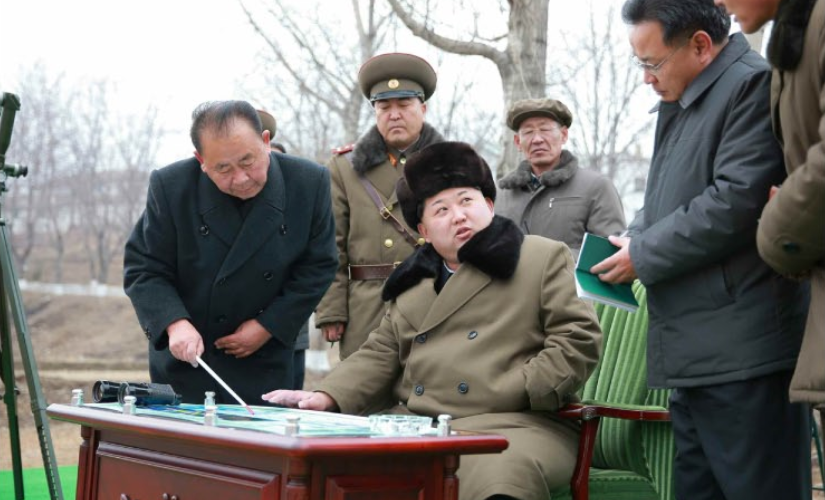 There are precious few things that help to maintain peace and order in the world. The pacifying nature of free trade among all nations is certainly one of the most important pillars of peace. Perhaps just as important as commerce is the delicate art of diplomacy. After all, one of the many functions of diplomacy is to prevent war and improve relations between nations. Therefore, without diplomacy, it is more than likely that much of the world would be in a constant state of war. The sheer importance of diplomacy notwithstanding, however, negotiations with the North Korean regime, particularly this regime, is a waste of everyone’s time and energy. Those who champion diplomacy and directly negotiating with Kim Jong Un have to ask themselves an important question. What are their goals? Are their goals to seek a more permanent peace in Northeast Asia or are they merely hoping for a temporary quiet? If all they seek is the latter, then direct negotiations are certainly the correct thing to do. The North Koreans have shown before that they are more than happy to accept bribes. If it is the former, however, they may wish to reconsider their position.
Even if the defenders of diplomacy get their way and the international community begins to negotiate with the North Korean regime, even though everyone knows that the North Koreans will never surrender their nuclear arsenal – and the international community would in fact be willing to give up on their demands of a denuclearized Korean Peninsula – it would still be unlikely that their actions would achieve the long-term strategic goal of getting the two Koreas to stand down and help to usher in an era of peace. At least not the kind of peace that doesn’t involve a jackboot stomping on a face. At best, it would only postpone the next round of provocations, weapons tests, and ludicrous demands. At worst, it would only embolden Kim Jong Un to double down on his decision to pursue more powerful nuclear bombs and longer-ranged missiles to deliver them so that he could more easily cow South Korea, and perhaps even the United States, into submission. After all, that has always been North Korea’s ultimate goal – the reunification of the Korean Peninsula under Pyongyang’s rule. For the rest of the world, the goal of diplomacy is to initially bring about reconciliation among the negotiating partners, build trust, and then to bring about peace. However, before any of that can happen, all parties to any kind of negotiation must first agree to have similar end goals. The interests of North Korea and that of the rest of the world could not be more different from one another. Whereas the rest of the world seeks peace and disarmament – and hopefully increased commerce in the future –North Korea seeks power, thus helping to prove correct Henry Kissinger’s aphorism that empires (even mini-empires) have no interest in operating within an international system; they aspire to be the international system. The best negotiations are the kind that help to bring about win-win solutions for those involved. A win-win solution in regards to North-South Korean negotiations would be for the North Koreans to abandon all of their WMD programs, for both sides to mutually draw down their forces, and for both sides to agree to reopen Kaesong and expand free trade between the two. In reality, however, that is extremely unlikely to happen. And that is because one very important thing that pro-engagers have to admit, if not learn, is the fact that the North Korean regime, from Kim Il Sung to Kim Jong Un, has always scoffed at the notion of win-win negotiations. For the North Korean regime, diplomacy has always been the continuation of politics by other means, not war. For them, war has always been the foundation of how they think and act. And in a war, there are certainly win-lose scenarios and sometimes even lose-lose scenarios, but never win-win scenarios. REGIME CHANGE? Over the years during the on-again-off-again rounds of negotiations, North Korea demanded and received all types of aid from the rest of the world – from food and medicine to fertilizers and computers, foreign investments, and infrastructure. But what have they ever offered in return? The nuclear crisis has only worsened since 1994 and the North Koreans have never once stopped trying to unravel the U.S.-ROK-Japan alliance. From thinly disguised Newspeak words such as “uriminjokkiri” (our people) to dangling kidnapped citizens at Japan to claiming that defectors are actually kidnapping victims, all the North Koreans have done is to ensure their own victories while ensuring that their “negotiating partners” face political defeats or lose face. There is only one language that the North Koreans understand and respect – force. Even though Kim Jong Un may appear to be quite good at thumping his flabby chest in defiance of the sanctions and South Korea’s rather impressive string of recent foreign policy victories, there is little doubt that it is becoming clearer that he is little more than a caged gorilla thanks to the forces that been arranged against him and his tinpot dictatorship.
But what about the fact that diplomacy is one of the most important pillars of peace? That hasn’t changed. Diplomacy is important. However, it is useful only when the negotiating partners can agree on their goals. Until that point is reached, other tools must be used to ensure peace – isolation, encirclement and the threat of annihilation. During the Sunshine years, while U.S. President George W. Bush spoke of regime change, South Korean President Roh Moo-hyun spoke of regime transformation. Whereas Bush was actually referring to a regime collapse, Roh was referring to the North Korean regime changing its behavior. They were both wrong. The world has seen what regime change means in places like Iraq and Afghanistan and later on in Libya and Egypt. What was once euphemistically referred to as “the birth pangs a new Middle East” has in reality meant untold suffering by millions of people. Such is the tastelessness of political euphemisms. “Things will be different in Korea,” people might say. “Plans have been made to ensure stability.” Rarely has any plan ever survived first contact. The hopes for regime transformation has also proven to be just as foolish as the world has seen the North Korean regime refusing to change while millions of North Koreans suffer under the yoke of 70 or 200 or 1000-day battles and while thousands more are sold as slaves to dark and distant corners of the world. There can never be peace with this North Korean regime. And it is high time that people learn to accept that regime change and regime collapse are not necessarily the same thing. Hurting the North Korean regime for cash, forcing it to pay a heavy price for the choices they have made – these are worthy and admirable goals. However, they are insufficient. Eventually, re-engaging in diplomacy will become necessary. After all, sanctions are not the goal in and of itself but when the time comes for negotiations to begin again, it will be all for naught if the rest of the world finds itself sitting across the table yet again from Kim Jong Un and his lackeys. Kim Jong Un’s goals have never and will never change. So the important question that few people seem to be asking is who will we eventually negotiate with, and how will we ensure that our future negotiation partners will not be the same crop of fools that stand in front of us today? Image: Rodong Sinmun © Korea Risk Group. All rights reserved. |


 SHARE
SHARE COPY LINK
 X
X MASTODON

Recent Stories