
This is the first in a five-part series by Dr. Andrei Lankov on his life in North Korea’s expatriate community in the North Korea of the 1980s.
It is sometimes surprising to notice the fact that you are getting old, so some events of your life have gradually drifted from the humble realm of private experiences to the loftier realm of history. The present author is 50 years old (alas!), and it has been nearly 30 years since I first arrived in North Korea. The date, to be precise, was September 10, 1984.
At the time I was a member of a group of Soviet students who had been sent to spend 10 months at Kim Il Sung University for language studies. Following the suggestion of this present publication’s wise and energetic leadership, I have decided to recall some of my memories from this time (it helps that I made some notes about my Pyongyang experiences).
FOREIGNERS IN PYONGYANG: WHO WERE THEY?
North Korea has always been a mono-ethnic country with few outsiders. It is likely that in the mid-1980s the number of permanent foreign residents of North Korea may have reached its lowest point. Gone were the days when large numbers of Soviet and Eastern European advisors worked at numerous development projects while the days of famine and economic collapse (but also of massive NGO presence) were still in the distant future.
As a rule, as a foreigner one could not just live and work in North Korea like the locals. Working at normal jobs, shopping in regular shops with rationing coupons, applying for travel permits when leaving one’s native city, and attending hours-long indoctrination sessions were just some of the luxuries beyond the reach of foreigners who live in the tiny gilded cage of the expat world.
“Applying for travel permits when leaving one’s native city and attending hours-long indoctrination sessions were just some of the luxuries beyond the reach of foreigners”
The only important exception to this rule were the hwagyo, the Chinese citizens whose families have lived in North Korea since before 1945 (currently there are some 5,000 hwagyo in the country). These peoples’ lives were indeed very similar to the lives of common North Koreans, from whom they were also almost indistinguishable. However, there was almost no interaction between us, privileged and suspicious foreigners, and permanent Chinese residents of North Korea.
As a matter of fact, until the late 1960s, there were foreigners who, like the hwagyo, could be seen as real permanent residents of North Korea. There were, for example, dozens of women from the Soviet Union and Eastern Europe who had married North Korean students and workers sent abroad during and after the Korean War. There was also a small number of Soviet Koreans who were allowed to move back to the country of their ancestors (many of them were prominent cadres, but some others were workers and peasants).
“There was almost no interaction between us, privileged and suspicious foreigners, and permanent Chinese residents of North Korea”
However, by the late 1960s, nearly all these people had been expelled from North Korea. Pyongyang made it clear that any long-term foreign residents should remain “proper expats” with little or no connection to North Korean society. The treatment of foreign spouses was especially brutal. In most cases, their Korean husbands were ordered to divorce their racially suspicious wives and immediately remarry proper Korean women (an immediate forced marriage was seemingly part of the package).
As I learned much later, at the time of my year-long sojourn in North Korea there still were two to three Soviet citizens of Korean origin who at the time lived in the Korean countryside as humble workers. Some Soviet Koreans who had been sent by the Kremlin in the 1940s and 1950s also survived the purges. However, the latter by the 1980s had long since renounced their Soviet citizenship and usually had gone to great lengths to keep their distance from both the Soviet embassy and from any association with the suspiciously “revisionist”northern neighbor.
REGULAR LENGTH OF STAY
Expats were only usually there for a few years. There were 20-odd embassies, most of which had a very small staff consisting of 3-4 diplomats (Malta for reasons unknown had its own permanent embassy in Pyongyang, the staff of which consisted of the ambassador himself). There were only two relatively large embassies – predictably, those of the Soviet Union and China. In general, it seems that there were some 100-150 or so foreign diplomats in Pyongyang at any given moment. Most of them brought their families with them, so the total number of diplomats and their families was probably in the region of 400.
Another group were foreign technical specialists and advisors. Their number could be counted in the dozens – so, including family members, we are probably talking about 100-150 people. Some of them came from the Soviet Union, which at the time was still involved in some construction projects in the country. There were also some Eastern Europeans, as well as a group of French engineers. The latter were involved with the building and interior fitting of the Koryo Hotel – or so I was told at the time.
There were also foreign students like me. In accordance with the system, all foreign students first spent about a year learning Korean at Kim Il Sung University. For the vast majority of students, this was all they did and, upon completion of their language studies, they went home. This was standard practice for nearly all Soviet and Eastern European students, who were in Pyongyang to study the language and only the language. In 1984-85 academic year, for example, there were some 30 foreign students doing language training.
“It appears that some 150 foreign students could be found in North Korea in 1984”
There were also some students from the Third World, who upon the completion of their language studies were dispatched to specialized universities or colleges where they would major in subjects of their choice. The number of these long-term students was quite small: 30 to 50, I suppose.
Finally, there were a few Soviet and Chinese students enrolled in the humanities at Kim Il Sung University, where they would spend the next four years perfecting their language skills and presumably preparing for official careers. This was somewhat unusual, so such students were usually selected by their respective embassies.
At any rate, it appears that some 150 foreign students could be found in North Korea at that time.
A small number of shady foreign characters also were denizens of the tiny and exclusive world of the 1984 foreigners’ Pyongyang. There were some businessmen, often from Southeast Asia who were involved in some deals with North Korean foreign trade companies. There were political exiles who were, or claimed to be at least, sympathetic to North Korea’s Juche socialism, and the like.
Thus, discounting a very peculiar group of hwagyo, there were about a thousand foreigners, staying in North Korea long-term in the mid-1980s.
Apart from these “real” expats, there were short-term visitors, who did not really belong to the same expat world described above. Some of these were tourists from the Soviet Union and Eastern Europe, while others were ethnic Koreans from Japan, sent to their alleged “motherland” on short visits by Chongryon/Soren, the pro-Pyongyang ethnic Korean group. Japanese-Koreans seldom interacted with other foreigners – partially because they usually spoke poor – if any – English, but also because both their North Korean minders and their Japanese-Korean supervisors seemingly discouraged such interactions.

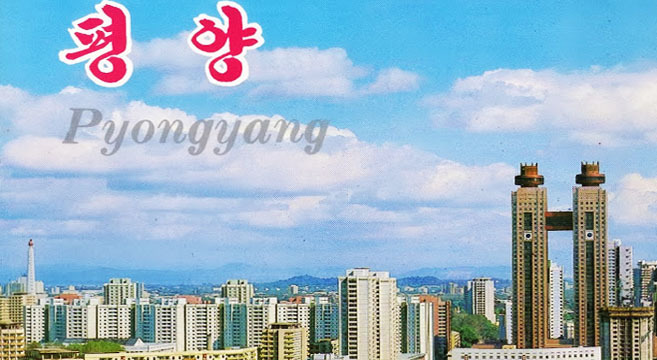
Juche Tower in 1990 | Picture: RetroDprk.com
JUCHE ENTHUSIASTS
There were also Juche enthusiasts from across the globe, largely from poorer countries. We were told at the time that the Jucheistas had become less numerous than in the glory days of Juche’s international phase in the 1970s. Nonetheless, these people were still very much present, and some of them were frequent visitors to Pyongyang. To what extent they were actually motivated by sincere ideological zeal and to what extent they were pragmatic manipulators milking the North Korean vanity gravy train I know not. They were fun to watch nonetheless. Soviet students did not spend too much time with them. This was partially as a result of our own caution: we understood that excessive interaction with such people would be frowned upon by the Soviet embassy since Moscow saw Juche as the epitome of communist heresy and it was not a good idea to be frequently seen in the company of the notorious heretics. However, this was the case when (implicit) restrictions did not arouse much irritation: a contemptuous attitude to Juche was one of the few issues on which nearly all Soviet people would agree upon in the early 1980s. Thus we did not feel much in the way of sympathy for professional Jucheists, sincere or otherwise, and saw them as a joke at best (or conmen at worst).
“To what extent they were actually motivated by sincere ideological zeal and to what extent they were pragmatic manipulators milking the North Korean vanity gravy train I know not”
While all expats, from humble and poorly paid Chinese students to rich Indonesian businessmen, usually frequented the same small number of facilities open for foreigners, and while they also faced the same level of suspicion from their hosts, there was a great deal of mutual distrust between foreigners. Most of them came from countries with authoritarian governments and had some serious political and/or career reasons to be in North Korea. In many cases, their own government’s discouraged or even banned them from attending some venues or mingling with citizens of certain other countries – Soviet students were suddenly banned from going to the diplomatic club in early 1985, and were also advised by embassy staff not to interact with anti-Vietnamese Kampucheans (who were present among the Korean language students at the time).
Thus, a measure of tension and politically motivated distrust was a part of life. Even students were sometimes on their guard for spies, schemers and provocateurs. We believed, not entirely without reason, that such people were plentiful in this very peculiar community. This did not prevent us from enjoying a very unusual life indeed.
Picture: RetroDprk.com
Join the influential community of members who rely on NK News original news and in-depth reporting.
Subscribe to read the remaining 1717 words of this article.
EXISTING MEMBER?


');
newWindow.document.write('
');
newWindow.document.write('