
|
Analysis What the re-emergence of Kim Yong Chol could mean for North Korean policymakingGiven the hardline official's past provocations, putting him back in play offers hints at Kim Jong Un's thinking
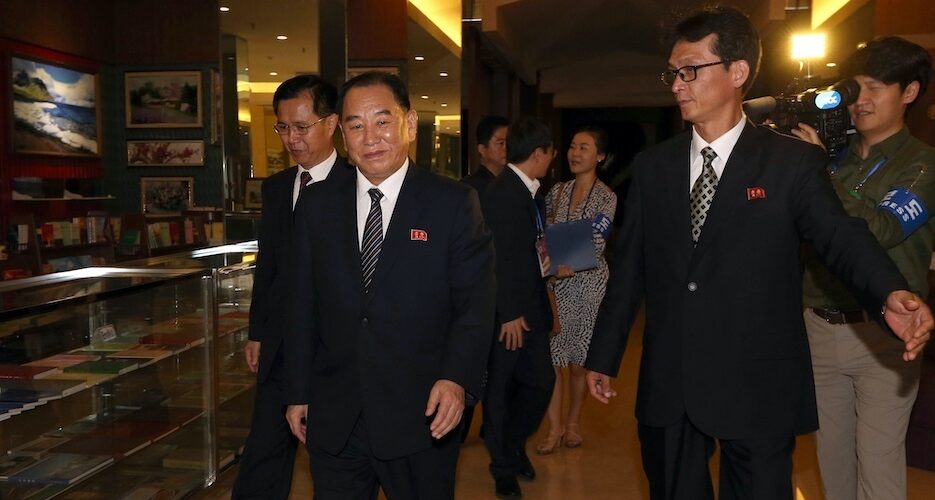 The increasing prominence of “first sister” Kim Yo Jong in recent months has rightly seized the attention of the world, particularly amid Kim Jong Un’s reduced public appearances. The focus on Kim Yo Jong as a potential successor to her brother, however, has overshadowed another interesting—and far more ominous—development in Pyongyang. We should be paying just as much attention to the re-emergence of Workers’ Party of Korea Vice Chairman, and retired general, Kim Yong Chol. In a nuance that has garnered little attention, the Rodong Sinmun party newspaper’s report of the decision to sever North-South communications in June prominently mentioned not just Kim Yo Jong, but also Kim Yong Chol as the leading players in this decision. As we consider what this portends, it is worth remembering other key moments we have seen Kim Yong Chol prominently paired with Kim Yo Jong. The first time they appeared as partners in a major event was their trip to Seoul for the closing ceremonies of the 2018 Olympics. The old general’s hawkish and blood-soaked reputation in South Korea, and the protests his presence garnered from some South Koreans, added even more to the theater of the visit than his dour expression and black Russian-style fur hat. He was the ideal “bad cop” to loom in the background and represent an older generation of North Koreans, while the young and charming Kim Yo Jong could play the “good cop” selling the opportunity for a new relationship. We also saw the pair figure prominently in the North-South summits that followed in 2018, with Kim Yong Chol and Kim Yo Jong shown in some memorable photos as the only North Koreans flanking Kim Jong Un during a meeting with South Korea’s President Moon Jae-in. Before Kim Yo Jong and Kim Yong Chol were mentioned together in the recent Rodong Sinmun article, the last time we saw these two in close official association was in February 2019, while accompanying Kim Jong Un to the Hanoi summit. Afterward, global media speculated that Kim’s dissatisfaction with the Hanoi summit’s results had led to a fall from grace with Kim Jong Un for both of them, among others in the North Korean delegation. The Straits Times charitably described them as having “faded from view.” It soon became clear that they had been spared darker fates that had apparently been doled out to others, but Kim Yong Chol fared worse of the two. Kim Yong Chol was stripped of both his post heading the United Front Department and of his role leading negotiations with the United States. A number of western media outlets even cited unconfirmed reports that he had been sent for a brief period of re-education, though his retention of a top post as a Party Vice Chairman was confirmed by state media. An official photo showed Kim Yong Chol seated near Kim Jong Un, a key location hardly indicative of an official who had fundamentally lost Kim’s trust, even if he had lost key positions of responsibility. Though Kim Yo Jong was left out of her brother’s summit with Vladimir Putin, and told to “lie low” according to some accounts, she soon re-established a pattern of public appearances. Meanwhile, Kim Yong Chol remained largely in the background for over a year after the Hanoi summit, with only perfunctory mentions in state media that proved he remained alive and in a high Party post. This sharp contrast continued unabated until the joint mention in the Rodong Sinmun last month. Since then, it appears Kim Yong Chol again has a public profile and voice—which was put to use in a 24 June press statement to criticize South Korea’s defense minister.  WHY IT MATTERS The natural question, then, is why does Kim Yong Chol’s re-emergence matter? What is it about Kim Yong Chol that makes him so significant? To answer this question, it is necessary to take a deeper look at the under-examined man himself. Though I have studied Kim Yong Chol for over a decade, I have never met him—perhaps this is for the best. I have vivid memories of discussing him with colleagues while assigned to Seoul, and later with experts inside and outside of government, in my time as the U.S. National Intelligence Officer for North Korea. I have found him to be not only an under-appreciated figure worthy of further study by Korea-watchers, but perhaps the top practitioner of North Korea’s unique brand of provocation and engagement. In early November 2014, I had been NIO for mere months when my then-boss, Director of National Intelligence James Clapper, traveled to Pyongyang to secure the release of two detained Americans. As the head of North Korea’s Reconnaissance General Bureau (RGB) at the time, Kim Yong Chol had been selected to be Director Clapper’s primary interlocutor and dinner host. I received a colorful and detailed personal readout of these interactions from Director Clapper, after his return. I will not retell it here—Director Clapper’s accounts of Kim Yong Chol’s confrontational behavior are well-documented in many media interviews and in his memoir. Kim Yong Chol lived up to his reputation for provocations and bellicose rhetoric–he jabbed an accusing finger at Director Clapper while underscoring North Korea’s justification for nuclear weapons. This was not the only provocation from Kim Yong Chol that November—as Director Clapper recounted just weeks later, Kim Yong Chol oversaw North Korea’s cyberattack on Sony Pictures. At this time, despite Director Clapper’s interviews and speeches about his experiences with Kim Yong Chol, relatively few Americans took note of him, and he remained to the public eye a fairly obscure North Korean general on a long list.
Though he was regularly included in publicly available analyses of the North Korean leadership during this period, he typically received only a short mention as a “second echelon” figure. Besides his role leading the RGB, he was noted for having overseen Kim Jong Un’s military education at Kim Il Sung University. Kim Yong Chol’s public profile outside North Korea only began to rise with his appearance at the 2018 Seoul Olympics alongside Kim Yo Jong. Soon after, when he became Kim Jong Un’s pointman for negotiating with the United States, he turned into North Korea’s second most prominent figure seen in western media. In this role, Kim Yong Chol grabbed headlines, most of all with an unusual visit to the Oval Office to deliver an oversized envelope with a message from Kim Jong Un to President Trump. Yet, outside of a few specialists, all this attention did not result in much more study of Kim Yong Chol or his role. When scanning for his name through the indices of most recent English-language books on modern North Korea and on Kim Jong Un, one finds passing references only to the Oval Office visit, if Kim Yong Chol merits a mention at all. Though little is publicly known about Kim Yong Chol, even by North Korean standards, it is fair to describe him as a hawkish and bellicose figure. It is also fair to describe him as having had an unusual amount of opportunities to engage with U.S. and South Korean officials, beginning decades ago during his military service, long before his meeting with Director Clapper. Despite his extensive experience representing North Korea and his time advising Kim Jong Un on summits, Kim Yong Chol is more provocateur than diplomat. He is well aware of his nefarious and combative reputation, even acknowledging and cultivating it, having referred to himself as “the man you blame for sinking the Cheonan” when speaking to South Koreans.  INSIGHTS INTO KIM JONG UN’S THINKING It is hard to believe that North Korea’s state media apparatus would put forward a figure with this reputation and history without it being an intentional move. Though it might have been the Reagan Administration that popularized the phrase “personnel are policy,” this truism applies to any system where the leader can select and remove his key subordinates. As a result, it is far more constructive to view the current public role of Kim Yong Chol as a manifestation, rather than a driver, of North Korea’s policy direction. It is probably fruitless to speculate at this point about exactly how much Kim Yong Chol’s advice may figure into Kim Jong Un’s decision making. What matters more is what Kim Yong Chol’s status says about Pyongyang’s — indeed Kim Jong Un’s — state of mind. Kim Yong Chol’s return to state media coverage in a key leadership role is almost certainly another manifestation of the more confrontational path that North Korea has been on for over a year. Given Kim Yong Chol’s history of provocations, and his personal association with the Singapore and Hanoi summits, his return as a voice of the regime speaks volumes about what North Korea is trying to project. In essence, it looks to me that Kim Jong Un is signaling to the world that it is officials in Seoul and Washington, not North Koreans like Kim Yong Chol, that are to blame for the current impasse. Given Kim Yong Chol’s association with past provocations, putting him “back in play” in state media is also an implicit threat from Kim Jong Un as much as a gunfighter quietly resting his hand on the grip of his sixgun. However, Kim Yong Chol’s history should also serve as a reminder that engagement and provocation are not mutually exclusive—they often go hand in hand in Pyongyang’s calculus. As is often the case with the “hard target” of North Korea—and given the complex variables that affect the fortunes of the top political figures in any country—outside observers cannot be certain what is behind Kim Yong Chol’s re-emergence or the true state of his relationship with Kim Jong Un, Kim Yo Jong, and others around them. We do not even have a guarantee we will see any more of him soon. Admittedly, his age—he is now in his seventies—means that he may be in the very twilight of his role. However, we have seen enough of Kim Yong Chol to warn us that any developments in his role and his public statements bear watching. I suggest to Korea-watchers—inside and outside of government—that they keep a closer eye on Kim Yong Chol as he steps out of the shadows, even though Kim Yo Jong is in the spotlight. I certainly will. Edited by Oliver Hotham © Korea Risk Group. All rights reserved. |


 SHARE
SHARE COPY LINK
 X
X MASTODON


Recent Stories