
One of the best decisions by Kim Jong Un’s government so far has definitely been the move to conduct a series of economic reforms. Readers of NK News are probably well aware of these changes, which focus on agricultural and industrial management.
The former was conducted in two stages. Under Kim Il Sung, North Korean farmers were grouped in large work units – roughly 15-20 households. They worked together and all their harvest was confiscated by the state. This, essentially, was a form of state serfdom.
The first stage of the reforms, the introduction of the “Sub-Workteam Management System” (분조관리제) reduced the size of work units to roughly two households and let farmers keep some of the harvest. This was done in 2012.
The second stage introduced a “Vegetable Garden Responsibility System”(포전담당책임제) and went further: farmers were allowed to keep their harvest for themselves. State serfdom, in effect, was abolished.
The second major reform has been the introduction of the “socialist system of responsibility of enterprises” (사회주의기업책임관리제), which gives factory directors essential control of the enterprises, thus bringing North Korea closer to a private property-based system of market competition.
Someone may suggest that the reforms are considered to be off-limits for the official press, but Rodong Sinmun mentions them quite often
OUT OF CHARACTER
If we want to narrow it down, the reforms were authored by a person who:
1. Knows the North Korean economy well,
2. Understands that it can be improved not by random projects but by systemic reforms,
3. Knows that these reforms should include privatization, as Kim Il Sung-style mass mobilization campaigns are ineffective,
4. Knows how to wrap major reforms in socialist-style rhetoric to preserve existing Party traditions,
5. Is patient and is willing to wait years to implement reforms step-by-step.
All this does not point to the leader. From what we know, Kim Jong Un is not an economist at all. When his father was still alive, he was given positions in the Party’s Central Military Commission and the rank of four-star General – not a position in some kind of economic ministry. None of his speeches point to some special interest in economic affairs.
Second, Kim Jong Un is a fan of random projects, such as the Masikryong Ski Resort, Ryomyong Street, Mirae Scientists Street. These are the things he pays attention to, not reforms that target the entire economy.
From what we know, Kim Jong Un is not an economist at all
Third, Kim Jong Un regularly conducts mass-mobilization campaigns, similar or maybe even grander than that of Kim Il Sung. The recent 200-days campaign preceding the Seventh Congress is a good example.
Fourth, Kim Jong Un is not a man who feels that all Party traditions are sacred and is happy to dispose of them. The very public purge of his uncle is a striking example, the recent quarrel with China is another. All this was supposed to be done quietly – but not under the young Kim.
Fifth, Kim Jong Un is by no means a patient man: look at all these generals he has had executed in the last few years. If something or someone displeases him, he gets rid of the problem immediately.
However, most importantly is the that the leader never mentions the reforms during visits to factories or the countryside.
Some may suggest that the reforms are considered to be off-limits for the official press, but, no, Rodong Sinmun mentions them quite often. Maybe Kim Jong Un does not want to attract special attention to them by openly discussing them? The ruling party organ has published entire articles focused on the changes such as this one (English translation by Peter Ward here).
My explanation is that the true authors of the reforms are individuals – or maybe even one person – in the North Korean elite, but not Kim himself. They prepared the plans, which was then signed by Kim Jong Un: this would logically explain virtually all the oddities mentioned above.
Prospects for the North Korean economy are not bright
Kim Jong Un does not speak of the reforms in public because he is not really interested in them and they are not his project. He is interested in parades, watching sports games, and military exercises.
A GRIM PERSPECTIVE
Such suggestions contradict nothing of what we know about North Korea. Indeed, Kim Jong Un has only 24 hours per day, we all do, and he has to rely on suggestions from his subordinates.
Absolute monarchies have plenty of cases when kings spend their time basking in a life of pleasure, relaying the daily duties of state to their ministers. It is quite possible that same thing happens now in Pyongyang – at least in the economic sphere.
If my hypothesis is true, that means that prospects for the North Korean economy are not bright. These reform instigators are not in total control of the country, and their efforts are constantly being sabotaged by whoever is in charge of foreign policy.
Worsening relations with every neighboring nation do not help, especially with North Korea’s the most important neighbor – China. Add the reputation of a country which constantly begs for money offering nothing in return, cheats investors on a daily basis and uses its nuclear program as a means of blackmail: no sane businessman would invest in such a place.
And of course, let us not forget that North Korea is still a cruel dictatorship, and many people have ethical issues dealing with such a country.
Getting a poor nation richer is an extremely hard task – Zambia, Tanzania and other developing countries can attest to this. It requires major reforms and creation of an investor-friendly image. Without it, perspectives for real, sustained growth are bleak – and without these, the only thing which can save North Korea is a coup d’état.
Join the influential community of members who rely on NK News original news and in-depth reporting.
Subscribe to read the remaining 962 words of this article.
EXISTING MEMBER?

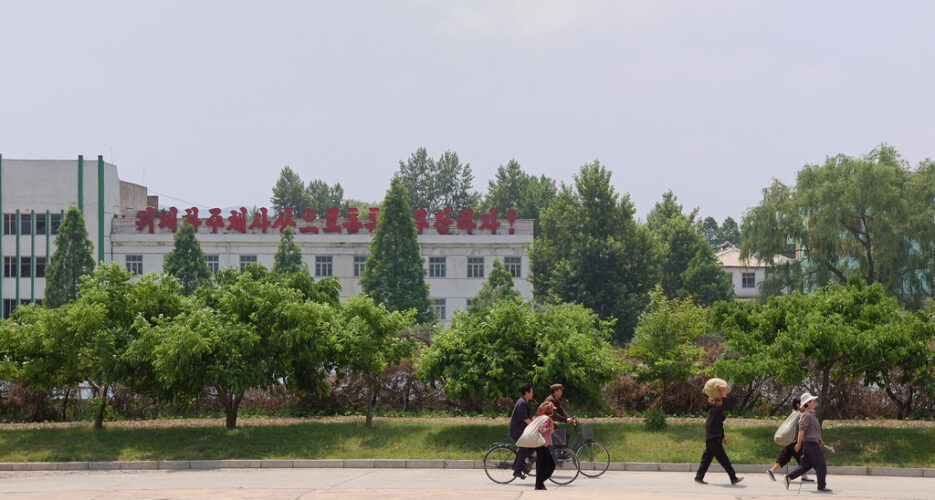
Featured Image: Chongsan-ri Farm, North Korea. by (stephan) on 2008-06-10 12:06:03


');
newWindow.document.write('
');
newWindow.document.write('