
In the city of Dandong, on the Chinese side of the Yalu River, one can see a long row of restaurants decorated with North Korean flags. Songs about the leaders, Great, Dear and Supreme, are heard from the windows of these establishments, and the beautiful women dressed in smart uniforms wait to greet guests at the front of each. These are North Korean government-operated restaurants, to be found not only in China, but also in Southeast Asia, Russia and Europe,.
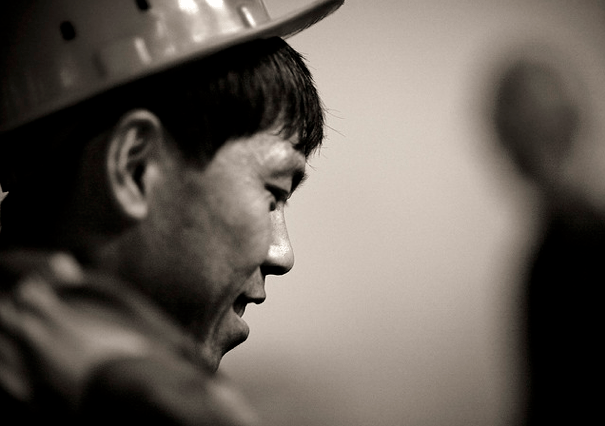
On the main thoroughfare of the Russian city of Yuzhnosakhalinsk, on the southern tip of the Sakhalin island, nowadays one can encounter teams of construction workers painting and beautifying the facades of old Soviet buildings that line the street. They work from dawn to dusk dressed in drab overalls, with little regard for safety. These are North Korean construction workers dispatched to Russia by the North Korean government.
Indeed, there are tens of thousands of North Koreans employed worldwide. No statistics are available, but the current estimate is in the neighbourhood of 60 to 70,000. Their job, of course, is to make money for the government and for themselves.
From time to time, one comes across statements alluding to such people as “victims of human trafficking” or “slave labor.” Some activists even demand that the international community intervene to save these people, and ban labor exported from North Korea – until regime change, perhaps.
But are these people actually “modern day slaves?” Well, they certainly do not see themselves as such, and not because they have been brainwashed by North Korean propaganda, but rather because they are doing what they and their compatriots overwhelmingly see as a prestigious and exceptionally paid job. Indeed, the selection process is highly competitive, and nearly all those who make it have to make use of family connections and/or bribes to get selected.
The present author’s Russian-Korean contact from Sakhalin Island, an entrepreneur himself, recently complained about how corrupt the selection process has become in recent years. He said: “Nowadays, they send the sons of petty officials who have the right connections and can afford to pay bribes but have no clue how to lay bricks, paint walls or cut trees.”
Is it a slave labor? Last time I checked, slave traders in 17th century Africa were not begged and bribed by locals for the privilege of being taken on a slaver bound for the Americas. And, of course, slaves were not seen as the object of envy by those who were not taken from their ancestral lands.
The key issue is, of course, money. The wages earned by North Korean workers overseas vary greatly, depending on their place of employment and the type of work they do. Nonetheless, it is more or less a common assumption that a construction worker in Russia would normally save $300 a month. In China, the same amount of savings is achievable for a minority, most average around $150 saved a month. Glamorous girls in North Korean restaurants in Southeast Asia and elsewhere can save even more.
Right now, the average income of a North Korean family, including income from the unofficial economy, seems to be between $30 and $50 a month – and we are talking average total income here, not disposable income, let alone savings. This means that after two years of working overseas, the average North Korean is likely to bring back an amount of money that will keep his family reasonably well-supplied by North Korean standards for five to 10 years.
Currently, the U.S. medium income is about $50,000 a year, hence one can wonder: How many Americans would go overseas if they knew that they could bring back between quarter and half a million dollars in cash after two years’ work? Thus, one should not be surprised by the level of competition that has always surrounded such jobs.

Life for North Korean laborers is hard, but those outside the country can make a lot more money. E. Lafforgue
Of course, all workers overseas are subject to many rules, regulations and restrictions. Secret police officials, very well paid even by the standards even by the country where they are resident, are always present on site and keep a watchful eye over their charges in order to prevent defection. As a matter of fact, defection incidents are relatively rare – largely because families in North Korea make reliable hostages, but also because many workers assume that once they go home they will be able to start a profitable business in North Korea’s gray economy and then enjoy a rather agreeable lifestyle back home.
WORKING GIRLS
Lamentations about these people are especially ridiculous when their object is North Korean girls working at North Korean restaurants (as is often the case, due to both their high visibility and good looks). These girls by definition come from elite families – not the top elite of course, of course, but politically reliable mid-ranking elite like colonels in the military or low-level party and security officials. They are selected to do a job that they see as both romantic (it is indeed a great adventure to go overseas at a young age in most countries, let alone a tightly closed society like North Korea) and very well paid by domestic standards. Given the amount of remuneration, it is not surprising that North Koreans do their best to follow the rules and avoid unauthorized encounters with foreigners (which are, of course, strongly discouraged by their supervisors). They stick to the regulations partly because they see them as necessary for their security, but largely because they want to avoid any trouble and in due time come home with bagloads of cash, and this is indeed the fate of the majority.
In other words, the state selects young, fit and sometimes highly educated members of semi-privileged social groups to go overseas to do a job with conditions that require the person to lead a much more regimented life. The job is well-paid and candidates are all volunteers selected from a large number of competitors; does it not sound a bit like elite military service? If so, can we describe U.S. Navy SEALS as victims of slave labor and human trafficking?
It might make political sense to introduce restrictions on these labor exports because these builders and waitresses constitute an important source of foreign currency for a regime that is an international pariah. But let us be honest and admit that the goal of such measures, should they ever be taken, is to undermine the regime, and not to save the poor daughters of North Korean lieutenant colonels or the sons of countryside party secretaries from becoming “modern-day slaves” and “victims of human traffickers.” Most of them like what they are doing, and have not the slightest desire to be “rescued” and then send back to back-breaking and poorly paid labor in their native places.
Main picture: Eric Lafforgue
Join the influential community of members who rely on NK News original news and in-depth reporting.
Subscribe to read the remaining 1147 words of this article.
EXISTING MEMBER?


');
newWindow.document.write('
');
newWindow.document.write('