
|
Border Controls Panmunjom tours could be possible again from June: Minister of UnificationSeven-month border closure has created significant problems for South Korean tour providers
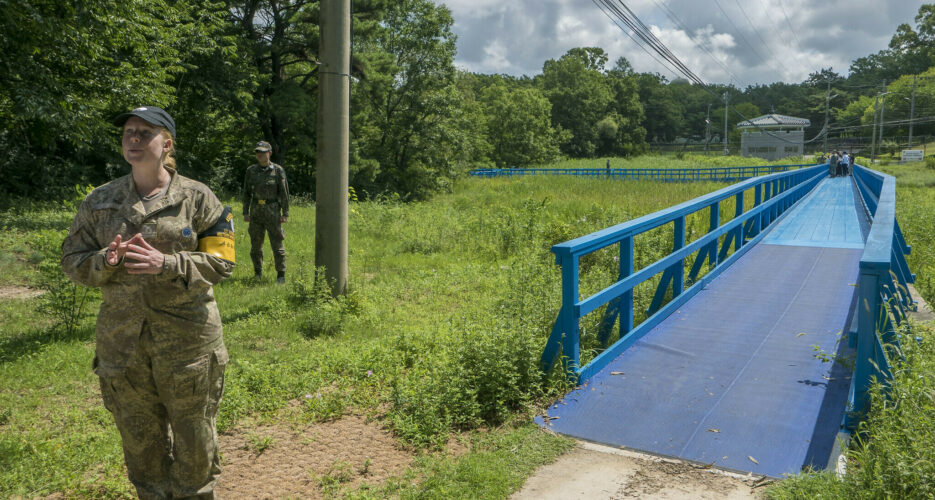 Tours to Panmunjom could be possible again as soon as June, South Korea’s Minister of Unification said on Thursday, following a more than seven-month closure of the area to prevent the spread of infectious diseases. The decision to suspend Panmunjom tours, implemented in October 2019 to prevent an outbreak of African swine fever (ASF) spreading to the North, was compounded this year due to growing concerns about COVID-19. “I’m thinking demonstration [tours to Panmunjom] with low numbers may be possible from June,” Minister of Unification Kim Yeon-chul said in a briefing to local journalists on Thursday. However, he said that the ROK’s Ministry of Environment will need to conduct an inspection of wild boars in the DMZ area to ascertain whether the swine flu can be contained. Consequently, the decision will be made based on a sample survey to be conducted around mid-May, he said. Concerning COVID-19, Kim said that the MOU will work with United Nations Command – which controls the border area – to mitigate risks there. Steps such as wearing masks on buses, keeping minimum distances between visitors, and reducing the number of personnel could all help make it safer to visit the DMZ. “While comprehensively considering these things, I wonder whether the method of initially starting demonstration [tours] and expanding by gradually building up is appropriate,” he said. The minister’s remarks, coming a day after he conducted an inspection visit to the border area, will bring fresh hope to local tour operators that have struggled since visits to the DMZ were suspended last October. “Our tour agency hopes to re-open the tour again soon,” said a spokesperson from DMZ Tours in Seoul on Thursday. “We have never been closed in so long.” The long-term closure has had significant impacts on business, they said. “Around 150~200 tourists have joined the DMZ/JSA tour with us per day in the spring season… but for now all bookings have been canceled.” As a result, DMZ Tours has stopped all business and staff are “doing paid time off now,” the spokesperson said. Yet even if tours can resume, it’s unclear whether such businesses will be able to recover quickly. Rob Koh, who runs the Seoul-based Korean Tour Guide company, said that a key problem will relate to the absence of foreigners eligible to go to the Joint Security Area (JSA). “(The DMZ) is currently only limited to foreign tourists, so it would not benefit unless global travel came back to normal again,” he said. “Even a resurgence in domestic travel wouldn’t really matter unless they changed the rules for Korean nationals being able to go into the JSA.” The seven-month toll is likely, then, to create an unprecedented impact for local tour providers for the foreseeable future. “In the past, the DMZ was closed at random times due to military exercises, politics, or reconstruction,” Koh said. “Usually just for a day, but sometimes a bit longer”. “But when ASF came around, it became evident that the DMZ was going to be closed indefinitely. “There were rumors that it was going to open back up in 2020, but then that’s when COVID-19 hit,” he continued. “Now I wouldn’t even bet on it.” James Fretwell contributed to this report © Korea Risk Group. All rights reserved. |


 SHARE
SHARE COPY LINK
 X
X MASTODON


Recent Stories