
|
News New website sheds light on “weird and wonderful” contemporary North Korean artSpecialties include classical reproductions like the Mona Lisa and surprisingly subtle works of propaganda
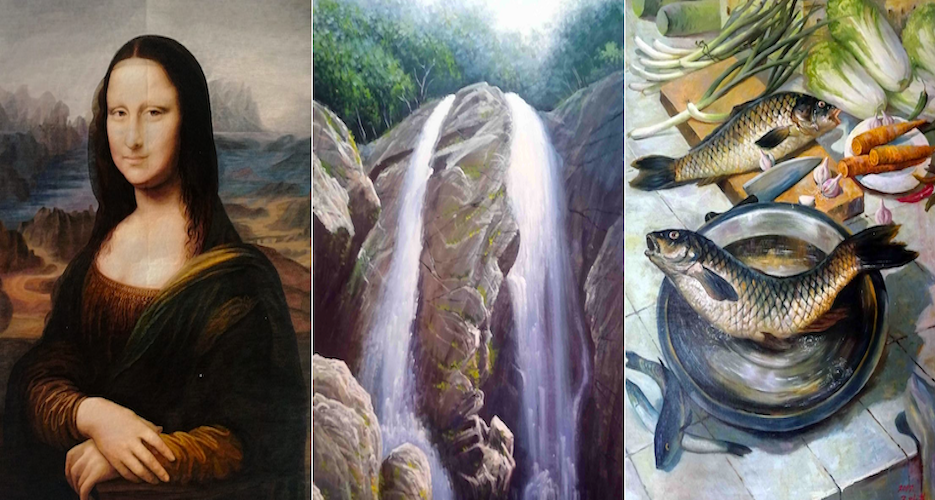 Update at 16:08 KST: This article has been updated with additional input from an informed source. Registered in February, the “DPRK Artwork” website joins similar “Western art galleries” such as Nicholas Bonner’s Koryo Studio and Pier Luigi Cecioni’s North Korean Art Gallery in offering North Korean-produced art to the world. The site, which also has an Instagram, showcases the private collection of South African doctoral candidate Ruehl Muller, who writes that all pieces are from the Korean Art Studio, “a fresh, contemporary art institution modeled on Mansudae,” a reference to the DPRK’s most well-known art production house. While the site assures buyers that “all works shown on this website are part of a private collection and can be legally sold,” the sale of works dated past 2017, when the state-sponsored Mansudae became a sanctioned entity, might raise some eyebrows. With over 100 unique works on sale and more expected to come online, DPRK Artwork describes itself as the “world’s largest collection of contemporary North Korean art available for purchase.” 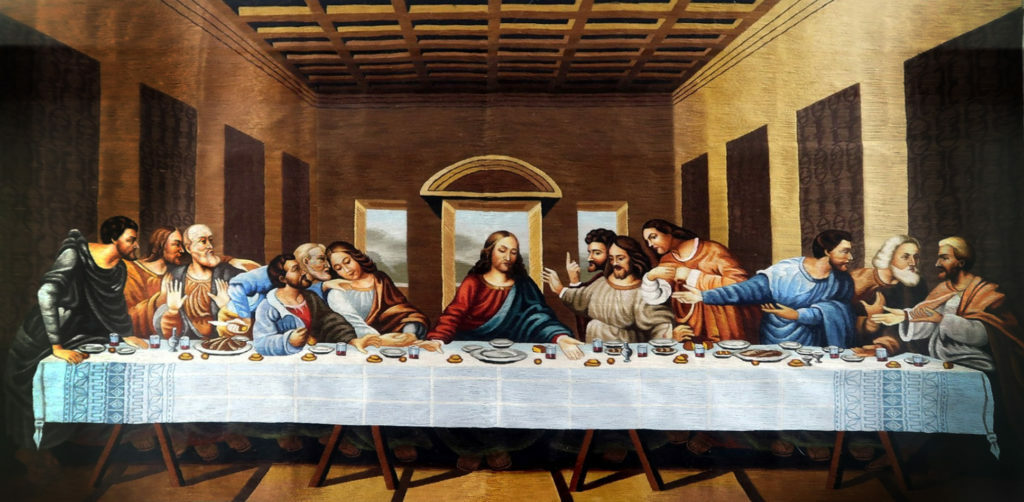 Among gorgeously-rendered landscapes and lush still lifes are curiosities such as classical reproductions: Da Vinci’s Mona Lisa, Klimt’s The Kiss, and Raphael’s Madonna della Seggiola are all on sale “straight out of Pyongyang.” For an embroidery of Da Vinci’s The Last Supper, Mueller writes in its sale notes that “the creator selected the image from a catalogue of renowned artworks, recreating it purely to display her technical skill.” “When asked about the piece, she showed no understanding of who the characters depicted were or of their relevance. As such, John (to the left of Jesus) has been depicted as a female.”  Other “special” works include a still life of two fresh fish in a kitchen symbolizing the inter-Korean conflict, with the southern fish in a pan ready to be cooked (“by capitalism,”) and the northern fish surrounded by bounteous produce. Smaller fish are placed on the southwest side of the pan, supposedly symbolizing Jeju. “More interesting however is the representation of the DMZ – a sharp knife separating the two fish. Notably, the knife points northwards, indicating Southern aggression,” Muller notes.  Muller, a researcher on “North Korean sociophilosophy and aesthetics,” says the collection came into his hands after organizing a North Korean art exhibition last October for the Nelson Mandela University in Port Elizabeth, South Africa. “Following the exhibition, I was gifted the collection as a “thank you” – though I imagine this had less to do with being thanked and more to do with them not having space/funds to store it,” he said via email on Thursday. “So it was very much a case of inadvertently winding up with a load of art and not knowing what to do with it. Not exactly a Cold War-esque smuggling story, sadly.” When asked about previous statements on the website claiming the works were from Mansudae, he cited “a mistake on the site builders part and my lack of oversight. I’ve had it corrected.” “Fortunately (unfortunately?) it is not from Mansudae.”  On the legality of the artworks’ sale, Daniel Wertz of the Washington DC-based National Committee on North Korea said that “UN sanctions prohibit the import of statues from North Korea, but not necessarily other forms of artwork.” “However, the largest and most prominent North Korean art producer, Mansudae Art Studio and its subsidiary Mansudae Overseas Projects, are subject to UN sanctions designations, meaning that UN Member States are obligated to freeze the assets of these entities… [and prevent] providing the entities with any funds or economic resources.” He posits that the sale of works from unaffiliated workshops such as Korean Art Studio might be safe: “Theoretically… individuals could contract with other art studios or with individual artists to import North Korean artwork, so long as Mansudae or another designated entity isn’t a party to the transaction.” Muller has written that the profits will go towards paying off his university fees and other personal expenses; “no transaction goes to any UN sanctioned parties whatsoever.”  But one person with prior business dealing experience with the DPRK said buyers should be careful. “I do not recommend you purchase art from anyone who (has a) cover story that cannot be verified.” “Mansudae distributes hundreds of paintings to North Koreans assigned overseas,” the source continued. “They then generate sales as their side income… to fund their own personal expenses.” North Korean art — known as Chosonhwa — from Mansudae itself was imported to South Korea as part of a cultural exchange for the 2018 Gwangju Biennale, and in 2019 a traveling North Korean culture exhibition debuted in Beijing, with representatives exchanging paintings as gifts. Muller says he is happy to educate others on the “weird and wonderfulness regarding North Korean art.” “I will likely donate the collection to an interested gallery, but, considering the state of things at the moment, making a bit of money would be ideal.” Additional reporting from Chad O’Carroll Edited by Oliver Hotham © Korea Risk Group. All rights reserved. |


 SHARE
SHARE COPY LINK
 X
X MASTODON


Recent Stories