
YANBIAN – Li Delin, an ethnic Korean Chinese businessman, lives in the small Chinese border city of Hunchun –– a seedy but quickly developing town full of Russian shoppers on weekend spending sprees looking for a cheap deal on Chinese electronics and clothes.
“Look at this road, it goes straight to Russia,” Li says. “If you turn right here you’re in [North] Korea. It’s great here, there are three border crossings –– two [North] Korean ones, and a Russian one. Everything’s close.”
But like many Chinese businessmen in the area, Li is looking towards North Korea, not Russia, to do business. Li has been running factories in North Korea’s Rajin-Songbon area for over 12 years, and sees Kim Jong Un’s North Korea as a future economic powerhouse worthy of investment.
“Kim Jong Il didn’t understand economics, but Kim Jong Un does because he was educated overseas,” Li told NK News, justifying his decision to keep working in the North Korean Special Economic Zone (SEZ).
“Kim Jong Un does more on-the-spot guidance, he understands what needs to be done,” he added, puffing on a contorted mahogany cigarette holder. “Kim Jong Il just didn’t get it; he thought he could just issue orders then go round the country looking at things.”
THE ‘THIRD KOREA’
China’s Yanbian region shares land borders with Russia and North Korea, and is home to most of China’s two million ethnic Koreans.
But despite its proximity to North Korea, Yanji, the regional capital, looks further South for its pop culture fix.
More and more hole-in-the-wall Chinese-Korean restaurants are being replaced by South Korean-owned coffee shops serving up a mix of K-pop and sweet potato lattes to local Chinese youth wearing South Korean-branded clothes. Although just 20 kilometres from the border, North Korea feels like a world, and an era, apart.
At night, packed nightclubs play South Korean pop music to dance floors full of young Chinese-Koreans. “Come on you c***s!,” a female DJ shouts at the crowd before stripping down to her underwear and dancing on the stage.
Yanji Style is somewhat edgier than its South Korean cousin.
A short drive through some very Korean-looking mountains lies a small town called Tumen –– home to the river of the same name that neatly keeps Namyang, its North Korean opposite number, at arm’s length.
On the sandy banks of the river a group of elderly Chinese-Koreans are working hard to distract each other as they play Muqiu, a Chinese form of croquet. Across the water, a North Korean farmer snoozes on the North Korean side whilst his ox grazes in the reeds.
“We’re ethnic Koreans” one old man says, in Korean, taking a pause between shots “but I’m 100% Chinese,” he says, slipping back into Mandarin.
“In the 1960s, we used to envy them [North Korea]. “You see all those apartment buildings there? They built them in just six or seven days; hundreds of people worked together to construct them.”
“They were better off than us back then,” he says, “but now they’re starving.”
ECONOMIC DREAMS
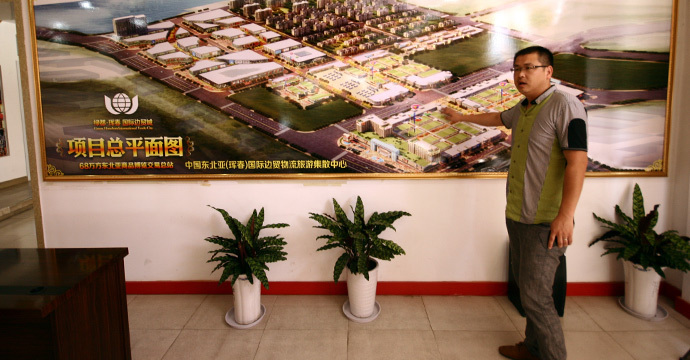
Back in Hunchun, local developers have crafted major plans to turn one corner of the city into a multi-storey shopping complex specifically catering for Russian and North Korean consumers.
“Hunchun is the only border city to sit on the borders of China, [North] Korea, and Russia. Located downstream of the Tumen river,between roads to Russia, rivers to [North] Korea, and seas to Japan and [South] Korea,” promotional materials handed out by the Hunchun Green Trade City Zone proudly explain.
Local government and private investors have already invested over $6m in securing the real estate needed to develop the shopping zone. Developers are hoping to attract both foreign and Chinese brands to open discount shops to sell goods to a predominantly Russian and, one day, North Korean market.
A newly-built express road now connects Hunchun to Yanji; a high-speed railroad is also under construction, and will run alongside some stretches of the Sino-North Korean border. These transport links and the potential North Korean audience, developers say, will turn Hunchun into an international hub of trade.
Traders like Li, however, see no reason to wait while business inside North Korea is already booming, and are prepared to take the risk and invest.
“The Rason government hasn’t tried to cheat anyone yet, but you have to watch out for certain business people with power there –– they’ve tricked people in the past,” Li says.
Although his factories have been exporting everything from table legs to clams over the past ten years, now is the best time to trade with heavily sanctioned North Korea, Li says passionately.
“Kim Jong Un’s alright –– much better than his father. Kim Jong Il did not understand economics, but Kim Jong Un does; he understands what kind of Korea they’re living in, so there’s hope.
“[North] Korea is definitely on the verge of opening; I can feel it when I’m there.”
Some names have been changed upon request. Headline image: NK News
Join the influential community of members who rely on NK News original news and in-depth reporting.
Subscribe to read the remaining 843 words of this article.
EXISTING MEMBER?


');
newWindow.document.write('
');
newWindow.document.write('