
|
News North Koreans are drying corn — and you can literally see it from outer spaceSatellite images show this year’s grain drying season, which is especially important after recent typhoons and floods
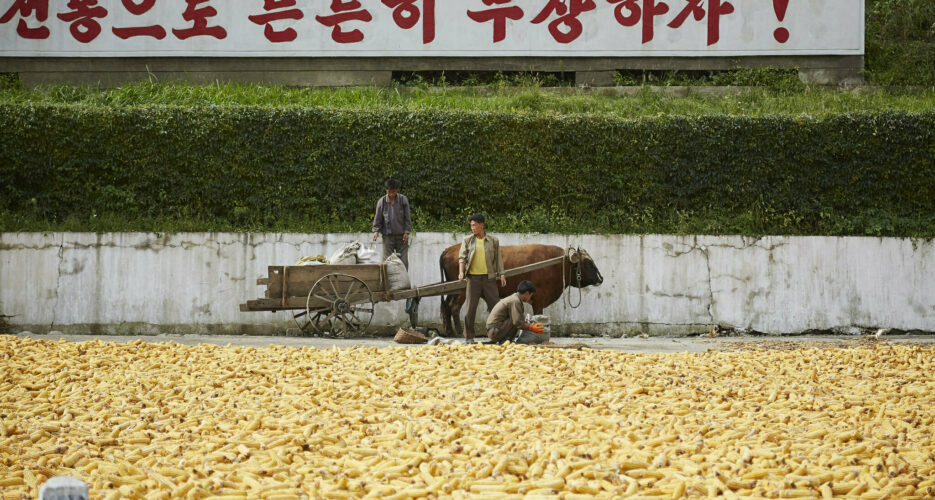 After a month of floods and devastating typhoons, North Korea is now trying to reduce its losses and recover crops. Swaths of corn and other grain are now drying in the parking lots of Pyongyang’s top institutions — which can literally be seen from outer space. Recent satellite imagery shows the grain drying in open areas, which is a common sight throughout the DPRK’s autumn months. Important institutions have long taken part in the process, and this year’s grain drying efforts are likely of particular urgency to North Korean leader Kim Jong Un, who emphasized the importance of this year’s harvest during several recent appearances. It’s a traditional method that’s still used today, largely because of shortages in modern drying equipment and because North Korea maintains socialist farming practices that emphasize collective mobilization. Large, orange-colored patches of corn or other grain are seen drying at elite universities such as the Kim Jong Un National Defense University (KJUNDU) and the Kim Jong Il Military Postgraduate Institute under Kim Il Sung Military University, according to Planet Labs satellite images taken between Sept. 13 and Sept. 19.  Similar scenes were also observed at the Sanum-dong missile research center, as well as at the North Korean space program’s primary satellite launch control center in Pyongyang. However, it is not new for even those elite institutions — some without fields of crops in their immediate vicinity — to engage in these activities. Satellite imagery has shown that many of the above have dedicated their grounds to drying grains in the past. Workers at industrial factories and even sports stadiums also appeared to be drying grain, according to the satellite images. Not every major city showed signs of widespread post-harvest grain drying as of Sept. 20, but signs of the activity were still visible on both coasts. This included areas that were hard hit by early-August flooding and then three successive typhoons, such as Wonsan in the east and Nampho in the west. In separate visits to inspect damages from typhoons Bavi and Maysak, North Korean leader Kim Jong Un acknowledged the natural disasters’ negative impact on the harvest season and called for the country to do its best to reduce the damage.  State media outlets have since continued to emphasize the importance of increasing cooperation between local officials and scientific institutes to carry out this goal as a priority. Meanwhile, a 2019 FAO/WFP Joint Rapid Food Security Assessment for North Korea recommended that aid groups “provide assistance to improve and upgrade storage facilities to minimize post-harvest losses.” “This includes the upgrade, repair or provision of grain-drying equipment to ensure grains going into storage have adequate levels of moisture content, thereby reducing storage losses and avoiding the occurrence of mold, fungus and mycotoxins,” the report stated. It added that “the use of solar grain driers or other alternative forms of energy should be prioritized.” Earlier this month, a Crop Monitor Special Report by the Group on Earth Observations Global Agricultural Monitoring Initiative (GEOGLAM) also stated that this year’s harvests are expected to suffer after what it concluded was the worst August of rains on record. Below are additional satellite images of grain drying in several parts of North Korea, as well as on-the-ground photos that show the drying process from previous years:           Edited by Kelly Kasulis © Korea Risk Group. All rights reserved. |


 SHARE
SHARE COPY LINK
 X
X MASTODON


Recent Stories