
|
COVID-19 Indonesian ambassador to North Korea hopes sanctions eased to boost tradeDespite 2019 trade rebound, sanctions still major obstacle, Ambassador Berlian Napitupulu says in radio interview
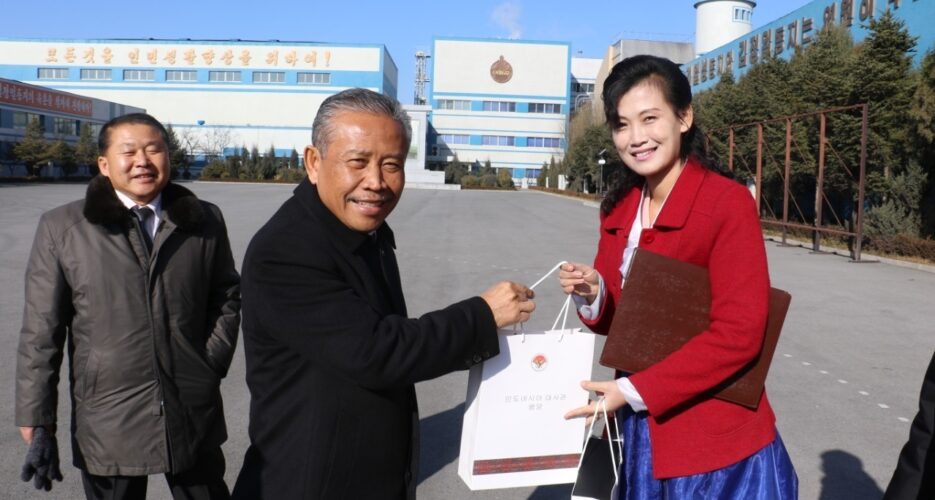 Indonesia’s ambassador to North Korea said Monday that he hoped the UN and U.S. “ease” international sanctions against the DPRK in order to boost long-hampered bilateral trade. Speaking in a radio interview with Voice of Indonesia Radio, Ambassador Berlian Napitupulu also said North Korea should open its borders, but that in the meantime, the time was right for Indonesian business representatives to travel to the DPRK to begin the process of forming new trade ties. “We do have some obstacles, because of some things like UN sanctions, but there are still ample opportunities for us to develop, especially in trade,” he said. Appearing to place some faith in North Korea continuing to negotiate with the U.S., he said “I hope that in the future they will ease the sanctions” and that “[North Korea] will open the border.” “And now is the right time for you, for especially Indonesian businessmen, to visit this country, to see for themselves the opportunity, and the embassy is ready to help.” The embassy regularly promotes Indonesian goods in North Korea, Berlian added, where he said his country’s consumer goods such as foods and household cleaning products are popular among locals. But these products are imported from Indonesia only through third parties and third countries, he noted, as “there is no direct shipment from Indonesia.”  “There is some technical problems, for instance no bank transfer in hard currency due to UN sanctions, and also there is [the] blockade from the UN for all metal-containing products or anything that may be converted into weaponry.” The ambassador said he began surveying all the Indonesian goods in various stores in Pyongyang and other cities when he arrived in the job in 2019. “They love this product, but the problem [is] that this product is not always available in the market, there’s no continuous supply — this is the challenge,” Berlian said. Indonesia’s Ministry of Trade reports on its official website that the country’s exports to North Korea reached a recent high mark in 2019, with just over $3 million in goods — even more than the $2.6 million in 2015, and triple the $931,000 in 2018. It has already exported $163,000 worth of goods through the end of last month, statistics show. The value of imports from the DPRK, however, have fallen dramatically since tough sectoral UN sanctions were imposed in 2017. The numbers fell from $5.5 million in 2016 to just $33,000 in 2018, before slightly rebounding to around $200,000 in 2019. No goods were imported through February this year. NK News has reached out to the embassy for more detailed sector-specific trade data for recent months. But Berlain said Monday that North Korea is an “exporter of minerals, chemicals, (inaudible), electrical filaments, and semiconductors,” and has also expressed interest in the past in importing other products such as the DPRK’s premier local beer, Taedonggang, to become a distribution hub in the Oceania region. Other areas of focus for bilateral cooperation that the ambassador mentioned in the interview included tourism, sports exchanges, and local government exchanges. While Indonesian tourists in the DPRK remain scarce and North Koreans are still not allowed to travel freely abroad, Berlian instead highlighted DPRK athletes participating in events in Indonesia, and vice versa.  Previously, an article posted to the embassy’s website last July said the new Wonsan-Kalma tourist area on the DPRK east coast — set to finish construction just three weeks from now — holds “opportunities for economic, trade, and investment cooperation” for the Indonesian tour industry. “We need careful and quick steps” to beat other countries to invest in the project, Berlian was quoted as saying in the article, given the fact that “China and Italy… have collaborated and invested in Wonsan-Kalma.” He appeared to have changed his tune by the interview Monday, however, saying that “I’m sorry to tell you but investment is still very difficult because still under sanctions.” “That is why… I put emphasis on trading rather than investment, and even in trading there is some limitation: only in those product that not listed in the sanctions.” On exchanges, he also mentioned an Indonesian parliamentary visit to Pyongyang in 2019, but said “we have to promote more, because [of] the lack of understanding, the lack of knowledge between the two countries.” Last year also saw the “Korea City Federation” and deputy head of the North Korean city of Phyongsong visit the East Javan city of Surabaya to learn about the city’s development.
But all of the above is unlikely to move forward until North Korea’s current COVID-19 prevention measures, which have seen tourism banned and trade slowed, are lifted. And while some embassies have suspended operations or reduced staff in Pyongyang due to the coronavirus crisis, Berlian said 23 Indonesian staff members remain “in healthy condition.” He added that the only other two Indonesians in the DPRK — a doctor with UNICEF and a worker in the Syrian embassy — are also in frequent contact with the embassy and that they have been offered masks, sanitizer, and other equipment as part of their efforts. The two countries enjoy long-standing close relations, forged in mutual state visits by their former leaders Kim Il Sung and Sukarno in the 1960s, but have seen those relations decline under sanctions in recent years. In one high-profile case of Indonesian cooperation on sanctions, the country impounded the Wise Honest cargo ship and handed it over to the U.S. due to reported coal-smuggling activities, though Indonesia did not receive public blame from the DPRK for the incident. Edited by Oliver Hotham © Korea Risk Group. All rights reserved. |


 SHARE
SHARE COPY LINK
 X
X MASTODON

Recent Stories