


Analysis
Into the future: Where North Korea might be by the year 2040
Trends suggest the DPRK will have a sophisticated and reliable nuclear deterrent by 2040. What will be the consequences?
 SHARE
SHARE COPY LINK
 X
X MASTODON
During a panel I spoke on with a U.S. ambassador some years back, he talked a lot about how Washington might deal with a North Korea conflict, collapse, or internal regime change. But when a student asked about strategy if the current system lasts another hundred years, he had real trouble providing a coherent answer.
The truth is that while North Korea discourse has long focused on crisis management, few ever talk about what happens if things continue decades into the future.
And in the past ten years of running this website, I’ve begun to conclude this could be a real problem. While North Korean officials have the privilege of planning for the long-term, policy-makers in democracies like the U.S. and South Korea tend to think on four or five-year timelines.
 Washington’s embrace of carrots and sticks | Composite made by NK News
Looking back at the last four U.S. administrations, it’s clear that in responding to DPRK strategy, short-term fixes like “carrots” and “sticks” have been the principal mechanisms of choice.
But neither short bursts of sanctions nor engagement have been effective at encouraging Pyongyang to consider a fundamentally different direction. Even the Trump administration’s extremes of Maximum Pressure and unprecedented high-level engagement have had little tangible impact.
Given its resistance to such tactical approaches, what will be the likely outcomes if DPRK strategy continues on the same path for the next two decades to come? And how will those outcomes impact foreign policy options towards North Korea in the future?
The following future-look – produced in association with Gotham Studios Melbourne – sets out to answer these questions in a visual way: extending the trendlines of the past two decades to forecast where the North Korea portfolio might be in twenty years from now: 2040.


Predicting the future is a risky business, of course. Many North Korea watchers got things wrong when they predicted the country’s near-term collapse in the 1990s and 2000s. Caveats must therefore be considered, especially when black swan events are always a risk when looking so far ahead.
But when U.S. and South Korean policy-makers have made a persistent habit of responding to the North Korea of today – instead of considering the North Korea of tomorrow – thinking creatively about the longer-term might help encourage different ways of thinking about existing issues.


Military: What’s ahead?
DPRK military capabilities have significantly improved in recent years, culminating in the unexpected intercontinental ballistic missile (ICBM) tests of 2017. Given the recent pace of missile developments, continuing throughout 2019, what does the overall direction suggest?
One likely area of progress relates to North Korea’s ability to mass-deploy its ICBMs. Although Kim Jong Un in January 2018 ordered his country to mass-produce missiles and nuclear warheads, a key obstacle to fielding them relates to his country’s shortage of heavy launch vehicles.
Indeed, Pyongyang is thought to only possess six such vehicles, imported as Wanshan WS51200 heavy logging trucks from China in 2011. Though the North has modified these significantly, it is thought that it has been unable to reverse engineer the design for indigenous production.
With the six far short of what’s needed for credible nuclear deterrence, it is probable that mastering an indigenous heavy launch vehicle capability will be a key medium-term priority for Pyongyang. Thus, within just a few years, it’s possible we may see scenes like this at future Pyongyang parades: dozens visible at a time in Kim Il Sung Square.


A notable issue with liquid-fuel ICBMs like North Korea’s Hwasong-15 is that they can take hours to prepare – meaning launches could be detected by enemy satellites in advance. In addition, transporting liquid fuels over long distances can be dangerous.
In comparison, solid fuel ICBMs can be launched much more quickly and the fuel is less volatile, making them tactically more advantageous.
Given recent DPRK advances in solid-fuel missile technology, it’s plausible that Pyongyang could even parade new solid-fuel ICBM prototype within just a year or two.
But fast-forward 15 or 20 years, and the DPRK will have likely developed highly reliable solid-fuel ICBMs. Combined with an indigenous heavy vehicle manufacturing capability, the possibility of a mass parade and mass deployment of solid-fuel ICBMs could then be possible.


Another area to watch: North Korean submarine technology.
Last July, Kim Jong Un visited a factory to inspect the ongoing construction of a ballistic missile submarine. Then, just days before the failed Stockholm talks in October last year, the DPRK conducted a test of its new solid-fuel Pukguksong-3 missile.


But what will have happened by 2040? While many still scoff at emerging North Korean prototype SLBM capabilities, recent momentum suggests real progress is being made.
By then, should tensions rise again, it’s conceivable that North Korea might respond with a show of power not dissimilar to the below video simulation: multiple test-firings of an ultra-reliable SLBM.
Could North Korea multi-launch several SLBMs to demonstrate evolving capabilities? | Video: Russian Ministry of Defence, edited by NK News
Finally, given North Korea’s ongoing space-related efforts, still active after the Singapore summit, it will be important to monitor activity and progress in this area.
Given the dual-use technical data satellite launch attempts can provide missile engineers, it is likely that Pyongyang will continue to periodically conduct rocket launches.
And theoretically, DPRK spy satellite capability might not be too far away. Not only could this play a role in monitoring military assets in South Korea, but also for tracking telemetry on long-range ICBM tests.


Foreign Relations: What’s ahead?
Given sanctions have continued to build over the past several decades, there is no reason to expect this momentum to reverse.
As a key component of the tactical approach favored by administration after administration, it seems likely that Washington – and sometimes Seoul – will continue spearheading sanctions initiatives as the aforementioned DPRK military capabilities grow.
So, what does that mean for North Korea’s foreign relations?

Aware of this probable trajectory, it’s most likely that the DPRK will focus more time on cultivating relationships with countries that Pyongyang knows care little about global sanctions priorities: fellow “axis-of-sanctioned” countries.
To an extent, this is already happening. In June last year, for example, Syria and North Korea signed a memorandum of understanding on forming a consultatory political committee on how to overcome sanctions together.
The more sanctions pressures increase, the more North Korea will seek to mitigate through cooperating with other targets of U.S. sanctions policy, like Iran, Cuba, Russia, and so forth.


Of course, relations with China will continue to be a key strategic priority.
Besides further summits and promises by Beijing to abide by UNSC sanctions, relations between the two countries will likely continue to warm at a practical level.
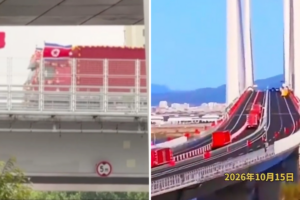
One key articulation of this will likely be at the New Yalu River Bridge – which despite being completed in 2013, has remained unopened ever since.
However, NK Pro satellite imagery analysis from September 2019 suggested it may open soon, a game-changing development that will enable large cargo flows between the two countries.
And though traffic will likely begin slowly, as China increasingly turns a blind eye to sector-level sanctions it will eventually get busier, with the prospect of significant economic benefits for Pyongyang.


The result of these foreign policy trends? Future Air Koryo route maps might look a bit like this – with much greater connectivity to China and potentially even direct routes to the likes of Tehran and Damascus.
Not only will this help bolster tourist numbers to the DPRK – another source of important revenue – but it could also facilitate sharing of tacit military expertise among countries of proliferation concern, too.
Future of the economy?
Since Kim Jong Un came to power – and in spite of growing sanctions – there has been a major construction boom throughout the DPRK.
Why? Because in North Korea, construction is very cheap. The main ingredient, labor, costs little more than food and water for the state, while many of the necessary construction inputs can be produced domestically.


So even if sanctions remain and economic growth is relatively limited, it is likely that the Pyongyang skyline will continue to develop in superficially impressive ways.
Not only will this mean more apartments to accommodate citizens – a highly sought-after location for those living in the countryside – but the extra inventory will help propagandists show that the leadership continues to serve the people. In other words, a modest win-win for both people and party.


Though Kim Jong Un encountered some serious problems with electricity supplies in 2015, the situation has improved to a relatively decent degree since. Unlike the Kim Jong Il days, Pyongyang is no longer pitch-black at night, though there are still extended periods of unreliable supplies to many areas.
North Korea won’t have fully overcome its chronic power shortages by 2040, but in central Pyongyang at least much more sustained supplies can be expected.
That, in turn, could mean working elevators to the upper floors of “Pyonghattan” apartments – making them finally desirable for local citizens. Once again, another modest win-win.


Unable to attract foreign brands to officially open in the DPRK due to sanctions and foreign investor fears, it is probable that major domestic brands like Air Koryo will continue diversifying their activities in the decades to come.
Already running a number of small-size department stores, fast-forward to 2040 and elaborate stores like the ones visible in South Korea might start appearing in exclusive Pyongyang neighborhoods.
Not only will this sophistication of DPRK branding help placate growing expectations, but it will increase revenues for state-owned enterprises and help promote DPRK “self-reliance”.


Life in rural North Korea is currently highly under-developed and relies upon a significant amount of manual labor. By 2040, things likely won’t have changed much.
But faced with long-term economic difficulties due to the impact of chronic sanctions, North Korea will likely continue focusing on improving self-sufficiency.
In the agricultural sector, then, this may manifest in a growing proliferation of low-cost mechanized farming machinery to bolster crop sizes.
Though such improvements will be poorly distributed, as time goes by the DPRK will get better at defending itself against seasonal weather problems and be better able to feed its population.


How about economic progress outside of Pyongyang, in secondary and tertiary cities? Let’s look at the East Coast, where the beach city of Wonsan can be found.
Though it once received regular flows of visitors from the Japanese port of Nigata, there have been little changes to the city skyline in recent decades. And absent a major change in the local economy, it is unlikely that authorities will invest much in the city over the decades to come, besides infrastructure to support nearby resort facilities – which due to sanctions might not do so well.


That’s because the city is adjacent to the massive Wonsan-Kalma tourist resort construction.
Though superficially impressive, it’s a good example of a project that may fair poorly, for not everything will always go well for Kim.
While an opening ceremony for the twice-delayed resort will likely take place in 2020, in twenty years’ time the thousands of hotel rooms there could represent the crystallization of key challenges Kim will continue to face.
Absent a breakthrough in inter-Korean relations and UN sanctions to facilitate mass South Korean or Japanese tourism there, it’s probable this facility will end up as a ‘White Elephant’ project.
Officially, it won’t be allowed to fail, of course.
But by 2040, significant parts of it might be abandoned or unused. In other words, the Wonsan-Kalma project could become a manifest sign of North Korea’s failure to break sanctions in a meaningful way: a Ryugyong Hotel project of modern times.


In contrast, ongoing construction activity at the iconic Ryugyong Hotel – unfinished since the late 1980s – has been visible since Egyptian telecom provider Orascom entered the DPRK market in 2008.
Though a full opening of the mammoth-size hotel is unlikely, it is very likely that upper floor areas will open soon, giving a modest propaganda win after decades of failure there.


Information Access and Control
For the above trendlines to continue in the ways outlined, Kim Jong Un will need to maintain a significant level of support from senior officials and the general public.
Consequently, authorities will need to maintain effective controls on outside information – as well as devise new systems to monitor and surveil the population at large.


One key area developments may occur is on the border, where illicit information, cargo and people flows have been an issue for decades. With defector numbers to South Korea reaching the lowest levels since 2002 – partly as a result of increasing security along the DPRK-PRC border – it is likely that increasing securitization of this area will continue.
But in a decade or two, the Kim Jong Un government could decisively turn the tide by fully sealing off the border. It would not take much, resource-wise, and could significantly help manage illicit flows there better.


And as technological developments prevail, so too will the risks of ideological contamination from “hostile” and “imperialist” sources overseas.
By 2040 the government will almost certainly need to make enhanced efforts to block sources of foreign media and systems to communicate with overseas.
But this could well become one of the biggest risks for the Kims, with technological innovation likely to get to the point where significant blocking of outside information will have become impossible.
As a result, it is unclear whether the DPRK can fully maintain the information cordon it has benefitted and relied upon to date.


But as surveillance technology improves, one of the most likely ways Pyongyang will try to mitigate increasing inflows of outside information and “non-socialist” behavior will be through Chinese-style mass monitoring.
Consequently, the proliferation of CCTV and automated systems to surveil civilians can be expected, as can that of apps to monitor horizontal communications on the official intranet and cellular systems.
Though such phenomena will require significant resources, the technology will help Pyongyang better understand where potential threats within the domestic population may lie.
What does it mean? Key implications
As said at the outset, it appears that U.S. and South Korean policy-makers have made a persistent habit of responding to the North Korea of today, rather than considering the North Korea of tomorrow.
Given the possibility of these outcomes emerging by 2040, what do they mean for future policy-making towards the DPRK?


During a period of excessive tension with the U.S. and South Korea in March 2013, North Korean state media published a map featuring targets for strikes on the U.S. mainland.
Kim Jong Un “finally signed the plan on technical preparations of strategic rockets, ordering them to be on standby to fire so that they may strike any time the U.S. mainland,” KCNA said at the time.
Back then few North Korea watchers took the map seriously, aware that DPRK missile capabilities were far from what would be necessary to reach targets so far away.
But fast-forward to 2040 and the reality is that strike-plans like the one shown in 2013 will have become highly credible. In other words, by then the DPRK will have multiple systems to reliably deliver nuclear weapons to cities throughout North America.
Naturally, this will have significant implications in the event of any escalation of tensions.


Military: North Korea’s shelling of the South Korean island of Yeonpyeong-do, which took place in November 2010 after the sinking of the Cheonan corvette, illustrated vividly how inter-Korean relations can promptly spiral out of control – with often deadly consequences.
But when Pyongyang has proven ICBMs and second-strike SLBM capabilities, how will the U.S. and ROK be able to respond in the event of similar future escalation?
For example, what kind of USFK responses might be considered if – during a period of heightened tensions – North Korea were to shoot down a civilian ROK aircraft, arguing it had entered DPRK airspace?
Alternatively, how could South Korea respond if the DPRK were to unilaterally seize a cluster of islands near the disputed Northern Limit Line?
Response-mechanisms are already constrained due to the lack of strategic depth on the Korean peninsula and North Korea’s long-range artillery arsenal. But the already slim range of existing options will become reduced further when Pyongyang has credibly targeted Washington DC with nuclear weapons.


Foreign policy: As North Korea will likely need to continue weapons testing to refine its ICBM capabilities, the necessity of “strong” political responses from the international community will continue to prevail. Given the sanctions-first trend of the past two decades, it can be expected that further measures in this area will remain the fallback of choice in the years to come.
But when ways to expand political and economic pressure on North Korea begin to run out, what will be left?
The U.S., for example, might try to discourage travel to the DPRK – on the basis such visits could indirectly fund WMD programs. And this might result in legal means to arrest foreigners who have visited the country should they subsequently ever travel to a U.S. jurisdiction.
Sound far-fetched?
Consider U.S. national Virgil Griffith was arrested upon arrival at Los Angeles International airport last November for conducting a presentation on crypto-currency in North Korea – a violation of unilateral U.S. sanctions. And recall that Washington last year imposed new visitor restrictions on foreigners who visited North Korea after 2011.
As far as Treasury sanctions go, given its reluctance to designate the primary entities of concern involved in DPRK transactions – Chinese banks, Chinese state-owned enterprises, and private Chinese firms – over the years it will likely continue to focus on entities at the lower end of the spectrum.
But as time goes on, even this pool of small-scale targets will diminish. As a result, future DPRK tests might be followed with unilateral sanctions targeting the increasingly mundane.


Economy: As the DPRK evolves to overcome the long-term impacts of sector-level sanctions – which will probably be augmented in the years to come – opportunities for Pyongyang to actually raise revenues through legitimate means will likely decrease.
Already unable to export basics like coal, seafood, and textiles, as the noose tightens North Korea will need to invest in areas that can generate much higher rates of return.
Already possessing a sophisticated cyber-team – accused of stealing $81 million from Bangladesh’s Central Bank – the DPRK could be motivated to improve existing capabilities with scope for potentially much more damaging attacks.
Likewise, with a track record of proliferation to countries interested in missiles and Cold War-era military know-how, as North Korea’s WMD continues to evolve so to will the fees it can theoretically attract from future clients.
And once the DPRK has deployed a reliable nuclear deterrent and sanctions are close to peak levels, what can the international community realistically do to deter “axis-of-sanctioned” countries like Iran and North Korea transparently cooperating in sanctioned domains like weapons sales/acquisitions?

Inter-Korean: As economic disparities between the two Koreas continue to widen, it’s also likely that anti-unification sentiment will continue to rise in South Korea.
Already common among younger South Koreans, in 20 years’ time anti-unification views will likely become the mainstream view. In response, political parties taking the currently unprecedented step of campaigning openly against rapprochement towards the North may emerge.
Beyond having first-order consequences for bodies like South Korea’s Ministry of Unification, a mainstreaming of anti-unification sentiment will indirectly cement the Kim family’s legitimacy to rule the North come whatever may.

Information control: When it comes to information control, two phenomena are likely to emerge if the current trajectory continues to 2040.
Firstly, while some in the West hoped to see scenes like the Arab Spring spread to North Korea, the reality is that security services there will maintain a significant advantage over the population.
Even if outside information seepages into North Korea increase, best practice and technology from China’s emergence as a digital surveillance state will make it hard for any form of DPRK protest culture to emerge.
Secondly, as sanctions continue to rise, the scope for foreigners to legitimately visit or work in the DPRK will continue to diminish. And in 20 years from now, it could be that the majority of foreigners visiting Pyongyang will be from countries closely aligned with North Korea, such as China or Russia.
The implication is that even if domestic opposition were to ever articulate, countries in the West might simply never know.
After Kim Jong Un?
In 2013, former NBA basketball star Dennis Rodman told a UK newspaper that he met Kim Jong Un’s daughter, Kim Ju Ae, during one of his trips. Then a baby, by the year 2040 she will be at least 26 years of age – roughly the age Kim was when state media first introduced him in 2010.
If she’s ever introduced as successor and North Korea has evolved according to the above trendlines, what will happen next? Facing unprecedented sanctions and international isolation, what incentive will any fourth-generation Kim family member have to pursue a fundamentally different course from their father?

Into the future: a summary
The goal of this forward-look is not to provide the answers or any policy recommendations. Instead, I’ve tried to extend already visible trends to forecast where things could be going in the long-term.
In summary, it seems that:
- The U.S. (and South Korea) has been mostly responsive to North Korean actions and WMD advances, focusing on short-term applications of pressure or offers of carrots to try and stimulate change.
- Neither sanctions nor engagement has ever been sustained enough to actually have a strategic impact or seem credible to the DPRK. Due to the myriad of international actors involved and the short-term nature of democratic political office, it remains highly unlikely that more of the same will ever change strategic thinking in the DPRK.
- In comparison, the Kim dynasty has long pursued a strategic approach to guarantee its viability decades into the future, focusing on the acquisition of highly reliable nuclear weapons, asymmetric means to raise finance, and near-total control of information and the general public.
- Above all, Pyongyang has the ability to pursue these goals because it need not concern itself about international isolation, domestic politics, public opinion, or even economic shock.
Given the above, it seems it would be prudent for policy-makers to respond to North Korea’s strategy with a strategy of their own. Something which is coherent and can be implemented regardless of who is president or whether or not China is determined to sufficiently help.
Easier said than done, yes, but it’s clear that two more decades of flip-flopping short-term policies will result in much more serious risks for the U.S. and South Korea’s relations with North Korea.
Photo retouching by Gotham Studios Melbourne.
Edited by James Fretwell
© Korea Risk Group. All rights reserved.
No part of this content may be reproduced, distributed, or used for
commercial purposes without prior written permission from Korea Risk Group.
Recent Stories