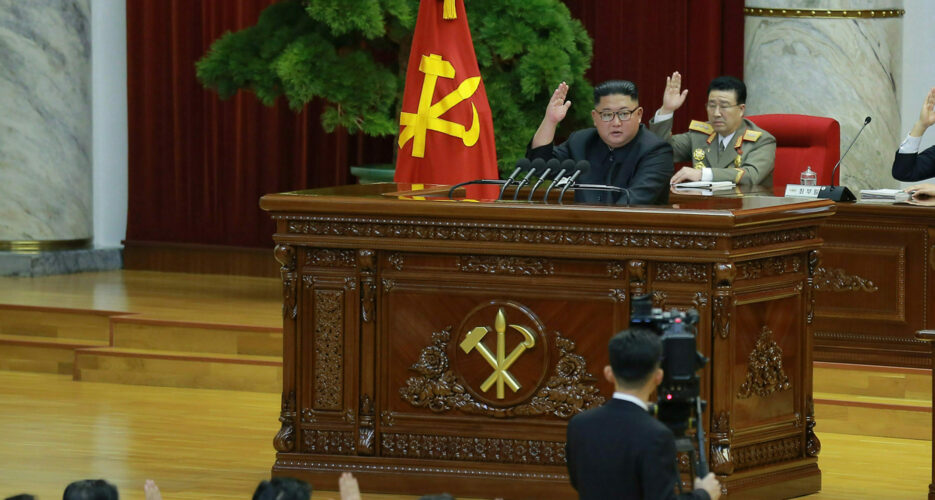
North Korean leader Kim Jong Un on the final day of a four-day ruling-party Plenary Meeting on Tuesday delivered a speech outlining major policy shifts with regards to military developments, sanctions, and the country’s stance on stalled talks with the U.S.
The speech was covered in state media on the morning of New Year’s Day in place of the much-anticipated annual New Year Address, where Kim was expected to lay out the nation’s policy direction on additional areas, review the past year of economic activity, declare detailed expectations in various sectors for the new year, and announce new slogans to be used in state propaganda.
That speech may still come on January 2 or in some other format through state media in the coming days, but Kim’s plenum speech has nonetheless already stirred debate among North Korea watchers regarding what to expect from Pyongyang in 2020 — some of whom were asked by NK News to provide readers with their take on the present situation.
The following North Korea watchers responded in time for our deadline:
Cheong Seong-Chang, Director of the Center for North Korean Studies at the Sejong Institute
Hoo Chiew Ping, Senior Lecturer in Strategic Studies and International Relations, National University of Malaysia
Joshua Pollack, researcher at the Middlebury Institute of International Studies at Monterey
Kim Young Hui, Senior Research Fellow at the Korea Development Bank’s Inter-Korean Economic Cooperation Research Unit
Li Nan, Senior Research Fellow at the Chinese Academy of Social Sciences
Mintaro Oba, former U.S. State Department Korea Desk Officer and NK Pro contributing writer
Thae Yong Ho, President of Coalition for Change in North Korea and former Minister of the DPRK Embassy in London
Kim Jong Un’s plenum speech was aired on the morning of New Year’s Day and edited on DPRK television in a similar style as past New Year Addresses | Photo: KCNA
How do you read Kim Jong Un’s remarks about the long-range and nuclear testing moratorium? Has North Korea definitively ended its April 2018 commitment?
Cheong Seong-Chang: At the plenum, he directly said that he will make a shift to “a shocking actual action,” and overall the remarks can be seen as an announcement putting an end to the moratorium of nuclear and missile [tests]. North Korea making it a fait accompli that the hostile and confrontational relations with the U.S. will become long-term, and saying that internal power should be strengthened, is showing that Pyongyang is not expecting anything from DPRK-U.S. denuclearization negotiations anymore.
They have used expressions that seemingly look like leaving room for talks, but compared to Kim’s 2018 April speech at the SPA, there was zero mention of how North Korea will make one last negotiation with the U.S. They are making their stance clear that they will not dwell on [the hopes of] dialogue anymore, unless the U.S. straightens up their North Korea policy.
Kim Young Hui: During the plenum coverage, Kim Jong Un mentioned that the reason why North Korea had to continue projects on developing strategic weapons was because of U.S. “hostile policy” on North Korea. He also said that, until such a U.S. policy is withdrawn and a lasting and durable peace-keeping mechanism is established, the development of strategic weapons will be pursued without suspension, for the sake of national security. Hence, it should be seen as a ‘conditional’ termination of the moratorium, depending on whether or not the “hostile policy” is withdrawn and whether a peace agreement will be signed.
Hoo Chiew Ping: I don’t think this will be the case. It is still too soon to call it an abandonment of the moratorium, as the remarks indicated that it has to be dependent on the U.S.’s follow-up gestures or actions. I believe the emphasis is on U.S.-ROK military exercise and alliance activities, that North Korea has given a close watch and reacted upon for the period of diplomatic impasse in 2018 and the stalemate throughout 2019.
Thae Yong Ho: It can be seen as an announcement of the termination of the moratorium — in other words, reviving the byungjin line of nuclear and economic development.
Joshua Pollack: Kim Jong Un has clearly indicated that he will no longer uphold the unilateral testing moratoria of April 2018. He also indicated that “the world will witness a new strategic weapon to be possessed by the DPRK in the near future,” which is certainly suggestive of a testing campaign of some sort, although no details are offered.
Even half a dozen years ago, Kim might have been content with a mere parade display of untested missiles, but he now seems to believe that something more definitive is required to shake the status quo—a “shocking actual action,” in the stilted formula of the official translation.
Li Nan: Kim [in the plenum speech] “stressed that under such condition, there is no ground for us to get unilaterally bound to the commitment any longer, the commitment to which there is no opposite party, and this is chilling our efforts for worldwide nuclear disarmament and non-proliferation.”
So what he emphasized in the previous sentences is that under the such condition, they won’t keep the commitment. Suppose the conditions have been changed such as the sanctions lifted partly, or no offensive weapons delivered to the Korean peninsula, the commitment would still be there. It shows the commitment without any condition in the past has been adjusted to one with conditions. It also shows to the world that if North Korea one day breaks the commitment, it is because of U.S. hostile policy.
Mintaro Oba: The great thing about foreign policy comments by governments is that they are so precisely worded for external consumption that you can tell when the government wants to preserve flexibility for itself because of the verbal gymnastics it goes through. Kim Jong Un’s language was written extremely carefully, as if it was saying, “we don’t feel formally bound by the moratorium anymore, but we’re also not saying we’re definitely about to start testing again and shutting the door on diplomacy.” I think it showed that North Korea has more of a stake in the diplomatic process than it lets on.
Images of the various missile tests in 2019, including this of the Pukguksong-3 SLBM, were featured in the KCTV broadcast of the plenum speech | Photo: KCTV
Some of Kim Jong Un’s remarks imply that Pyongyang would still be open to further dialogue with the U.S. What must Washington offer North Korea at this point to get them to return to talks, and what is the likelihood of it happening?
Cheong Seong-Chang:Realistically, the U.S. does not have any negotiation strategy that can budge North Korea. It’s a big problem that even South Korea doesn’t have it either.
Meanwhile, North Korea’s weak link is its relations with Beijing — the reason why North Korea is saying they will make “frontal breakthrough” on sanctions without negotiating with the U.S. seems to be because their relations with China and Russia have improved. China has aided more than 1,000,000 T of food to North Korea, and it is known that China did not send many of the North Korean workers back home [despite the UN deadline for overseas North Korean workers].
With this going on, North Korea does not see a reason to succumb to sanctions. Cooperation with China is crucial for leading North Korea to denuclearization, and the current U.S. stance trying to work things out via bilateral negotiation is unrealistic. If the DPRK-U.S. bilateral talks did not draw fruit, the framework should quickly move to a DPRK-U.S.-China-ROK quadrilateral, but both the U.S. and South Korea are being passive about this option.
Kim Young Hui: What North Korea wants is being provided aforementioned conditions: withdrawal of ROK-U.S. joint drills, [ending] South Korea’s acquisition of high-tech war equipment, and U.S. sanctions, et cetera. The U.S. should provide these conditions if they want to bring North Korea back to the dialogue table, but implementing all three would be unlikely realistically due to U.S. domestic political reasons. However, it seems that such things as suspending joint drills or sanctions exceptions will be strategically possible to keep the negotiations going.
Hoo Chiew Ping: Since the moratorium is on the table, increased pressure from Pyongyang on sanctions relief would be one item on the agenda, as Kim Jong Un’s remarks also implied that due to the U.S. inaction and stern position on refusing sanctions relief, the DPRK’s economic development was not progressing according to plan. I suspect Kim Jong Un actually aims for more than sanctions relief, which would be establishing the peace regime, which means U.S. troops must first be reduced (if not removed) from the Korean Peninsula (Trump’s motion was blocked by the U.S. Congress). From National Security Advisor O’Brien’s remarks, I don’t think the Trump administration will make much headway on this in the coming months.
Thae Yong Ho: The most important thing is whether the U.S. can ease sanctions, but they will not do this. Kim Jong Un today also said that the U.S. North Korea policy is to gradually weaken the North’s power. The U.S. will keep continuing such policy.
Joshua Pollack: The entire point of developing and testing ICBMs and hydrogen bombs, for North Korea, is to alter the terms of its relationships with the great powers, starting with the United States. Kim Jong Un appears to have believed that he achieved a breakthrough at the Singapore Summit in mid-2018. But now he has expressed disappointment with President Trump, whom he says failed to keep his promises to Kim concerning the suspension of combined military exercises with South Korea. He is also critical of the American approach to bargaining, saying that despite North Korea’s urgent need for relief from sanctions it will not trade away its nuclear arsenal: “we can never sell our dignity which we have so far defended as valuable as our own life, in hope for brilliant transformation.”
By refraining from attacking Trump by name — only mentioning the U.S. president by title — Kim may be hedging his bets, but it appears for now that he has decided to try to wait him out, further strengthen his strategic nuclear arsenal, and see if the U.S. attitude shifts once the next president is sworn in.
Li Nan: Kim surely leaves a ray of hope for further talks with the U.S. However, he already prepares for a long-term match with the U.S. by consolidating national defense instead of talks only. Kim shows the U.S. the possible options, such as changing “the hostile policy” of [deploying] offensive weapons on the peninsula, sanctions, and military exercise, or else resulting in seeing North Korea building up its military capability with high technologies, plus conducting some “aggressive acts” at some point.
Kim already raised the military’s role during the 5th Plenary Meeting this week, squeezing the diplomatic space to the U.S. Now the ball is in the U.S. court. Personally, I don’t think the U.S. can do that much. There will probably be another summit between Kim and Trump this year if the situation fits. But it will be another show. The deadlock will still be there. North Korea keeps improving its military capability, especially conventional.
Mintaro Oba: The prospects for progress between the United States and North Korea remain as dim as ever.
The chief reason is that the two countries are engaged in what I call “defibrillator diplomacy.” Rather than making hard choices to treat the underlying disease that has repeatedly brought the diplomatic process to the brink of failure, the two countries have kept it alive through repeated, occasional jolts of energy through summits.
If the two countries want to make real progress, they can’t rely on just the optics of cooperation and progress — substantively, they both need to demonstrate much more creativity and flexibility. The United States needs to be more willing to offer sanctions relief that’s significant enough to be worthwhile for North Korea, and North Korea for its part needs to accept that it needs to make real moves toward reducing the nuclear and missile threat and that initial sanctions relief will have to be limited and include some type of snapback provision to have a realistic chance of getting the United States on board.
Trump and Kim last met on June 30 for a surprise short summit at the inter-Korean border | Photo: The White House
What can be inferred from today regarding further weapons tests and other military strategies and actions in 2020?
Cheong Seong-Chang: It was said that a “shocking actual action” will be made: such “shocking” military actions could be thought of as something like Multiple Independent Reentry Vehicles (MIRV) or Submarine-Launched Ballistic Missiles (SLBM). Through the plenum, North Korea is clearly showing their stance that they will go through the path of their choice despite sanctions.
It seems they have ICBMs in their mind — which the international community already assessed have neared the level of completion — to show the capacity of intercontinental reach. Unless they test more, there’s not much pretext to slap on more sanctions. However, today, it seemed that North Korea is bearing in mind that harsher sanctions can fall upon them. North Korea bringing in central and provincial cadres and holding a four-day meeting to explain their new path shows their willingness to advance nuclear and missile abilities, putting up with even stronger sanctions that may come.
Kim Young Hui: Nuclear weapons and missiles are of course included in the “strategic weapons” that North Korea mentioned, but not stating “nuclear development” directly seems to be intended to not provoke the U.S. too much and keep the possibility for negotiations open, while also pressuring it. It appears that the emphasis is more on other strategic weapons development such as super-large MRLS (multiple rocket launch system).
Hoo Chiew Ping: I believe it would still be in North Korea’s best interest to extend the stalemate while continuing to develop their “strategic weapons,” which I [believe does] not exclude a more advanced stage of ICBM development and continuing work on nuclear weapons development where they left off since September/November 2017.
Thae Yong Ho: Kim Jong Un this time used considerably violent language, such as how he will move on to “shocking action,” how the world will “witness new strategic weapon,” and how North Korea will continue developing prerequisite strategic weapons without stopping. Kim also said that the North will “reliably put on constant alert the powerful nuclear deterrent.”
Joshua Pollack: It’s a reasonable guess that 2020 will be more like 2019 than 2018, featuring a series of escalating missile tests. If the UN Security Council responds with condemnation, perhaps North Korea will start to restore its nuclear test site. The reference to something “shocking” in the “near future” is certainly worrisome. It may point to something qualitatively new, perhaps involving a new, heavier missile connected to the ground tests conducted this December.
Something else to watch for is the production of large numbers of new launch vehicles for ICBMs. These could be shown off in news coverage, and perhaps displayed in a parade. The report of the Party Plenum indicates that the 75th anniversary of the founding of the Party, this coming October 10, should be marked “with splendor.” That day has sometimes been the occasion for a major military parade.
Li Nan: More high-tech conventional weapons will be brought out.
Mintaro Oba: Frankly, not much, except that North Korea isn’t definitively committed to any specific tests or military actions, but it will try to get as much leverage as possible out of the prospect of raising tensions by conditioning its shows of strength on U.S. actions.
The language on a “new strategic weapon” is in keeping with North Korea’s continuing efforts to put pressure on the United States by suggesting North Korean military capabilities will continue to advance absent a deal soon on North Korean terms. But the substance and timing of any tests were unclear. We should consider that North Korea may be taking into account the U.S. presidential election in 2020 and timing potential tests to generate the most pressure on the United States at the most sensitive political moments for President Trump.
In a recent non-weapons test military inspection, Kim visited newly-constructed facilities on the small island of Changrin near the maritime border with South Korea in November | Photo: KCNA
How do you think North Korean citizens may respond to calls to “tighten our belts” and build the economy without sanctions relief?
Cheong Seong-Chang: The people will also be staying on their toes, as the North Korean leadership showed that they are taking the current situation seriously, displaying their strong will to take the bull by the horns on sanctions.
Meanwhile, it’s reported that the economy is not doing so well in Pyongyang; the North Korean people will probably be nervous that the economic situation will worsen, after what was said in today’s plenum.
Kim Young Hui: The decision of the North Korean leader (Suryong) and the party equates law in the country, so the people will have to follow Kim’s decision, but complaints will arise among the people — as the country is not guaranteeing their basic livelihood while forcing them to “tighten belts.”
Hoo Chiew Ping: I would say Kim Jong Un’s remark in 2012 on not allowing their people to tighten their belts anymore is more unusual than the “tighten our belts” narrative. In other words, Kim Jong Un over-estimated his strategy in advancing the economic objectives, so falling back on the usual narrative of “tightening the belts” makes more sense, so the regime can spend more resources on weapons development rather than feeding the people.
But the focus of the plenum outcome still has a people-focused narrative: that economic development is still being prioritized. The theme of self-reliance will be contradicted by the actions of the DPRK’s continuing economic reliance on China and Russia.
Thae Yong Ho: The North Korean people would have started the new year with a heavy heart. Getting ready for a long-term battle, people will indeed ‘tighten their belts’ without opening their wallets in 2020.
Joshua Pollack: They’ll have to do whatever they must to survive. It is especially discouraging to hear Kim call upon North Koreans to redouble their efforts to build the economy and to tighten their belts. He also calls for cracking down on “anti-socialist” and “non-socialist” tendencies in society, language that sounds ominously as if the regime might be rethinking its toleration of widespread market activities.
These are the parts of Kim’s remarks, rather than anything concerning military technology, that I find the most disturbing. In recent editorials and leadership remarks, the regime has expressed disquiet about the outlook of the new generation of North Koreans. It is unclear just how the Party plans to proceed, but the prospects sound bleak.
Li Nan: As for citizens who are living under the Juche [ideology], what they’ve found out from the conference is an independent new policy. Kim rushed to make a deal with the U.S. last year but failed to achieve it. Plus with some radical policies on the economy and military, many North Korean people cannot fit the change, showing no understanding. Now Kim faced the reality, trying to improve the economy even without sanctions lifted while raising the military role and strengthening national defense. It very much fits Juche. These policies very much fit the bureaucratic thinking. It can consolidate the country with no doubt.
To me, “tighten our belts” just looks like propaganda, showing North Korean people not to forget what they had experienced. Keeping the spirit to make progress.
Mintaro Oba: It’s always hard to speculate how the North Korean people will react to anything given the limited information we have and the extraordinary restrictions on freedom of action and expression North Koreans face. What I think we can say is that North Korea has always been incredibly adept at creating domestic narratives of self-reliance and perseverance, justified in part by external threats. This is, after all, the country that weathered the Arduous March.
Ordinary North Koreans will be reading about and likely be required to study news of policy changes Kim delivered in the Plenum speech | Photo: NK News
Besides nuclear and foreign policy issues, what are the biggest issues that drew your attention in the Plenum outcome, and why?
Cheong Seong-Chang: On the leadership reshuffle, it seems that it is a bit of a mystery why Kim Yo Jong was appointed to first vice-department director again. It is also possible that she was promoted after demotion, but it’s more likely that she has moved to the Organization and Guidance Department (OGD).
Ri Pyong Chol’s promotion from first vice-department director to the director of the Munitions Industry Department is especially notable, showing Pyongyang’s stance on empowering the munitions industry.
Also, it was natural that 2020 was absent of a New Year’s Address. The state media report on the party plenum result had everything a New Year’s Address needs, hence realistically there was no need to give the Address separately. One thing that was missing from it was inter-Korean relations; it was omitted because its improvement seems unrealistic at the moment when the North is making it official that the DPRK-U.S. will be having a long-term confrontation. All in all, it can be said that today’s plenum report proclaimed the Party’s new “Frontal Breakthrough” policy line. “Frontal Breakthrough” is the “new path” that Pyongyang chose.
Kim Young Hui: To me the interesting part was where Kim framed the long-term confrontation between the U.S. and the DPRK as fait accompli, saying how the demand in people’s livelihood should be guaranteed through changing the system and methods of economic projects under this domestic and external environment.
The past era’s method for economic work was depreciated as ‘ad hoc measures.’ This is where Kim Jong Un’s pragmatic way of thinking is reflected, implying that the economic management method – even if it’s that of his father and grandfather – should be transformed boldly to correspond to reality.
Hoo Chiew Ping: The shuffling of leadership position is another aspect to watch out for, and it would be interesting to see if the military positions have been enhanced in its importance vis-a-vis the party positions. The award of military ranks to civilian scientists that made breakthroughs under Kim Jong Un’s rule shows that this is an interesting dynamic to observe.
Thae Yong Ho: For me, the most shocking passage was how Kim said that in 2019, “an unprecedented bumper harvest was made, exceeding the crop year with the highest harvest.” I wonder if this means they have exceeded the 8,000,000 T grain goal the North achieved in the 80s.
If they did break through the highest crop year last year, it means that they are proclaiming that 2020 will be endurable — it is something that drains the U.S., which is trying to pressure North Korea through sanctions.
Joshua Pollack: Holding a Plenum at the end of the year and reporting its outcome in this manner is a departure in itself. Doing so allows for a break in format from the standard New Year Address.
There are a striking number of references to failures, unmet needs, and corrective actions. There is even a subtle expression of dissatisfaction with North Korea’s scientific enterprise, which has enjoyed great favor under Kim Jong Un. His expectations are high; he calls science and technology an “inexhaustible strategic asset” for overcoming “manifold hardships” in economic development. But he confines his praises to the achievements of North Korea’s “reliable” weapons scientists. Near the end of the report appears the name of a new President of the State Academy of Sciences, one Kim Sung Jin. Good luck, Kim Sung Jin.
Li Nan: The military role in the decision-making process has been raised up largely because of the deadlock with the U.S.; Kim strongly criticized the weakness of the economic system and bureaucratic doctrines, especially to the Cabinet.
Mintaro Oba: Kim Jong Un’s continuing focus on the economy was something I expected and thought was positive. He has made himself accountable for maintaining North Korea’s economic situation. Therefore, he may be more amenable to sanctions relief or other external incentives that help him deliver on those domestic commitments.






 SHARE
SHARE COPY LINK
 X
X MASTODON

 Hoo Chiew Ping: I don’t think this will be the case. It is still too soon to call it an abandonment of the moratorium, as the remarks indicated that it has to be dependent on the U.S.’s follow-up gestures or actions. I believe the emphasis is on U.S.-ROK military exercise and alliance activities, that North Korea has given a close watch and reacted upon for the period of diplomatic impasse in 2018 and the stalemate throughout 2019.


 Mintaro Oba: The great thing about foreign policy comments by governments is that they are so precisely worded for external consumption that you can tell when the government wants to preserve flexibility for itself because of the verbal gymnastics it goes through. Kim Jong Un’s language was written extremely carefully, as if it was saying, “we don’t feel formally bound by the moratorium anymore, but we’re also not saying we’re definitely about to start testing again and shutting the door on diplomacy.” I think it showed that North Korea has more of a stake in the diplomatic process than it lets on.