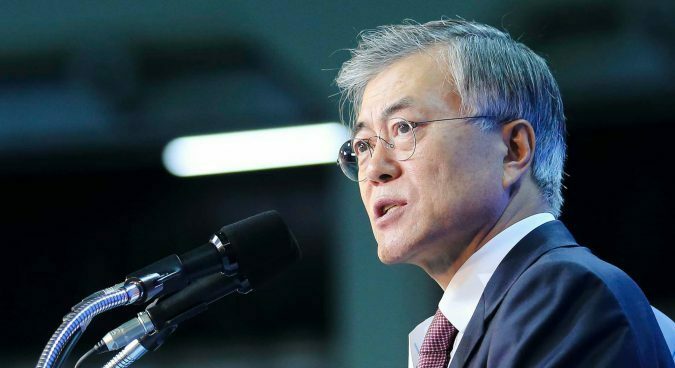

Progressive candidate Moon Jae-in, former chief of staff to the late President Roh Moo-hyun, is suddenly facing a real horse race in the South Korean May 9 presidential election. Pragmatist Ahn Cheol-soo has pulled almost even in the latest polls for the election to replace Park Geun-hye.
With the situation on the Korean peninsula reaching a level of tension not seen in years, some voters may be re-evaluating whether Moon’s advocacy of the warmed-over Sunshine policy of his late mentor may be the best approach to dealing with a defiant Kim Jong Un and an increasingly assertive U.S. President Trump.
Trump recently dispatched the USS Carl Vinson aircraft carrier and strike group to waters off of Korean peninsula, following his ordering of an airstrike against Syrian bases.
The President further tweeted on April 11 that “North Korea is looking for trouble. If China decides to help, that would be great. If not, we will solve the problem without them! U.S.A.” Reuters reported that “North Korean state media on Tuesday warned of a nuclear attack on the United States at any sign of U.S. aggression.”
Some voters may be re-evaluating whether Moon’s advocacy of the warmed-over Sunshine policy
Candidate Moon Jae-in stepped into the fray, according to a recent report in the Financial Times: “The leading contender for the South Korean presidency has struck back at US sabre-rattling over North Korea, saying any military action on the peninsula must have Seoul’s consent.”
Moon’s assertion, however, that he or any other foreign ally would have veto power over the actions of a U.S. President as Commander in Chief, taken to protect the lives of American citizens from “all enemies foreign and domestic,” would certainly be questioned by many Americans. The assertions of Kim Jong Un that he might launch a nuclear attack on the American homeland have raised the threat level posed by Pyongyang to the United States.
The Washington Examiner reported on March 4 that “former President Barack Obama is believed to have warned President Trump that the greatest threat the country would face during his administration would be North Korea’s nuclear and missile program development.”
Some military experts have estimated that Pyongyang will have developed the long-range missile capability and will have a sufficient arsenal of nuclear weapons to strike the West Coast of the United States by 2020, at the end of President Trump’s current term. That makes Kim Jong Un not just a South Korean problem, but also an American problem.
Yet Moon Jae-in, who is still the front-runner to become the next South Korean President, could according to a Reuters report on March 12, “significantly soften Seoul’s stance toward North Korea.” Pyongyang has even gotten into the game of commenting on South Korean politics, indicating that it has its own favorite.
That makes Kim Jong Un not just a South Korean problem, but also an American problem
NK News reported on March 29 that “the Rodong Sinmun declared Minjoo Party presidential candidate Moon Jae-in the ’candidate with high chances to win’ the upcoming South Korean Presidential election on May 9 in an editorial.”
It is small wonder that Pyongyang would be cheering for Moon Jae-in’s candidacy. His expressed views on re-engagement, including a re-opening and expansion of the Kaesong Industrial Complex (KIC) and a renewed flow of funds to the hard-strapped North, minus any real monitoring or verification, must be music to Pyongyang’s ears. The fact that such income would likely be used to further fund Pyongyang’s missile and nuclear programs would not go unnoticed by the Trump Administration.
Then there is the question of the Terminal High Altitude Area Defense (THAAD) anti-missile defense system. Moon has hinted at a possible delay or even reversal of the previous South Korean administration’s decision to deploy THAAD. Beijing has vehemently opposed the deployment, even retaliating against the South economically for the decision.
Caving to Chinese pressure, however, would set Seoul on a potential collision course with Washington. Repeated Pyongyang missile launches, plus Kim Jong Un’s murder of his own half-brother with an internationally banned chemical weapon, have only served to harden U.S. Congressional and public attitudes in support of both the THAAD deployment and other means to rein in the provocative North Korean regime.
Caving to Chinese pressure, however, would set Seoul on a potential collision course with Washington
Yet Moon Jae-in appears headed in a policy direction diametrically opposed to this hardening American opinion. According to a March report in the South China Morning Post: “In December Moon said that if elected, he was willing to visit North Korea ahead of the US, the South’s security guarantor.”
Moon has reportedly reversed that rather provocative statement, but more recent reports indicate he has expressed an interest in visiting Beijing before Washington to discuss North Korea policy. That would not be viewed favorably by an American public who have 28,000 sons and daughters with their lives on the line while posted with the U.S. military in South Korea.
The New York Times reported on March 10 that “Mr. Moon has called himself ‘America’s friend,’ grateful that the United States protected South Korea from communism and supported its economic growth and democratization. The alliance with Washington is “a pillar of our diplomacy,” he said in an interview on the eve of Park’s court-ordered ouster. But he also said in a recently published book that South Korea should learn to ‘say no to the Americans’.”
This attitude would not be a particularly good match with the “Make America Great Again” approach of the blunt-speaking new U.S. president. President Trump has not shied away from rather cutting comments directed at such traditional American allies like Germany and Australia, who are far less dependent on Washington’s largesse for their national security than Seoul.
Candidate Trump had repeatedly criticized South Korea and other allies for their “free ride” in not paying enough cost-sharing expenses for the stationing of U.S. forces. He has also shown less tolerance for the kind of anti-American rhetoric than George W. Bush and Henry Hyde did during the era of Moon’s mentor, Roh Moo-hyun. That was the era when anti-American crowds gathered across South Korea to demand “Yankee Go Home” after two school girls tragically died in an auto accident involving U.S. forces.
House Foreign Affairs Committee Chairman Hyde, a veteran of the Pacific War which helped liberate the Korean peninsula from Japanese imperial rule, was repeatedly frustrated with the Sunshine policy of the Roh Moo-hyun Administration. Engagement, for example, did not deter Pyongyang from missile launches in 2006 on America’s own 4th of July holiday weekend.
There were also endless deliberations about OPCON transfer – transfer of operational control of South Korean forces in the event of war on the Korean peninsula from U.S. to South Korean commanders. And finally, there was an issue that was close to Chairman Hyde personally, as he had served under General MacArthur in the Pacific.
That was the era when anti-American crowds gathered across South Korea to demand “Yankee Go Home”
That was the attempt by South Korean leftists to remove the statue of MacArthur from above Incheon harbor. Hyde, in his last official visit to Asia as Chairman, made a pilgrimage to that statue in the summer of 2006 to deliver remarks on the importance of the Inchon landing to the preservation of South Korean liberty.
The potential election of Moon Jae-in and the resulting policy divergence from Washington on the North Korean issue portend a potential alliance train wreck which would be far more challenging for the US-ROK alliance than even former President Kim Dae Jung’s disappointing March 2001 Washington visit.
That was the occasion when Kim Dae Jung famously failed to sell his Sunshine policy to a skeptical newly installed George W. Bush Administration. President Bush went on to famously label North Korea as a part of an “axis of evil” in his January 2002 State of the Union address. Donald J. Trump is even more unlikely to be receptive to a renewed Sunshine policy presented by Moon Jae-in than George W. Bush was back in 2001.
Featured image: Moon Jae-in’s Facebook
Join the influential community of members who rely on NK News original news and in-depth reporting.
Subscribe to read the remaining 1367 words of this article.
EXISTING MEMBER?


');
newWindow.document.write('
');
newWindow.document.write('