
|
Opinion How elections in U.S. and South Korea will impact North Korea policyTime running out for President Park to set in stone North Korea pressure policies
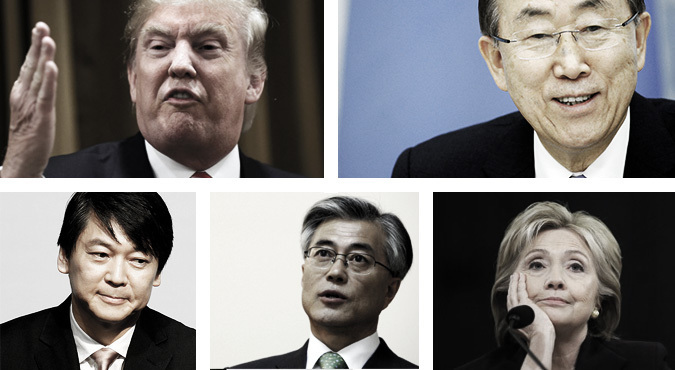 Now that Donald Trump has officially been coronated as the Republican nominee for president and that Hillary Clinton would have received her party’s blessings for the same office by the time this column is published, debate will heat up in South Korea over the future of inter-Korean relations. For more than twenty years, each time there has been a change in leadership in Washington, North Korea policy was usually put in the backseat as newly elected American presidents had other more pressing concerns. And when they finally got around to revisiting their North Korea policies various new approaches were attempted, only for all of them to fail and force everyone back to reality to face the fact there are no good options in dealing with North Korea. Unlike in the past, however, the next United States president, whoever he or she may be, will not have the luxury of ignoring Asia. As North Korea continues blundering about with WMD and China shows no sign of its appetite for aggressive expansion in the South China Sea waning any time soon, American leaders who choose to ignore Asia even for a moment would do so at their peril. IMPACT ON KOREA From Seoul’s point of view, it is clear which of the two candidates it would prefer to see emerge victorious in November. Although it would be highly unorthodox and an utter disregard for protocol for any government to publicly support a particular candidate to become the next president of the United States, South Koreans’ personal feelings on the matter is likely to be one of the worst kept secrets in the world. Hillary Clinton by no means has a perfect track record in regards to North Korea. After all, strategic patience, which essentially came down to doing nothing while North Korea continued to build up its nuclear weapons program, is as much hers as it is also President Obama’s failed policy. In fact, since her time as First Lady and as Senator and then as Secretary of State, Hillary Clinton has been part of the establishment that oversaw the United States’ most spectacularly unsuccessful foreign policy initiative.
However, there is a silver lining. Now that the Obama administration, though belatedly, has decided that the best way to deal with North Korea is by making it pay through its nose for choosing to pursue nuclear weapons, it is likely that a President Hillary Clinton will continue that policy as well. After all, though it is true that North Korea does not respond to pressure well, it is also true that North Korea does not respond to anything else. A few more years of near debilitating sanctions (which must be vigilantly enforced) will force Kim Jong Un to choose between negotiating in good faith or possibly getting overthrown and killed by his own lackeys. Donald Trump, on the other hand, offers no silver linings whatsoever. With no experience in government or international politics, Trump has so far offered nothing more than poorly thought out, if at all, statements that are comparable to a gorilla beating its chest. From having burgers with the boy king, threatening to make him disappear then being willing to talk to him, or threatening to upend the US-ROK alliance, Donald Trump has shown to the whole world what having Twitter-comments morph into what partially resembles a human being looks like. For South Koreans, it is clear that Hillary Clinton would be the preferable victor in November. Regardless of whom South Koreans or other non-Americans would prefer to see elected as the next American president, however, what is clear is that both Hillary Clinton and Donald Trump, for their own respective reasons, are not very popular with American voters. With such unpopular people vying for the Oval Office, it’s still unclear who will be victorious. Best case scenario, the United States’ North Korea policy remains unchanged and worst case scenario, at least initially, Northeast Asia will go through a political sea change that hasn’t been seen in more than sixty years.
MOVE TO THE LEFT However, everyone is so busy talking about the American elections that, at least for now, few seem to be talking about what might happen in South Korea after its presidential elections next year. With South Korea’s exports having fallen for eighteen months in a row, news that the Korean economy grew more rapidly than was expected in the second quarter is hardly giving anyone any feeling of comfort whatsoever. A sluggish economy and an appearance of aloofness and being out of touch with voters mean that it is likely that the ruling Saenuri Party might not be able to retain control of the Blue House after President Park Geun-hye’s constitutionally mandated single term is up. It speaks volumes that the ruling Saenuri Party is looking to woo UN Secretary General Ban Ki-moon to run for South Korea’s presidency under their party’s label, especially considering the fact that Ban was South Korea’s foreign minister under the Roh Moo-hyun administration – a man that the Saenuri Party has no love for even to this day.
Other possible contenders for the Blue House from the opposition are just as worrisome. Moon Jae-in, the former leader of the Minjoo Party and former chief-of-staff to the late President Roh Moo-hyun, declared in 2012, during his last unsuccessful run for the Blue House, that the only way to resolve North Korea’s nuclear crisis was through a peace treaty. And that’s something which happens to be what Kim Jong Un has long demanded: a peace treaty that ends the U.S.-ROK alliance and which would do nothing to ensure the North Koreans abandon their nuclear arsenal or their other WMD programs. Another possible contender is Ahn Cheol-soo, the former leader of the People’s Party, who thinks that the THAAD deployment ought to have been put to a referendum. Yet another contender is current Seoul Mayor Park Won-soon, who went on record saying that South Korea and the United States ought to return to the days of the Sunshine Policy – like as though that was such a resounding success! Should any of these three men from the opposition become the next South Korean president, all of the effort that the Park Geun-hye and Obama administrations have put forward in their respective governments and through the United Nations would have been for naught. The North Koreans will be given more breathing room – and more concessions and aid and tribute – all the while being given free rein to continue to imprison their people and blackmail the rest of the world for free goodies whenever they want. The fact that in a few months in the United States and a little longer in South Korea there could be a new crop of leaders who – by every measure can most politely be described as rank amateurs – ought to frighten anyone with any semblance of sense whatsoever. What will happen in the United States come November is beyond the control of the South Korean president. Regardless of what happens, South Korea will have no choice but to accept the results, good or bad and everything in between. But the South Korean president does have the ability to set in stone key policies, both diplomatically and militarily, to assure that the next South Korean president’s North Korea policy will at least have to be partially built on what she leaves behind. President Park only has about a year left in office and time is not on her side. Main picture: NK News © Korea Risk Group. All rights reserved. |


 SHARE
SHARE COPY LINK
 X
X MASTODON


Recent Stories