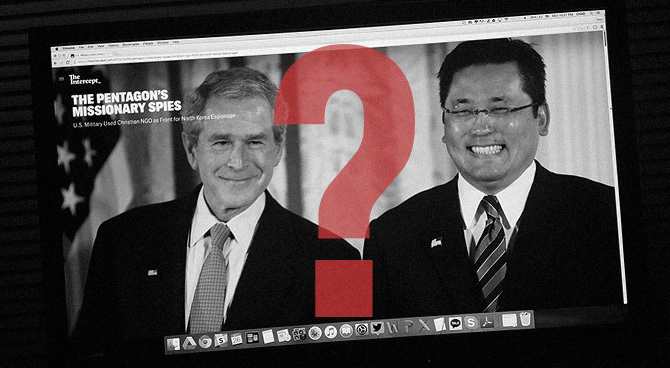

Current and former staff of American not-for-profits with experience in North Korea have expressed doubts about key claims related to a “missionary spies” intelligence-gathering program that surfaced on Monday.
The program, said to have existed from 2004 to 2013, was claimed to have used a now defunct U.S. NGO to smuggle “scores of bibles” into North Korea in order to “test run” a smuggling route on behalf of the Pentagon, online outlet the Intercept reported on Monday.
Benefiting from in-country access facilitated by the Denver-based Humanitarian International Services Group (HISG), the Intercept said the U.S. Department of Defense used the NGO and its network to subsequently “move equipment into and around North Korea.”
But four individuals with direct experience in the oversight and implementation of aid distribution initiatives inside North Korea told NK News on Monday there were reasons to doubt key elements of the story.
BIBLE BURDEN
One source, who wished not to be identified because of ongoing projects inside the country, said it was difficult to believe any NGO could covertly import even bibles into the country, especially those hidden under a shipment of donated clothing, as the Intercept investigation claimed took place.
“Every container entering the country is unpacked by North Koreans, its gone-through by customs, its unloaded, transported and finally delivered directly to the warehouse.
“We don’t see (the aid) until we get there, after all of this has been done, so there’s no physical way to hide stuff,” the source said. “And for that to happen on more than one occasion … is hard to believe.”
‘The North Koreans are so paranoid to begin with that I can’t imagine a shipment of anything from the U.S. getting in without close scrutiny’
The Intercept said that HISG had conducted the bible “test-run” sometime between 2004-2006, conducting two further “humanitarian” trips in 2007 and 2010, though it is unclear if those were directly involved in the secret Pentagon program.
Another American source, who also requested anonymity due to the sensitivities of involvement with in-country projects, echoed suspicions about the plausibility of importing “scores of bibles” into the country.
“The North Koreans are so paranoid to begin with that I can’t imagine a shipment of anything from the U.S. getting in without close scrutiny and even if it did, the first person to discover bibles would have reported it.
“That means all future shipments would have been monitored even more closely,” the source said. “The idea that the U.S. could (subsequently) smuggle in military equipment this way is absurd.”
The first source further added that, “the North Koreans are constantly looking for anything that smells wrong,” with the impact that if bibles were intercepted, “your work would stop immediately – and lots of people would pay a tremendous price.”
However, a third American source with in-country experience noted that at the reported time of the bible “test-run” – between 2004-2006 – security lapses along the border may have allowed for such an import, provided it was brought in by Chinese groups or even unwitting North Koreans.
“At that time there was lots of smuggling going on along the border, things were more porous and there were more corrupt officials,” that source said. “So it wouldn’t have surprised me if some things had gotten in.”
NO RECOLLECTION
Notably, all those who spoke to NK News pointed to one red flag, which is that nobody in the U.S. DPRK humanitarian community had ever heard of the key person in the investigation: Kay Hiramine, the Denver-based founder of HISG.
“I have never heard of HISG or Kay Heramine,” said David Austin, former DPRK Program Director of the Washington, D.C.-based Mercy Corps. “None of my former NGO colleagues had ever heard of this group, nor of Kay Hiramine.”
Hiramine, the Intercept claimed, had played a key role in funneling “millions in funding from the Pentagon” to enable the project, publishing a photo of him in North Korea alongside portraits of late leaders Kim Jong Il and Kim Il Sung.
Yet the lack of knowledge of his activities meant they were either extremely limited or reason for further suspicion, the first source speaking to NK News said.
‘Three trips over several years is completely meaningless’
“I have never heard of this guy, or his organization … and North Korea is a small community. We run into each other, we stay at the same hotels, we (often) go to the same churches.”
The source added that even if Heramine’s three trips had taken place with direct Pentagon involvement, they would have been of limited value.
“Three trips over several years is completely meaningless: You have no relationships, there’s no systems setup, and there’s no transportation network,” the source said.
All that would have made any intelligence gathered by HISG extremely limited, something the Intercept investigation suggests may have been why the intelligence-gathering program was shut down in 2012.
Key questions do, however, still circulate about the mysterious disappearance of HISG just one year later, following what the Intercept highlighted as millions of dollars of revenues in the years prior.
“The article shows the result of what happens when the approach is simply to isolate a country so far that the government has ‘zero’ options left for intelligence gathering that it must enlist a corrupted religious organization for its purposes,” said Austin.
“If the article is true, and missionaries or aid workers were used – against their own knowledge – for military purposes, then it goes without saying that the leadership of HISG lost its humanitarian and religious integrity by selling its services to the Pentagon,” he said, “(meaning) the administration would have put at risk the lives of true humanitarians serving in places like the DPRK, Afghanistan and Pakistan.”
However, Ambassador Joseph DeTrani, who served as the Senior Advisor to the Director of National Intelligence from 2006, told NK News on Monday that he had never heard of the program.
“I have no knowledge of this alleged operation into North Korea. It was my clear understanding that the Intelligence Community would not work with or use NGOs to collect information in North Korea,” De Trani said.
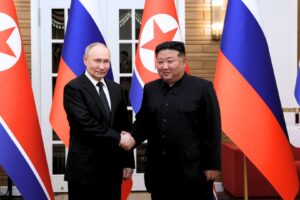
Main picture: NK News photo, featuring portion of AFP photo as rendered at “Theintercept.com” on Monday, October 26
Join the influential community of members who rely on NK News original news and in-depth reporting.
Subscribe to read the remaining 1043 words of this article.
EXISTING MEMBER?


');
newWindow.document.write('
');
newWindow.document.write('