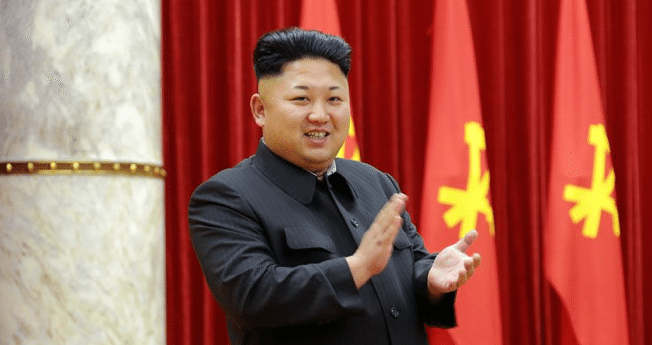

On the 1st of January North Korean watchers are busy: they are studying a New Year speech, delivered by the acting North Korean leader. The tradition is as old as North Korea –technically, it is even older, since the first New Year speech was delivered by Kim In Sung on the 1st of January 1946, well before the formal inauguration of the North Korean state.
Since then, Kim Il Sung always delivered the lengthy New Year speech himself. Only twice, in 1966 and 1970, due to some unknown reasons the tradition was broken, and the speech appeared as a Rodong Sinmun editorial. The speech was to be memorized by nearly all adult North Koreans
Under the watch of Kim Jong Il, the tradition was partially revised. Since the second ruler of the dynasty was remarkable averse to talking in public, the speech was replaced by a joint editorial of three major newspapers. However, with the ascension of Kim Jong Un, the tradition was fully revived in 2012. This year was marked by the fourth speech he delivered himself.
At first glance, the New Year speeches have always been lengthy and, frankly, boring documents, compiled in a dry party jargon. Nonetheless, speeches are studied carefully, both inside and outside the country, since behind the formulistic expressions there are hints at the country’s future and current way of thinking in Pyongyang. This is the reason why the first days of every year are marked by the expert’s efforts to decipher the speech hidden meanings.
CONTENT
Generally, the document followed the established pattern; Kim told about the great achievements of the previous year
So, what is new or important in the 2015 New Year speech?
Let’s start from the speech format. It lasted for 29 minutes, a bit longer than previous ones. Most observers agree that Kim Jong Un behaved with greater confidence than before, even though there are at least four moments when the footage was edited, obviously, to correct some mistake the Supreme Leader made during recording. It also seems that he is less eager to emulate his grandfather’s style and manner of speech.
Generally, the document followed the established pattern; Kim told about the great achievements of the previous year.
The speech moved to the great tasks which should be fulfilled in the new year. As one should expect, Kim Jong Un began with military issues, extolling soldiers to be the protectors of “Leader (that is, himself), Party and People.” Then he talked about science, agriculture, fishing, light industry, mining and heavy industry, tourism and construction.
The order of reference has always been important, since it indicates priorities. By the standards of the Leninist regime that North Korea has emulated for decades, the order is somewhat unusual. Traditionally, top priority was given to heavy industry, with agriculture being perceived as the least important area of the economy. In this speech both agriculture and fishing were mentioned before heavy industry and also described in greater detail.
This changes is not new: last year, the agriculture and fishing also took priority. However, there are some changes in the order of tasks in comparison with the 2014 speech. Remarkably, science and technology now occupy the top of the tasks’ list. It is also remarkable that light industry now is placed ahead of heavy industry – a reverse of last year’s order. Fishing also moved up the priorities’ list, and it is the first time that international tourism made an appearance in the New Year speech.
A TECH FETISH
Thus, the signal the Supreme Leader and his advisors want to send is seemingly clear: The government will pay more attention to the wellbeing of the populace, developing the areas which provide people with food and daily necessities. The high priority allocated to the science and technology might reflect both individual preferences of Kim Jong Un and the “technological fetishism,” a typical feature of the many a Leninist regime, a belief that problems can be solved not by changes in the incentives’ system, but by introduction of some wonder technology. Tourism is another pet project of the Supreme Leader who obviously sees it as a way to earn much-needed currency without executing difficult and, perhaps, politically dangerous reforms.
…it seems more likely that the North Korean decision makers do not want to attract too much attention to the quietly unrolling reforms
For the last two years North Korean government has been quietly and cautiously implementing reforms, rather similar to what China did in the late 1970s. Until recently, the official media remained silent about the changes, but in December Rodong Sinmun mentioned the new system of the agricultural management, which is partially based on the household farming. No such references can be found in the 2015 New Year speech, even though some wording can be interpreted as a signal for greater flexibility. It might mean that the interest in change has waned, but it seems more likely that the North Korean decision makers do not want to attract too much attention to the quietly unrolling reforms which ostensibly contradict much of the official ideology.
The remarks on the economics were accompanied by a rather standard set of the ideological declarations. The North Koreans were extolled to be loyal to the Paektu spirit and two late Leaders, and the party officials were told to work even harder for the people. The doctors and artists also received wise instructions: the doctors and health care professionals were extolled to take care of the people’s health while the writers and others creative workers should, Kim Jong Un instructed, “produce larger numbers of contemporary masterpieces which inspire the masses to further efforts.”
Generally, the part of ideology contained little of interest, and largely confirmed the commitment to the old values and ideas.
A SOUTHERN SPONSOR?
Relations with China are deteriorating, and North Korean diplomats…are looking for other sources of external support
The foreign and South Korean media paid much more attention to the part of the speech dealing with international relations and policy towards South Korea. In this regard the 2015 speech is, clearly, a conciliatory document. Indeed, this might be the most significant part of the entire New Year speech.
It contains some critique of the South, but generally expresses willingness to talk and make compromises. Among other things, Kim Jing Un said that he does not see reasons which would make high-level talks impossible. This statement was made when the South Korean government also made some attempts to improve relations, so in few days’ time the media of both sides began to discuss the prospects of a new North-South summit.
This might be a timely decision. Relations with China are deteriorating, and North Korean diplomats, while pursuing their “Russian dream” (or, should we say, a mirage – Russians will be short-time investors and trade partners, but not sponsors) – are looking for other sources of external support. The South might be a good choice, and this is seemingly understood in Pyongyang now.
So, the 2015 speech produced little surprises. It still indicate that we are likely to see some attempts to improve life of the people by concentrating more on agriculture, fishing and light industry, as well as some efforts for better relations with the South. So far, good – if not revolutionary – signs.
Picture: KCNA
Join the influential community of members who rely on NK News original news and in-depth reporting.
Subscribe to read the remaining 1211 words of this article.
EXISTING MEMBER?


');
newWindow.document.write('
');
newWindow.document.write('