
Over the past two decades, North Korean authorities have struggled hard to keep up Stalinist appearances. Generally speaking, they have succeeded: for the casual short-term visitors can be forgiven for their belief that North Korea is still a Stalinist state. What is on display has not changed much – posters with sadistic U.S. imperialist monsters and muscular shock workers, military tunes booming out of loudspeakers and the pompous Stalinist architecture of Pyongyang being chief among them. However, there are things that officials cannot hide: the booming private economy and its unavoidable result – the growing gap between the haves and have-nots.
Nascent North Korean capitalism has produced significant material inequality. There are many very poor North Koreans, but there are also North Koreans who are quite rich – and not all of them are government officials. Apart from big market venders (whose capital can be estimated as worth hundreds of thousands of U.S. dollars), there are also a large number of successful mid-level entrepreneurs who are not particularly rich, but still make a decent living in North Korea’s informal economy – and whose income is well above nationwide average.
Until the mid-1990s, things were different. Officials were, of course, much better fed, dressed and provided for than the toiling masses. This inequality, though, was relatively modest and, in rare cases when it was not, it remained safely hidden from public view. In the old days, party officials could feast on pork and watch color TVs in their spacious flats, but the average person had no clue about this. Nowadays, the new rich have their own private cars and eat in restaurants where a meal costs the same as the income of the average family – and this is all common knowledge.
Who are the new rich of Pyongyang? Where did they get their money? And how many of them are there? There are no reliable statistics, but we do have ample amounts of anecdotal evidence.
Some of the new rich are officials who have made their money either through straight-up corruption, or managing state companies (which could be considered a form of corruption), but a seemingly larger portion of the new rich seems to be private entrepreneurs who made their fortune during and soon after the desperate days of the 1990s famine.
How rich are the people we are talking about? In monthly income terms, a family with income in excess of $300-400 is clearly affluent by the standards of present-day Pyongyang. Those who income is worth thousands of U.S. dollars are clearly rich.
Most of these people live in Pyongyang, since in a country like North Korea one must maintain good contacts with the bureaucracy in order to be successful in business. There are also some in major cities and towns, especially those close to the border with China. The borderlands provide many opportunities for entrepreneurial, if unscrupulous, business people. Many entrepreneurs are women, even though the seriously rich (with monthly incomes counted in four digits) are overwhelmingly male.
When it comes to consumption, we can find many similarities between these people and the rich and famous in the West (as well as elites in most human societies). The North Korean elite like to consume conspicuously, buying objects that demonstrate their power and wealth. A refrigerator and washing machine might be normal in much of the developed world, but in North Korea they are prestige items. The rich and famous of North Korea sometimes even buy such items not for use, but for show – because frequent blackouts would preclude their regular and correct use. In a sense, a fridge can be prepared with an expensive European sports car on the driveway of an American house.
Another increasingly common sign of luxury is air conditioning. In most cases, people who install air conditioning in their housing have to deal with frequent blackouts. The most common way of doing so is to arrange for the installation of a backup cable that will connect the person to major government institutions or military bases. This means that, in case of a blackout, the rich and successful person can get power from elsewhere.
Of course, household electronics like LCD TVs, rice cookers and Chinese furniture, as well as a computer for kids are other common signs of a prosperous household.
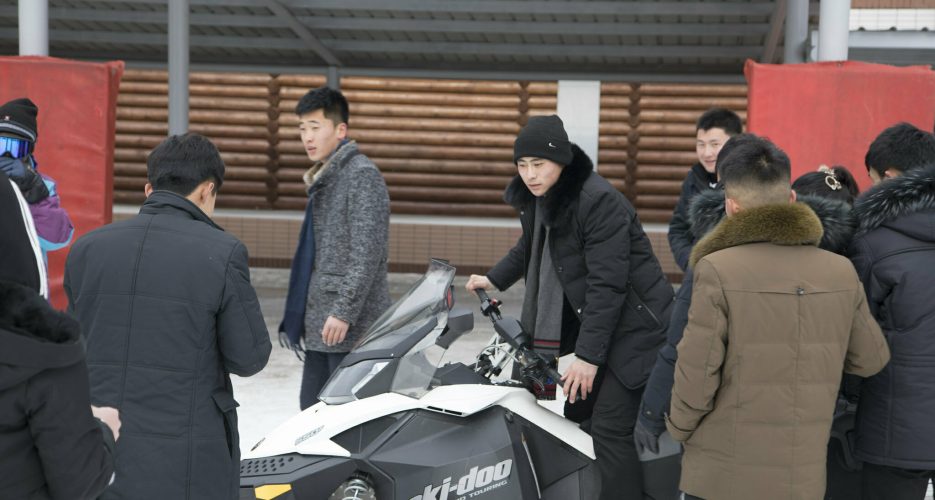
Rich people need wheels too, but in North Korea even a relatively rich household usually only has a good bicycle or motorbike. Privately owned passenger cars are no longer unheard of, but nonetheless remain very expensive and available to just the top 0.1 percent of households. Since private ownership of cars is restricted, most avoid trouble by registering theirs as state property (with an agency that they have connections with). Still, a private car in North Korea is hardly more common than a private jet in the United States (and carries the same connotations about the status and income level of the owner).
Koreans are great admirers of food. Eating out is therefore another favorite pastime of the North Korean rich. A meal at a good restaurant costs around $5-15 per person. For the average North Korean this is impossibly high. Nonetheless, if compared to similar food elsewhere, North Korean restaurants remain remarkably cheap. Most of Pyongyang’s restaurants are crowded nowadays, and therefore a reservation might be advisable.
Leisure travel seems to remain rare in North Korea. I have met some North Korean business people who have visited many parts of their country, but they seem to be an exception. It appears that most rich people in Pyongyang leave their city only if necessary for their business activities, and their trips are of a strictly business nature. Rich people in the countryside, however, make occasional pleasure trips to Pyongyang, which is seen as by far the most prosperous and sophisticated city of the land.
Foreign pleasure trips are still beyond the means of even most affluent North Koreans. If they go overseas, they usually do so not for pleasure, but for business. Only a tiny group of seriously rich persons can occasionally afford to overseas travel for its own sake.
It appears that most of Pyongyang’s wealthy do not care about their fitness and appearance nearly as much as their Western counterparts. As a matter of fact, many have excessive body weight – as was the case with privileged groups in most societies throughout human history. A slightly protruding belly in a malnourished society is another sign of status, an advertisement of one’s success.
Their attitudes toward education are rather Korean though. The last 10 years were marked by the growth of private education in many North Korean cities. The new rich are willing to pay to ensure that their children will do better at school and develop seemingly “useless” artistic skills. The children of the rich are learning English and math, but also music, taekwondo (yes, in this case sport matters) and/or painting.
We also cannot forget real estate. While trade in real estate is technically illegal in the North, many of the rich have begun to buy houses. A large flat in a high-rise apartment complex costs between $10,000-$25,000 in a smaller city, and some $50,000-80,000 in Pyongyang. The very best properties in Pyongyang can cost even more, with prices going so high as $150,000, but such houses are truly exceptional.
So, the Leninist system is well and truly dead in the North Korea of today. For better or worse, the new elite (greedy, industrious, entrepreneurial and ruthless) have taken over and made the most of what they got.
However, this leads us to a difficult question: How will the growth of markets and the emergence of the North Korean bourgeoisie influence the political future of North Korea? This question is more difficult to answer than most people assume.
On the one hand, markets certainly do not seem good for the regime politically. It is not incidental that the North Korean government (like similar regimes in the past) has not yet been willing to embrace the existence of markets.
First, markets are places where rumors and information circulate relatively freely. Until the 1990s, North Korea was a remarkably compartmentalized society: People interacted only with their immediate neighbors and coworkers. Travel was difficult and strongly discouraged. Changing one’s place of residence without government permission was impossible, and most changed jobs rarely – once or twice in their lives at most. As a result, most of what was known about the world came from official media, and the average person’s life experiences were extremely limited.
Markets are different. These are places where people can obtain much more accurate information about the outside world, including events never discussed in the official media. This is a place where one can hear stories about the prosperity of other countries, including China and South Korea. This is also a place where foreign DVDs and other subversive digital materials can be acquired, with proper discretion of course.
Second, the market economy itself is an anathema to the official worldview. In Kim Il Sung’s North Korea, one’s income and social standing usually depended on positions within the official hierarchy. The authorities determined the value of an individual. The old system rewarded not so much labor efficiency (let alone initiative), but rather ideological zeal. This is clearly not the case with markets, where one’s ability to memorize the lengthy speeches of the Kim currently in power does not count for much.
It is also significant that the growth of the market has demonstrated to North Koreans that they do not have to rely on the state for their survival. For decades, North Koreans survived on the meager but heavily subsidized rations from the state. Now the North Korean market economy is a viable alternative way of making a living.
Nonetheless, things are not as simple as they might appear. Certainly, North Korea’s market “forces” are often skeptical about the regime and its ideology. They do not have good reason to be supportive of a revolution either, though.
If regime collapse occurs in North Korea, the likely outcome is unification with the South – i.e. the absorption of North Korea by its far more successful twin brother. Many common North Korean people might welcome this. However, North Korea’s nascent entrepreneurial class (especially its more successful element) has good reason to have some reservations about the possible triumph of a North Korean revolution.
It is often overlooked that North Korea’s more successful traders share a crucial interest with the bureaucrats they despise – both bureaucrats and successful traders would like the North Korean state to remain separate rather than being swallowed by the South.
This might sound rather counterintuitive given the amount of Stalinist red tape that exists in North Korea at present. However, a collapse will also probably include unification. And in the event of unification, South Korean businesses will probably move into the North. This is not a good news for the North Korean businesses, since no amount of local knowledge, ruthlessness and acumen will help North Korean entrepreneurs compete with the expertise, technology, connections and vast amounts of capital of South Korean companies.
A North Korean currently running a few sweatshops, in which a few dozen girls are stitching cheap imitations of Chinese clothes, has some chance of becoming the head of a North Korean chaebol (or family-owned conglomerate), if North Korean capitalism remains intact. This is, after all, how the chaebol in South Korea came into existence. However, such people must be shielded from South Korean capital, because without such protection, he/she (many North Korean entrepreneurs are women) will stand no chance.
Of course, it is an open question whether these people understand the risks associated with regime collapse and unification. For many of them, bribe-hungry party bureaucrats constitute a greater threat than South Korean CEOs. However, business people across the globe are known for their guile. I would therefore not be surprised to learn that some of them already understand that they might be in the same boat as the party apparatchiks.
Join the influential community of members who rely on NK News original news and in-depth reporting.
Subscribe to read the remaining 2011 words of this article.
EXISTING MEMBER?


');
newWindow.document.write('
');
newWindow.document.write('