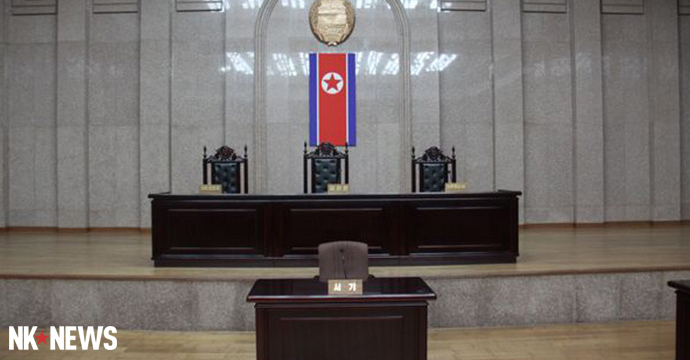

WASHINGTON, D.C. – NK News has obtained exclusive images showing the inside of the North Korean Supreme Court where Kenneth Bae—who is currently serving a 15-year “hard labor” sentence in North Korea—was tried.
“The DPRK Supreme Court held a trial of Pae [Kenneth Bae] at its court behind closed doors on Apr. 30, 2013 at his request in accordance with Section 270 of the DPRK Criminal Procedure Law,” a KCNA dispatch released on May 9 said. “As he refused pleading, the court did not allow the presence of a counsel, pursuant to Section 275 of the above-said law.”
“In the course of hearing [Kenneth Bae] admitted all his crimes and they were clearly proved in an objective manner by evidence and testimonies made by witnesses,” the article continued.
But it’s not just Kenneth Bae who has been tried in this court.
Among the list of other American defendants who have been sentenced there are Laura Ling, Euna Lee, and Aijalon Gomes. Robert Park, Young-su Jun, and Willem van der Bijl apparently never formally stood trial or their trial was not officially reported by KCNA.
COURT FUNCTIONS
The Supreme Court supervises all the lower courts and their proceedings. It is unclear, however, how busy the court is or what kinds of cases dominate its docket. The DPRK’s official media and other publications have only reported the well-known cases of foreigners mentioned above. Other case information remains largely unknown.
It is likely, however, that the North Korean court system plays little role in maintaining public order. The Ministry for State Security and the Ministry for Public Security at various administrative levels seem to handle the bulk of criminal sentencing and administration.
In surveys of North Korean defectors carried out by Stephan Haggard and Marcus Noland, only 13% of respondents reported any sort of trial or administrative hearing at all before they were incarcerated.
The Presidium of the Supreme People’s Assembly has the official power to elect and transfer judges of the Supreme Court.
The current President of the Supreme Court, historically known as the Chief Justice, is Kim Pyong Ryul. He has held this post since 1998. A full biography of his life can be found in the NK Leadership Tracker
NEW BUILDING
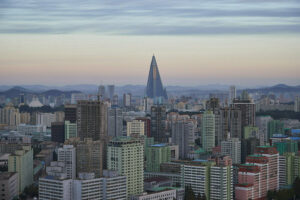
The Supreme Court received a new office building which was constructed between 2006 and 2009 in Mangyongdae District. The court’s previous location is believed to be in Pyongyang’s Central District.
Kim Jong Il visited the new building in January 2010, and sometime between April 7 and November 11 the organization’s name changed from the Central Court (중앙재판소) to the Supreme Court (최고재판소).
Though the reason and meaning for the name change were never announced in KCNA, Kim Jong Ils’ vision for the court system was:
At the end of his visit to the court he set forth on the spot important tasks which would serve as guidelines for further consolidating the socialist system in the DPRK by strengthening the education in the observance of law.
He noted that the socialist law in the DPRK serves not only as an effective means for promoting the revolutionization and the working-classization of all members of the society and giving strong impetus to the socialist construction but also as a powerful weapon for performing a great function to organize and mobilize people for economic and cultural construction.
Thanks to the strict enforcement of the Socialist Constitution under the WPK’s leadership a revolutionary system and order have been firmly established throughout the society, the three revolutions, ideological, technical and cultural, made dynamic progress, further augmenting the nation’s political, economic and military potentials and the sovereign rights of the working masses have been most firmly protected, he said, adding that the reality clearly proves the advantages and vitality of the socialist legislative system in the DPRK.
He underscored the need to steadily consolidate the state social system in the DPRK by further strengthening the observance of the socialist law as required by the Socialist Constitution and bring earlier the complete victory of socialism and the cause of building a thriving nation.
In order to strengthen the observance of law for enforcing the socialist law it is important to increase the function and role of the judicial organ, he noted, underlining the need for the officials in this field to strictly abide by the principle of loyalty to the Party, to the working class and to the people in enforcing law.
He expressed expectation and conviction that the judicial organs including the Central Court would firmly protect the interests of the state and people and their lives and properties by law with a high sense of responsibility and thus give full play to the might of the most revolutionary and popular and fair and aboveboard law in the DPRK.
Below are additional images of the interior of the Supreme Court building:


Additional reporting by James Pearson in Seoul. All images: NK News
Join the influential community of members who rely on NK News original news and in-depth reporting.
Subscribe to read the remaining 820 words of this article.
EXISTING MEMBER?


');
newWindow.document.write('
');
newWindow.document.write('