
Several sources have revealed to NK News that the DPRK is building a new headquarters for the Central Bank in Pyongyang.
Historically the Central Bank has occupied an important role in the official economy of the DPRK.
At the national government level, the central bank holds the won accounts for every state-owned enterprise (foreign currency is managed by the Foreign Trade Bank, a separate organization). It is responsible for ensuring the funds designated in the national budget are allocated for the correct uses. It is responsible for managing all official account transfers between state-owned enterprises.
The central bank is also responsible for providing loans to state-owned enterprises should operating or investment capital above the level allocated in the national budget be required.
Additionally, the central bank is required to provide cash to all state-owned enterprises for the payment of wages to workers once a month.
Finally, the Central Bank is responsible for administering local budgets as well as managing retail level banking services (savings accounts) for DPRK citizens.

Numerous planned and unplanned circumstances have reduced the importance and status of the central bank over time:
The August Third Consumer Goods Production Movement [1984] encouraged individuals and state-owned enterprises to produce (and retain earnings) outside the economic plan.
- The “Arduous March,” a period of economic collapse and food shortage that killed between 500,000 and a million people, led to a grassroots marketization and increased economic transactions taking place outside the formal economy.
- The July 1 [2002] economic measures brought many of these economic activities back into the official economy, though it formalized new economic transactions that reduced the importance of the national budget and central bank to state owned enterprises.
- Today many formal and informal (de facto privatized) organizations are accumulating local and foreign currency directly from their customers which they can retain or direct without the approval or oversight of the cabinet or Central Bank.
Though the importance of the Central Bank to the national economy has declined, the new headquarters is a substantially larger building. Does the new building capacity imply new responsibilities or a new vision on the part of economic policy makers for the role of the Central Bank? We don’t know.
Though KCTV has occasionally highlighted upgraded central bank offices in distant localities (now with computers!), DPRK official media has yet to comment on the status or current location of the Central Bank headquarters in Pyongyang.
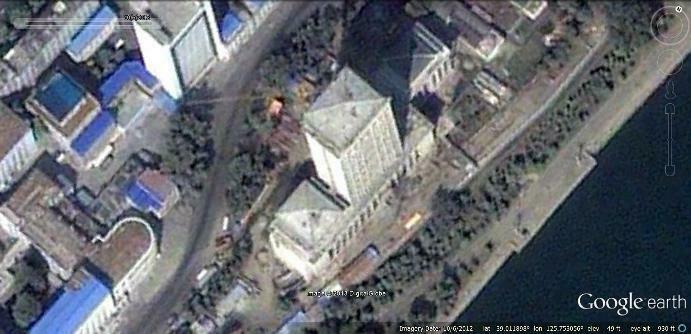
Satellite imagery indicates that construction of the new building began sometime between October 6, 2010 and April 10, 2011:
The site of the new Central Bank was previously dominated by greenhouses.
The Central Bank was previously located near the current site of the People’s Theater in the newly constructed Mansudae/Changjon Street Area (aka “Dubai”). It was torn down sometime between April 10, 2011 and September 22, 2011:
It unclear from where the Central Bank has been operating since its original building was torn down. It is also unknown when the new Central Bank building will be completed.
Images: Google Earth
Join the influential community of members who rely on NK News original news and in-depth reporting.
Subscribe to read the remaining 491 words of this article.
EXISTING MEMBER?


');
newWindow.document.write('
');
newWindow.document.write('