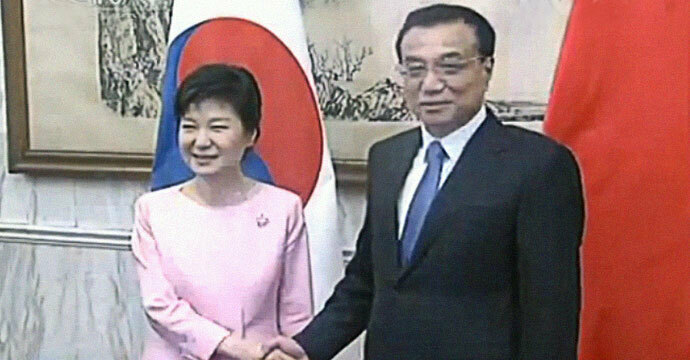
SEOUL – China and South Korea released conflicting statements regarding the denuclearization of North Korea, despite both sides using rhetoric that indicated Seoul and Beijing had reached consensus on the issue.
Park returned to Seoul on Monday morning after a long weekend of bilateral meetings with Chinese counterparts that were widely believed to have been dominated by discussion of North Korea’s nuclear weapons program.
“Li Keqiang said China is against North Korea’s possession of nuclear weapons, and wishes for a firm stance on the denuclearization of the Korean peninsula, something he said China would like to solve through the use of talks and negotiation,” a statement released by the Blue House on Friday said.
Chinese state media coverage of the same meeting, however, did not quote Li as explicitly referring to the North, instead implying China did not shift from its basic message of “peace and stability” and the “denuclearization of the Korean Peninsula”.
“Li Keqiang said that China has remained firm, clear and consistent on its position that the Korean Peninsula should denuclearize. China is determined to maintain peace and stability on the peninsula and hopes to collaborate with the international community through the use of dialogue and consultation to resolve the issue,” Xinhua news reported the Chinese Premier as saying.
CONFLICTING STATEMENTS
South Korean media coverage before the trip speculated that Park would try and achieve consensus on the denuclearization of the North Korean nuclear weapons program.
The apparent ‘altering’ of Li’s statement by the Blue House is a “considerable problem,” Moon Chung-in, Yonsei University professor and former North Korea advisor to Roh Moo-hyun, told NK News in Seoul.
The Chinese government has, however, agreed on North Korean denuclearization in private, then referred to denuclearization of the “entire peninsula” in the past.
“[Xi and Obama] agreed that North Korea has to denuclearize; that neither country will accept North Korea as a nuclear-armed state; and that we would work together to deepen U.S.-China cooperation and dialogue to achieve denuclearization,” a White House statement following a meeting between the U.S. and Chinese presidents said last month.
“The Chinese version of events again shows that they are pursuing their own national interests,” Sohn Kwang-ju, Director of the Daily NK Unification Strategy Center told NK News.
But whether Beijing refers to “denuclearization of the peninsula,” or “North Korean denuclearization” is more semantics than substance, Yonsei University professor John Delury argues.
“The really important point is what Beijing says about the means toward the goal of denuclearization: dialogue and cooperation. Not sanctions and isolation,” Delury told NK News via email.
KCNA STATEMENT
North Korean state mouthpiece the Korean Central News Agency (KCNA) released an article directly attacking Park Geun-hye for “provocative” comments made during her China trip that “damaged the dignity of the DPRK.”
“Park should understand that the DPRK’s nukes are a shield for justice and peace, and a national treasure that can never be a bargaining chip or subject on the negotiating table, regardless of how vehemently the puppet group –– who are war servants of the U.S –– may talk about them.
“Even a child knows that the nuclear threat on the Korean Peninsula comes from the U.S. and South Korea,” the statement said.
North Korean chief nuclear negotiator Kim Kye Gwan, however, is set to meet Russian deputy foreign ministers Vladimir Titov and Igor Morgulov next Thursday for discussions that are “part of efforts to resume the six-party talks,” the RIA Novosti news agency reported a Russian foreign ministry statement as saying on Monday.
Additional reporting by Subin Kim in Seoul. Headline image: CCTV.
Join the influential community of members who rely on NK News original news and in-depth reporting.
Subscribe to read the remaining 601 words of this article.
EXISTING MEMBER?


');
newWindow.document.write('
');
newWindow.document.write('