
WASHINGTON D.C. – A North Korean “drone strike” made headlines in March when KCTV footage of Kim Jong Un watched drills of the unmanned aircraft in a location NK News can now exclusively reveal as the Taewon-ri firing range.
Though the Korean People’s Army (KPA) has many demonstration and practice areas, the facility in Taewon-ri, Sadong-guyok, [대원리, 사동구역] is the most frequently used by the new general to demonstrate his effectiveness as a military leader in a time of rising international tensions.
The Taewon-ri demonstration area is located in the South Eastern corner of Pyongyang (38.947981°, 125.915947°):
The South Korean Ministry of Unification recently released a report analyzing the composition of Kim Jong Un’s inspection tours in his opening year as first secretary of the Korean Worker’s Party. Of Kim’s 192 official activities, the greatest percentage of his visits, 38%, were focused on the military. The remainder were political and economic.
Kim Jong Un’s first known visit to the Taewon-ri demonstration site took place on April 27, 2012 to observe KPA Combined Unit 655. By the first three months of 2013, however, Kim Jong Un had visited this area at least three times. His first visit on February 21st was to oversee maneuvers by a Sub-unit under KPA large combined unit 526. His second visit was to observe an artillery firing drill four days later on the 25th, and his third visit a month later on March 20th was to observe the DPRK’s first known public test of its self-proclaimed “super precision drone planes”.
The main observation building (38.948016°, 125.916006°) sits on top of a hill approximately 111m (366 ft) high. The building is approximately 2.7km (1.68 miles) north of the target areas which are drawn onto the side of the Jeryong Mountains [제령산]. The practicing artillery units are placed at lower elevations around the hill.
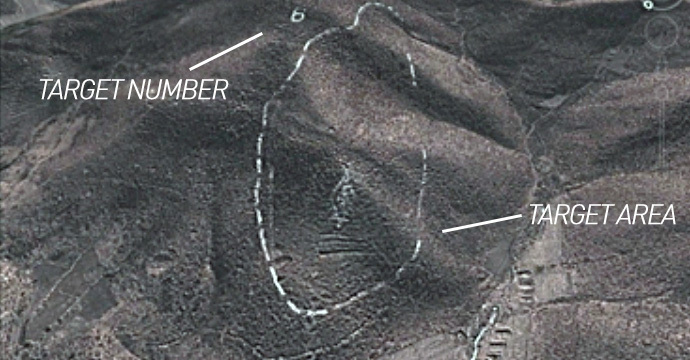
The target areas (numbered 1-8) are drawn along the geographic contours of the mountain to present specific shapes. Targets six and seven would have been seen as circles by Kim Jong Un in the observation building, though their actual shape is much more convoluted:
Pictured above: (top) target area No. 6 as seen on KCTV from the main observation building; (bottom) target area No. 6 on Google Earth (38.923012°, 125.936490°).
Taget areas 1, 2, and 3 appear to be shaped like specific administrative regions, although what regions they represent remains unclear.
Pictured above: Target No. 2 (38.924168°, 125.917012°) staggered along three folds in the mountain.
To the west of the main observation building is a small staging area where viewers or artillery and other equipment can be arranged (38.947363°, 125.913372°).
When Kim Jong Un attended the KPA artillery drill in February, rocket-propelled explosives were fired from this location towards target number 6—a distance of approximately 2.86km (/1.78 miles). In a publicly released video, the KPA projectiles hit their intended targets (although the accuracy of the weapons could have been easily enhanced during the editing process).
It was also from this clearing that the DPRK’s first known public test of an unmanned aerial vehicle (UAV), or “super precision drone planes” as the DPRK’s official news agency referred to them, took place. The capabilitues of these “drones” remains largely a mystery since the still shots and edited video did not reveal much information as to their firepower or technical capabilities.
According to footage broadcast by KCTV, three “drones” were launched. The first attacked target No. 6 (approximately 3.16km [1.96 miles] in a straight line from the launch site). The second and third UAVs appear to have been destroyed in an exercise designed to demonstrate anti-aircraft capabilites.
The most detailed images, available online, of the DPRK’s UAVs was taken by the Associated Press (AP) at the military parade honoring the 100th birthday of Kim Il-sung on April 15th, 2012.
To the west of the hilltop observation building and staging area are facilities believed to be the original open air observation stand (constructed before the hilltop observation building), although this is impossible to verify with the currently available satellite imagery. Kim Jong Un recently used this area to have his photo taken with the soldiers that participated in the artillery demonstration.
Heading south from this area is a road that links the KPA testing grounds directly to a luxurious leadership housing compound. Strangely, however, the housing compound lies directly on the other side of the mountain range that serves at the target area for the Taewon-ri testing grounds, placing the leadership housing compound unusually close to the target area of a live firing range.
Using publicly available satellite imagery, it is not possible to determine whether this compound was constructed before or after the artillery testing grounds.
Having shown some of the capacities and uses of the Taewon-ri demonstration area in recent months, it is safe to say that if tensions between the two Koreas continue to remain high, we can expect to see more tests at this facility and others like it throughout the year.
With the effective closing of the Kaesong Industrial Zone, the North Korean leadership may continue to use such tests and demonstrations as a signal of its continued displeasure with the passage of bilateral and multilateral sanctions and ROK-U.S. joint military exercises. If tensions begin to cool, however, it is possible we will not see this facility being used for some time.
Join the influential community of members who rely on NK News original news and in-depth reporting.
Subscribe to read the remaining 867 words of this article.
EXISTING MEMBER?


');
newWindow.document.write('
');
newWindow.document.write('