
|
News North Korea lashes out at US, UN watchdog for demanding denuclearizationVienna mission insists country’s nuclear status is ‘irreversible’ and necessary to counter US ‘nuclear threat’
 North Korea lashed out at the U.S. and the U.N. nuclear watchdog over their push for Pyongyang’s denuclearization on Monday, insisting its nuclear status is “irreversible” after the International Atomic Energy Agency (IAEA) raised concerns about continuing enrichment activity. In a press statement carried by the Korean Central News Agency (KCNA), the DPRK mission in Vienna accused Washington of a “grave political provocation” for calling its nuclear access “illegal” and repeating its “anachronistic denuclearization assertion.” “We strongly denounce and reject the U.S. provocative act of revealing once again its invariable hostile intention against the DPRK while openly interfering in its internal affairs and infringing upon its sovereignty and express serious concern over the negative consequences to be entailed by it,” the statement said. The mission claimed North Korea’s nuclear weapons help “guarantee global peace and stability” by countering “the U.S. persistent nuclear threat.” It added that the U.S., as “the world’s biggest nuclear weapons state,” is the one who undermines the nonproliferation system by building up its arsenal. According to the latest estimates, Russia has the world’s largest nuclear arsenal with 5,580 warheads, followed by the U.S. with 5,225 and China with 600 warheads. North Korea’s statement appeared to come in response to remarks by Howard Solomon, chargé d’affaires of the U.S. mission in Vienna, who called the DPRK’s nuclear program unlawful and said its weapons of mass destruction and ballistic missiles “pose a threat to the U.S. … and undermine security in the region.” He reaffirmed Washington’s commitment to the “complete denuclearization of North Korea.” The DPRK also chastised the IAEA for trying to “call into question and deter the just exercise of the sovereign rights” of North Korea, accusing the agency of “losing its independence and impartiality and disregarding the realistic and practical U.S. nuclear threat.” The statement stressed that North Korea’s status as a nuclear state is “irreversible” since it is enshrined in its constitution, warning the IAEA not to interfere in its internal affairs. Last Tuesday, IAEA chief Rafael Grossi kicked off a Board of Governors meeting by voicing “serious concern” over the DPRK’s enrichment facilities at Kangson and Yongbyon. He said Pyongyang likely continues to run its 5MWe reactor at Yongbyon in its seventh cycle and pointed to signs that its light water reactor “continued in stable operation, except for a one-month shutdown observed in April 2025.” “Since late January 2025 indicators have been observed at the Radiochemical Laboratory consistent with reprocessing of irradiated fuel from the reactor’s sixth operating cycle,” he said. “These indicators include an almost continuous operation of the steam plant serving the laboratory.” Grossi added that the agency is monitoring “the construction of a new building at Yongbyon which has dimensions and features similar to the Kangson enrichment plant.” 

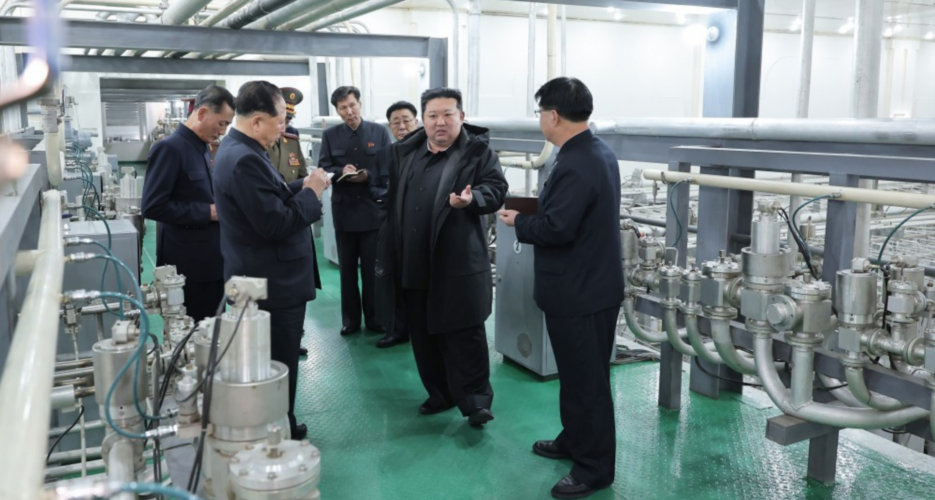
NK Pro previously reported that storms and mudslides may have led the DPRK to demolish structures inside the northern wall of the compound in late July. Planet Labs satellite imagery from Sept. 13 shows the wall has since been restored and that additional construction has taken place, although the facility still appears incomplete. Grossi repeated his June assessment of the Punggye-ri nuclear test site, stating that the IAEA has observed no significant changes and that the site “remains prepared to support a nuclear test.” He once again stressed that the DPRK’s nuclear program is a “clear violation of relevant U.N. Security Council resolutions” and “deeply regrettable,” while highlighting the agency’s readiness to play “its essential role in verifying the DPRK’s nuclear programme.” The back-and-forth came as DPRK leader Kim Jong Un announced plans to unveil a new policy to boost nuclear and conventional capabilities during inspections of the country’s armored and electronic weapons research hubs last week. Edited by Bryan Betts © Korea Risk Group. All rights reserved. |


 SHARE
SHARE COPY LINK
 X
X MASTODON


Recent Stories