
|
News Ryoo Kihl-jae, former South Korean unification minister, dies at 61Ryoo served as unification minister during a tumultuous time for inter-Korean relations and routinely pushed for talks
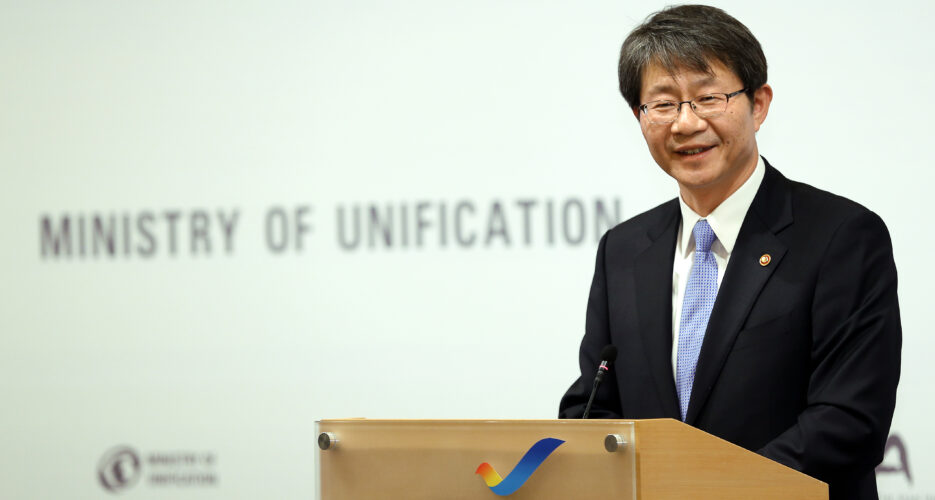 Ryoo Kihl-jae, who served as South Korea’s Minister of Unification (MOU) from March 2013 to March 2015, passed away from cancer in South Korea on Saturday. He was 61. Ryoo oversaw MOU duties at a tumultuous time for inter-Korean relations, but his career still included several rounds of dialogue with a range of senior North Korean interlocutors. In 2013, the world saw a significant spike in tensions as Kim Jong Un apparently sought to size up the newly elected Park Geun-hye administration, resulting in a nuclear test in February of that year. Ryoo was appointed just a month later, beginning ministerial duties on March 11 amid heightening North Korean threats, which culminated in Pyongyang’s unilateral shutdown of the Kaesong Industrial Complex (KIC) in April 2013. But under his leadership, subsequent inter-Korean talks resulted in the reopening of the KIC by September and a restoration of an inter-Korean military hotline shortly thereafter. Ryoo also led the ministry’s “Korean Peninsula Trust Process” and told a delegation of senior North Korean officials about it while visiting the ROK for a sporting event the following year. “In 2014, when North Korea’s top three – Kim Yang Gon, Hwang Pyong So and Choe Ryong Hae – came to South Korea to attend the closing ceremonies of the 17th Asian Games in Incheon, I had a conversation with Kim Yang Gon in the car we were both in,” Ryoo said at an event after his post as minister wrapped up in early 2015. “I told him, as the Unification Minister of the South, that my goal was to bring back inter-Korean relations previous to the July 11, 2008 incident – the day when Park Wang-ja was killed,” he had said. Ryoo was referring to the death of a South Korean woman who was shot and killed by a North Korean soldier in the Mount Kumgang tourism zone — an event now considered by many as the trigger of the end of inter-Korean cooperation under the prior Lee Myung-bak government. While talking to his DPRK colleagues, Ryoo said he tried to expand conversation about a broader inter-Korean vision, too. He recalled telling Kim that, “as soon as we can, we would have to resume tourism to Mount Kumgang,” latter adding that “on more solid future grounds, based on improved relations, South Korea would like to launch the ‘Korean Peninsula Trust Process,’ and take other step-by-step measures to further improve relations.” However, Ryoo at the time had said that the late Kim Yang Gon, director of North Korea’s United Front Department, did not respond with any thoughts on his suggestion. Reflecting back on his experience in serving a conservative-leaning ROK President as the minister of unification, Ryoo once lamented the way some of his efforts were perceived. “The moment I talk of having dialogue with the North, I would be branded as ‘progressive,’” he said in 2016. “In the South Korean political frame such as the one that we are currently in, it is very hard to speak of rational solutions to these problems.” Nevertheless, Ryoo tried his best to establish a pragmatic basis for talks. “It is known that Ryoo consistently flagged the importance of informal contact with the North, such as dispatching an envoy from then President Park, but his vision was never realized,” Yonhap News Agency wrote about his career on Saturday. After the scandal that eventually sank the Park Geun-hye government, Ryoo was also one of the first to apologize to the general public via a Nov. 2016 public Facebook post. In addition to his government work, Ryoo also served as a professor and senior researcher at Seoul’s University of North Korea Studies. One of his former colleagues, Dean Oulette – Director of International Affairs at the Institute for Far Eastern Studies in Seoul, said that Ryoo was “highly respected” by colleagues and “would be missed”. “As a scholar, former minister Ryoo played an instrumental role in the university’s international academic partnerships, in particular as a guiding force for and key contributor to our North Korean archival research and Cold War critical oral history projects with the Woodrow Wilson International Center for Scholars during the early years of those endeavors,” he said. Another colleague agreed he would be missed. “He was a scholar and a leader who tried to open a new dialogue channel both with domestic groups and interKorean side,” said Yoo Ho-yeol, who teaches North Korean studies at Korea University and formerly advised South Korea’s unification ministry and defense ministry. ”An expert in North Korean domestic political institutes and organizations, he was open to challenging ideas and competing arguments,” Yoo continued. ”I am missing him very much at this particular time when leftists are driving hard only in pursuit for legetimizing their own dogmatic doctines or wishful dreams.” As of Monday, the MOU had not issued any public statement about Ryoo’s death. However, his passing was confirmed to NK News by former colleagues and also reported in South Korean media. Jeongmin Kim contributed to this report. © Korea Risk Group. All rights reserved. |


 SHARE
SHARE COPY LINK
 X
X MASTODON

Recent Stories