
|
Expert Surveys Kim Jong Un to host Xi Jinping for their first Pyongyang summit: experts reactWhat's on the agenda for the fifth Kim-Xi summit, and how will denuclearization talks be affected?
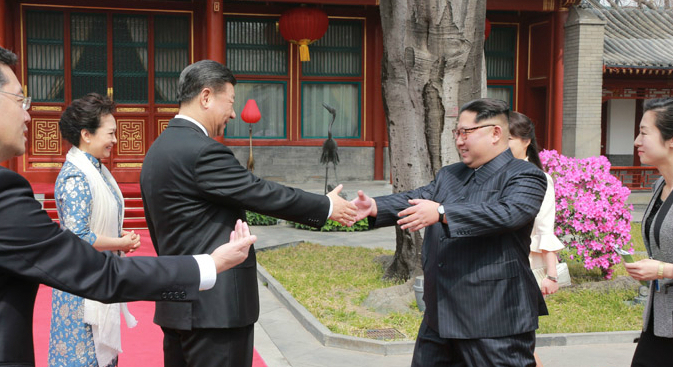 Chinese President Xi Jinping is set to hold his first summit with North Korean leader Kim Jong Un in Pyongyang later this week, following four meetings between the two in China since March last year. During each of Kim’s previous visits to China, the two sides have emphasized their strong bonds and promised to enhance cooperation in areas from the economy to cultural exchanges, and various other government-level exchanges. A Chinese spokesperson said Monday when announcing the latest trip that the two leaders would once again focus on boosting economic, cultural, and other exchanges, in addition to the “situation on the Korean Peninsula.” Coming amid a flurry of other summits – with Kim holding his first summit with Russian President Vladimir Putin in late April, Xi and Putin meeting earlier this month, and Xi set to meet both the U.S. and South Korean presidents later this month – this week’s summit is also bound to impact both North Korea’s domestic policy and ongoing denuclearization talks. So what has led the two leaders to finally meet in the North Korean capital, how will this summit be different, and how will it affect the ongoing stalemate in negotiations with the U.S. and South Korea? The following experts responded in time for our deadline:
 Why do you think Xi has finally decided the time is right to visit Pyongyang, and what can possibly be accomplished that couldn’t with another Kim visit to China?
Alison Sinead Evans: North Korea has sought additional summits, with China, Russia, South Korea, and the U.S., since the Hanoi summit in February ended early and without an agreement. Last week South Korean President Moon Jae-in said he hoped to meet North Korean Supreme Leader Kim Jong Un again before U.S. President Donald Trump’s proposed visit to Seoul at the end of June. However, all previous North Korea-South Korea summits have been preceded by a China-North Korea summit, likely due to the allies’ intention to share certain information, co-ordinate, and at least maintain the image of a close relationship. Similarly, this upcoming summit will be a key communication opportunity before Chinese President Xi Jinping attends the G20 summit in Japan on 28-29 June.
The Kim-Putin Vladivostok Summit did not enable Kim to extract substantive positive concessions from Russia, thus leaving North Korea with no choice besides the U.S. and China. The visit to Pyongyang is largely China’s geopolitical calculation in order to gain an upper-hand in the current U.S.-DPRK diplomatic impasse.
A state visit to Pyongyang, which has been quite rare for a Chinese leader since the Arduous March, is a stronger signal than merely once again welcoming Kim Jong Un in Beijing, and it reminds Trump that Chinese cooperation on the DPRK is crucial and that the trade war against China is counter-productive.
The North Korea-Russia summit is over. Pyongyang has little room for maneuver with Washington and Seoul. North Korea needs China but doesn’t want to highlight its dependence on China; China wants to stay in the diplomatic fray and show that it is pivotal to the process. Xi finally visiting Pyongyang might have been the only feasible way for both sides to meet these interests at the present time.  What do you think might be Xi’s agenda for the meeting, and what might the North Koreans be hoping to achieve?
Alison Sinead Evans: This summit is likely to cover similar topics to meetings in 2018, including economic cooperation, peace, and the “denuclearisation” of the Korean peninsula. Although trade remains constrained by United Nations Security Council sanctions strengthened in 2016 and 2017, China is likely to offer some humanitarian assistance to North Korea.
North Korea may request for more aid in light of the food situation as reported to the FAO, and the relief items crucial for the completion of Kim’s mega projects like the Wonsan Kalma tourist resort and the large-scale development plans in Sinuiju and Samjiyon, which are delayed by sanctions. Another area could be science and technology development in North Korea, as Kim Jong Un intends to strengthen this field in order to elevate Pyongyang’s livelihood standard and also as another means to bypass sanctions.
On the North Korean side, it is of course a boost in Kim Jong Un’s political and diplomatic prestige: once again, visits by Chinese leaders have been rare in recent years. However, North Korean policy-makers are smart enough to see that Xi’s move is aimed at the U.S. and that promises on economic engagement might be nothing more than a diplomatic bluff. I think that Pyongyang will be pretty irritated to be once again used as a pawn in the U.S.-China rivalry, but they will also see opportunities in using this seemingly conciliatory Chinese policy to pressure South Korea and the U.S. into more flexibility to move the denuclearization talks, and especially promises of economic engagement, forward.
Ideally for Kim, this will demonstrate he has strong regional backing for his priorities without creating an impression of great dependence on Beijing.  What can Xi offer in terms of expanding economic cooperation, despite being party to UNSC resolutions?
Xi’s offer will come with conditions attached, given Kim’s tendency in diplomatic forays such as his outreach to Russia after Hanoi without clear indication of communication with Beijing before the move. These kinds of actions show that Kim is yet to settle on the fact that China is North Korea’s sole security and economic provider. However, there is no reason for Xi not to offer any form of further sanctions relief and provide energy and financial assistance to North Korea, as this would increase China’s leverage over the peninsula.
A more or less explicit nod by Xi Jinping to a North Korean Special Economic Zone, the announcement of a new factory being jointly developed, or even economic or humanitarian assistance could be mentioned, for instance. Following the visit, I would not be surprised to see the Chinese business community in the borderlands being bolder in its sanctions-busting, interpreting the visit as tacit approval from Beijing.
 How will the summit’s timing affect the current impasse in DPRK-U.S. nuclear negotiations?
Progress in talks between North Korea and the U.S. most likely depends on the Trump administration deciding to alter its ‘all-or-nothing’ negotiating position on “denuclearisation” in exchange for sanctions relief adopted at the Hanoi summit.
Of course, there are other reasons for this visit as well. Xi seeks to enhance China’s influence on the Korean Peninsula and strengthen bilateral ties on the 70th anniversary.
As Bolton has confirmed that a third U.S.-DPRK summit is “entirely possible,” Xi may want to make sure the next step in denuclearization talks by both the U.S. and North Korea will not harm China’s interests.
If he can convey what the U.S. can do to get North Korea to make concessions on its nuclear program, then U.S.-North Korea diplomacy can be resurrected.
If Pyongyang plays it well, however, they might not only be able to boost economic cooperation with the Chinese side but also, in reaction, negotiate a more conciliatory attitude from Seoul, which clearly does not need China-DPRK ties to grow stronger. As for the U.S., if Donald Trump is the great dealmaker he claims to be, he’ll know that it is not the time for Washington to convene a third summit with Pyongyang, as clearly Kim Jong Un not only ignores economic pressure but also keeps making diplomatic progress with rivals of the U.S. such as Beijing and Moscow.
Another related, but more distant possibility is that being able to show the leader of China came to Pyongyang will garner Kim Jong Un some much-needed domestic political space after Hanoi, allowing him to take a risk on some sort of new diplomatic gesture to the United States or South Korea. Edited by James Fretwell Featured image: KCNA © Korea Risk Group. All rights reserved. |


 SHARE
SHARE COPY LINK
 X
X MASTODON




Recent Stories