
|
Expert Surveys Kim Jong Un’s New Year’s speech: experts reactNorth Korea watchers weigh in on what to make of the DPRK leader's annual address
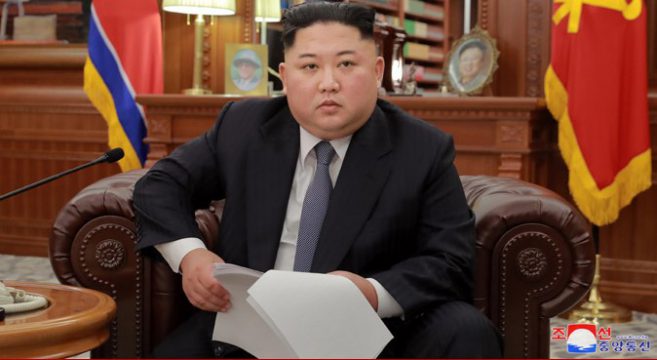
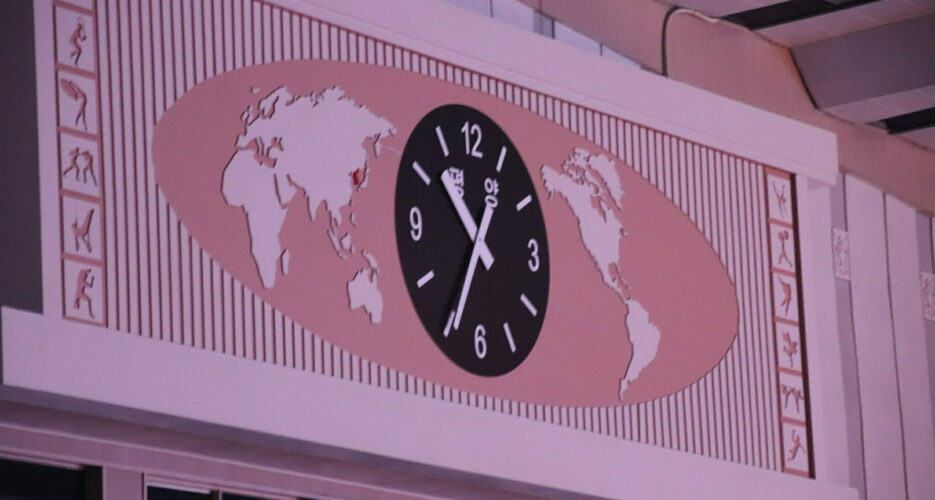 Kim Jong Un delivered his much-anticipated New Year Address for 2019 early Tuesday morning to fellow North Koreans tuning in to hear how the country’s strategy and policy might shift in the coming year. But as the DPRK finds itself in the midst of stalled negotiations with the U.S. and surprisingly constant progress in improving relations with South Korea, experts stationed outside the North also tuned in seeking signs of how things may play out on the international stage in 2019. In his speech, Kim made his first explicit request for a second summit with U.S. President Donald Trump, and while criticizing sanctions and cautiously signaling impatience with the stalled talks, he also largely avoided the more harsh rhetoric of some state media commentaries as of late. Kim also offered primarily kind words for his Korean neighbors to the south, and focused heavily on the successes of his summits with not only Trump and President Moon, but also the leaders of socialist allies like China and Cuba. Rounded out with a healthy helping of economic talk and boasts of the country’s ideology of self-reliance, the speech was mostly what observers expected. But to find out the implications of Tuesday’s speech as well as the significance of Kim’s choice of words and, indeed, choice of outfit and setting of the speech, we turn to the experts. The following North Korea watchers responded in time for our deadline:
 What is the biggest policy bombshell included in the speech?
The New Year’s pronouncements really reflect policy lines that develop in the months beforehand then get developed in more detail for the people of North Korea in the weeks afterwards as everyone studies the political priorities for the year.
By reaffirming the need for both sanctions relief and an end-of-war declaration, rather than focusing on one or the other, Kim also brought North Korea’s demands into dialogue.
The speech appears to contain a number of buzzwords signaling a lighter central government touch: light industry, the role of the cabinet, invigorating enterprise production. Could this be the year of de jure—as opposed to de facto—reforms?
Still, we did not hear a commitment to cap their nuclear technology or fissile material, and as we’ve seen post-Singapore, this has been a huge bone of contention within the disarmament community. Also, he declared that he wants an end-of-war declaration, which indicates his intent to engage in multilateral diplomacy with Xi and Putin, hopefully this year.
This year, the focus is again on self-reliant national development and economic prosperity, reunification, and a Korean Peninsula peace zone, which includes North Korea’s definition of denuclearization.
Similarly, he calls for an end to (Seoul’s) joint exercises with foreign powers and bringing in foreign military assets. Ponder this in the context of the various implementation steps of the inter-Korean military agreement and the current friction between Washington and Seoul over burden-sharing and other defense issues.
Since North Korea has not laid out the specific conditions under which this would take effect, it would be hard to hold Pyongyang to this. 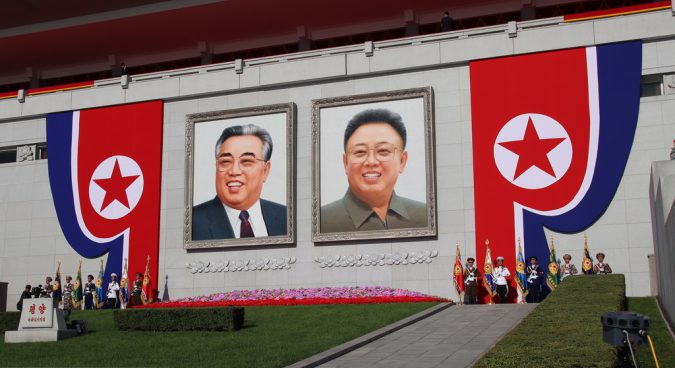 If 2017 was the year of byungjin and 2018 the year of international diplomacy and economic focus, what will 2019 be deemed, following from the speech?
He also implicitly acknowledged another key constraint on economic growth – poor domestic management practices. Kim has done much to improve economic practices, but clearly recognizes there is a lot more to be done to realize a more efficient, modern economy.
That would have both upsides and downsides for the rest of us, given that the tensions of 2017 were as much a part of the North Korean government’s strategic planning as the pivot to dialogue of 2018!
The hidden theme could well be the effective relaxation of sanctions as Russia plays spoiler and other countries tire of the effort.
Kim Jong Un did make clear that the U.S. has to play ball and offer concessions, but if the Trump Administration continues its hard-line rhetoric of unilateral disarmament, 2019 may be the year where the rubber meets the road as Trump may not be able to continue touting progress in the face of mounting evidence against it. As the economy takes a potential dip, Democrats in the U.S. take control of the House, and presidential contenders from both sides mount their presidential campaigns, Trump will face increasing criticism and pressure from both sides to cite progress on North Korean denuclearization. Domestically, Kim will focus his efforts to continue the “socialist economic construction” through the five-year economic plan as mentioned at the 3rd plenary of the Workers’ Party in April 2018. He further solidified that in today’s message.
Nationally, it’s to continue the North’s ‘revolution’ of uniting the two Koreas and, together as “one people,” to take peace and unification into their own hands, fending off big foreign meddlers. He’s saying that he has a bigger goal in mind that transcends the United States – reunification under North Korean terms. He acted like the leader of all the Korean peoples in the way he addressed his North Korean comrades, South Koreans, and Koreans around the world. Internationally, it’s to strengthen relations with other socialist states and put the past behind Pyongyang and Washington and work towards a new relationship. But new relations with the U.S. are conditional, dependent on corresponding actions.
The speech suggests it will likely continue to put pressure on Washington and Seoul without raising tensions so far that it loses the advantages it gains from the current process, like weakening sanctions enforcement and high-level diplomacy with all of the key regional players. Meanwhile, the United States also shows no signs of changing its signature approach of constraining itself by inflating expectations and refusing to consider any sanctions relief until denuclearization. Frustration will grow, but neither party has the right incentives to abandon the diplomatic process wholesale – yet. 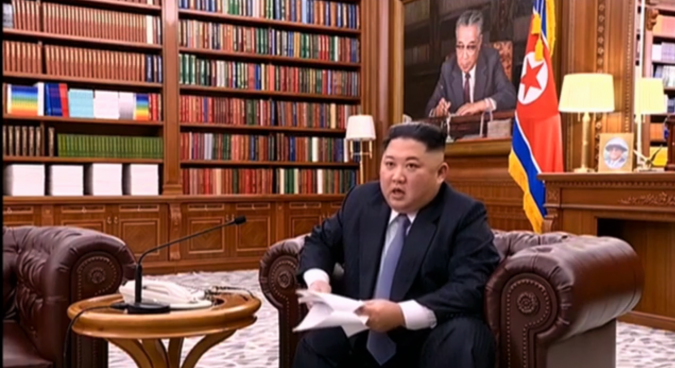 What is the significance of the change in format, with Kim Jong Un sitting in a cozy study in front of giant portraits of his father and grandfather hard at work?
It is also significant that the whole speech was shown in South Korea. This is perhaps a reciprocal trust-building measure following Moon Jae-in’s speech in front of hundreds of thousands of Pyongyangites at the May Day Stadium in September, which was not broadcast. This makes me think Moon will give a speech that is televised (or partly broadcast) on KCTV at some point in 2019.
Kim’s other surroundings – floor-to-ceiling bookshelves, leather sofas, oak desks – projected the longevity, gravitas and (importantly for the domestic audience) inevitability of Workers’ Party institutions.
Perhaps the most significant mistake analysts make of such regimes is their ability to build and sustain popular support.
I think he was ultimately trying to manage his image as a statesman. He came across polished and in control. This was further evidenced by the absence of his top officials.
He’s wearing a suit and tie, looking into the camera with multiple camera angles on him, and sitting comfortably in a luxurious, leather executive chair in his study, whose setting interestingly resembles the feel of the Singapore summit backdrop.
Further, this new presentation format is a visual representation of Kim’s comfort level with power and authority as a relatively young leader. This “relaxed” setting stands in marked contrast to Kim’s stern tone with Washington in his speech. Striking to me, that Kim’s chair was situated between the paintings of Kim Il Sung and Kim Jong Il – continuity of the Kim dynasty and signal to the rest of the world that the regime will persist in its influence-resistant, defiant ways. The fireside chat setting belies – perhaps even blunts – Kim’s sober message to the U.S. in the midst of scuttled negotiations between the two countries.
He may also be trying to center the image of North Korean leadership around himself instead of the broader party.
 Do you think Kim’s saying the country is no longer producing nuclear weapons in addition to not testing or using them represents a shift or perhaps an overture to the U.S. in denuclearization negotiations?
Skeptics will say that there is no proof they have ceased or intend to cease manufacturing weapons. But with some sort of agreement between Washington and Pyongyang, perhaps we could actually find out. Chairman Kim’s speech also contained a vague warning – that if things fall apart with the United States, North Korea could return to a more militaristic path.
This ostensibly affirms that North Korea is not producing new devices, though it may or may not actually be the case. The New Year’s address is a piece of political theater and messaging, not a description of reality, and certainly not a verified fact.
Perhaps Kim Jong Un would be better off with an explicit agreement, but maintaining a nuclear capability in the interim is not a bad place to sit.
But he also sent an uncomfortable message to Seoul to stop military exercises with Washington and halt the deployment of U.S. military assets to the Peninsula.
If the U.S. persists in its pressure campaign and sanctions, Kim will – “reluctantly” – go down a new path (unspecified). But of course, Kim is prepared “anytime” to “sit face-to-face” again with President Trump.
2017 was the year of North Korean qualitative nuclear attainment, with a thermonuclear device tested as well as two different intercontinental-range ballistic missiles. 2018 then became the year of quantitative attainment, with Kim using the New Year’s Day address last year to order the mass production of missiles and warheads. In 2019, Kim is now happy to offer up a production cap, but perhaps only as long as U.S.-North Korea diplomacy remains on track. If the process is derailed, we might expect all bets to be off—including the caps on production and on testing. It’s important to note here too that a production cap on nuclear weapons does not extend to the accrual of fissile material; Kim has not committed to cease enriching uranium or producing plutonium.
Since Washington is unlikely to bend, North Korea can now say it offered to stop producing nuclear weapons, but the United States wouldn’t offer anything in return. I view the second possibility as the most likely, but these are not mutually exclusive.  Does the speech represent a realignment in U.S.-DPRK-ROK diplomacy on the part of Pyongyang, or are we still in the same position as we were yesterday?
North Korea is in a reasonably strong position politically, but hasn’t achieved many concrete results yet. Kim suggested that North Korea wants those results to come in 2019, but didn’t say much to suggest that Pyongyang is ready to shift its own position in order to make it happen.
The urge to nail down the details by having the second summit with Trump aims at bypassing the obstacles of the high-level talks – security assurance to the DPRK through removing U.S. assets in South Korea and the lifting of core sanctions (especially on dual-use technology and equipment). Trump may overrule the concerns of the U.S. negotiation team by strong-arming the deal, which will cause friction in U.S.-ROK military alliance.
What I call the “Pompeo process” might plug along, but the U.S. has not openly revealed what it is willing to pay for interim steps. Kim Jong Un no doubt would prefer a summit because he came out of the last one so well. On the other hand, we still have no definitive clues as to whether Kim sees a summit as a path to endless stalling or the chance to reach a comprehensive settlement. The good money is on the former, but the latter still cannot be ruled out entirely. I continue to believe that Kim Jong Un cannot ultimately achieve his economic objectives without a formal rapprochement of some sort. But the regime has lived with second-best for some time, and is masterful in its capacity to evade and adjust to sanctions.
The devil is in the details since North Korea thinks it has done a lot to offer such concessions (Sohae, Punggye-ri, POW/MIAs, offer of Yongbyon closure) with little in return. The U.S., on the other hand, is split between Trump, who continues to cite progress, and his officials, who continue to cite otherwise. I will note that Kim Jong Un asked for efforts to denuclearize the “Korean peninsula” and the ceasing of U.S.-ROK joint exercises, which is significant since it’s aimed at prohibiting U.S. strategic forces on the peninsula (against ROK domestic opposition), and it plays into Trump’s wish to reduce U.S. posture and troop numbers in the South. 2019 will be a year where Trump will have to face the facts and make decisions. Hopefully this will begin with his next summit.
By contrast, Kim continues to pat South Korea on the back for its efforts to spur inter-Korean cooperation and exchanges. A “very pleased” Kim looks forward to advancing inter-Korean relations and moving toward a peace regime.
That was the core message reiterated by Kim today. His reference to his limited patience is notable as it suggests that we’re likely to see a breaking point in 2019 should the United States fail to deliver on said measures.
After all, he has been able to bring the great powers to the table, increase his diplomatic options, and weaken the pressure campaign without making major concessions on nuclear issues. He was savvy in the way he put pressure on Washington and Seoul, but he did not take on a particularly aggressive tone. Edited by Oliver Hotham © Korea Risk Group. All rights reserved. |


 SHARE
SHARE COPY LINK
 X
X MASTODON
 Andray Abrahamian:
  Chris Green:
  Hoo Chiew Ping:
  Stephan Haggard: Since assuming office, Kim Jong Un’s commitment to economic reform has largely been implicit: simply allowing the emergent market economy running room.
 David Kim: Kim Jong Un stated his commitment to cap his nuclear weapons program and not to spread them. This should be seen as a forward step. If we are going to move towards eventual disarmament, we need to begin with capping their existing arsenal.
 Duyeon Kim: There were no policy bombshells. Kim Jong Un hit all the usual themes: domestic policy and work plan, message to South Korea, and message to the United States.
  Soo Kim: Broadly speaking, there were no earth-shattering proclamations from Kim this year. But if I had to point out one bit that merits attention (besides references to denuclearization, Washington, and inter-Korean cooperation), in light of the broader context of inter-Korean cooperation and implications on the U.S.-ROK alliance: Kim stresses the need for the DPRK to strengthen its national defense capabilities at the global level to guarantee peace on the peninsula.
 Mintaro Oba:
  Ankit Panda: Kim’s overt mention of a production cap on nuclear weapons is notable and the only aspect of North Korean nuclear weapons policy that is new in this year’s address. Last year, on April 20, he committed to a testing freeze and little more.


Recent Stories