
|
Opinion Kim Jong Un doesn’t deserve an olive branchEven talking of reconciliation risks undermining an international consensus against Kim's crimes
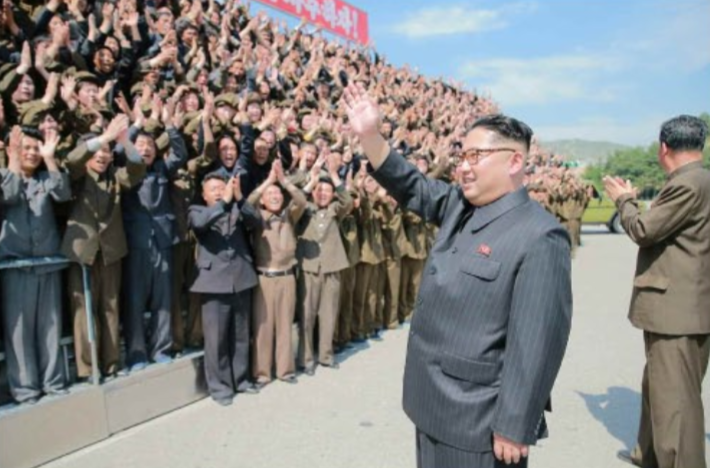 For the past few years, there has been an almost ceaseless drumbeat of insults, threats and counter-threats on the Korean Peninsula. From balloons to drones to loudspeakers to landmines to nuclear and missile tests – not to mention insults hurled against President Park Geun-hye and President Obama that are unrepeatable in polite society – there has been a slow but steady escalation of tension. Seemingly having grown tired of the unpleasantness of it all, every side seems to be motioning for peace these days. China is still trying to resurrect the long-dead Six Party Talks and has repeatedly stated that it wishes to see the Korean Armistice Agreement replaced by a formal peace treaty. President Obama, having successfully forged ahead with the Iran deal and having been the first U.S. president in decades to have visited Cuba, seems to desire one more accomplishment toward his legacy – as evidenced by the fact that the Obama administration secretly agreed to peace talks shortly before the North Koreans conducted their fourth nuclear test. Whether or not South Korean officials were aware of the secret negotiations is still unclear. In what appears to be a move to make sure not to embarrass their South Korean allies or catch them off guard, Director of National Intelligence James Clapper inquired “how much South Korea is willing to concede in case the United States begins discussions (related to a peace treaty) with North Korea.” Now that the unsurprisingly uneventful Workers’ Party Congress has ended, even the North Korean tyrant has also expressed his offer of “an open mind” toward inter-Korean negotiations, albeit in a manner that would have made Vito Corleone proud. What, drawn, and talk of peace? So does this mean that it is possible to have peace for our time? After all, the biggest players are suing for it. Unfortunately, however, there remain many reasons to remain doubtful. TOO MANY DISINCENTIVES First and foremost, no one aside from the North Koreans themselves are happy about North Korea being armed with nuclear weapons. However, one thing that no diplomat or world leader ever seems to want to admit publicly is that North Korea will never agree to give up its nuclear weapons. It is its ultimate trump card – which the leadership thinks is absolutely vital for its survival. It is telling that the North Korean government has repeatedly offered to cease its nuclear tests in exchange for a peace treaty or a cessation of all U.S.-ROK military drills, but never to dismantle its stockpile of existing nuclear weapons. And why would it? After having conducted four successful nuclear tests so far, it would seem for sure that the North Koreans have figured out how to build a bomb.
No two contradictory things can simultaneously exist at the same time. For a peace treaty to be signed, one side will have to give in to the demands of the other. But which side will give in? And what will be the costs of giving in? One way or the other, one side will perceive an existential threat no matter who caves. As long as this paradigm remains unchanged, a formal peace treaty, or at least a functional one, will be unachievable. The second reason is that a genuine peace deal is anathema to Kim Jong Un’s survival. Even though North Korea’s economy is a basket case and malnourishment is a serious issue that affects millions of North Koreans, one thing that the North Korean tyrants have been able to consistently use to rally the people around them is the specter of foreign invaders. That is what Songun (the military-first policy) has been all about. Without a powerful enemy to unite against, and more importantly, to scapegoat, Kim Jong Un’s subjects’ attention will be focused much more on the country’s domestic failures – and there are plenty. Even dictatorships need a raison d’être. The North Korean government’s excessive focus on its military, which often came at the expense of the people, was based on the premise that the Kim Dynasty was protecting the pure and innocent North Korean people from hordes of rampaging barbarians. But if there are no barbarians at the gates and there is no food in the pantry, then what good would the people perceive in their government? Without a proper raison d’être, it would only be a matter of time before Kim Jong Un and Bashar al-Assad shared more in common than mere correspondence. THE PRICE OF ‘PEACE’
In the highly unlikely event that Kim Jong Un gets everything he wants – a peace treaty, a non-aggression agreement, lifting of sanctions, normalization of trade and diplomatic relations, recognition of North Korea as a nuclear power, and a withdrawal of American troops from the Korean Peninsula – none of this guarantees that North Korea will become a wealthy nation. Nothing short of a complete structural overhaul and the abandonment of its failed economic philosophies will help North Korea even hope to resemble a modern nation. However, a modernized and free economy would mean that the North Korean government, at least in its current form and capacity, would no longer be necessary. Why would Kim Jong Un do anything to make himself obsolete? If anything, that “open mind” offer that he gave earlier showed that he was anything but open-minded about that. Considering the deeply entrenched interests of all sides involved, which makes compromise practically impossible, why is the United States, and South Korea by association, talking about peace? Kim Jong Un’s motivations are clear. He’s playing the same game that his grandfather and father perfected – brinksmanship with the goal of maximizing concessions from his negotiation partners. But what about everyone else? Incentives matter, which means that by necessity disincentives matter just as much. Although it is true that North Korea will never willingly give up its nuclear weapons (or other WMDs), the sanctions and the tough unified front that the whole world, including China, has put forward was meant to isolate the North Korean government and make it pay dearly for its actions – to turn the screws so that it would be forced to behave in a more desirable manner. However, what little gains have been made so far could be lost by openly discussing with one another about even the possibility of suing for peace with North Korea. Just as it is beginning to appear that the sanctions are hurting the North Korean leadership, this prospective olive branch, even if it is still theoretical at this point, suddenly being offered despite the fact that Kim Jong Un has done nothing, absolutely nothing, to deserve it has shown to the North Koreans yet again that all they have to do is wait. Wait for a peace-loving American president to send out feelers to determine if he can play Good Cop. Wait for the single-term South Korean president to be replaced by someone else whose policy toward North Korea could be radically different. Wait for the Chinese to worry more about North Korea’s implosion than about North Korea’s belligerence. And all the while Kim Jong Un may do whatever it is that he wants to do, which is to pretend to be Little Nero while his people starve. In the end, what everyone wants is peace. But it matters what kind of peace is being pursued. An offer of peace, even a hint of one, when the enemy has done nothing to deserve relief, trust or forgiveness is a travesty and a mockery of justice. © Korea Risk Group. All rights reserved. |


 SHARE
SHARE COPY LINK
 X
X MASTODON


Recent Stories