
|
News Yoon Suk-yeol survives impeachment vote after martial law fiascoExperts envision major ramifications for Korean security as opposition likely continues trying to oust ROK president
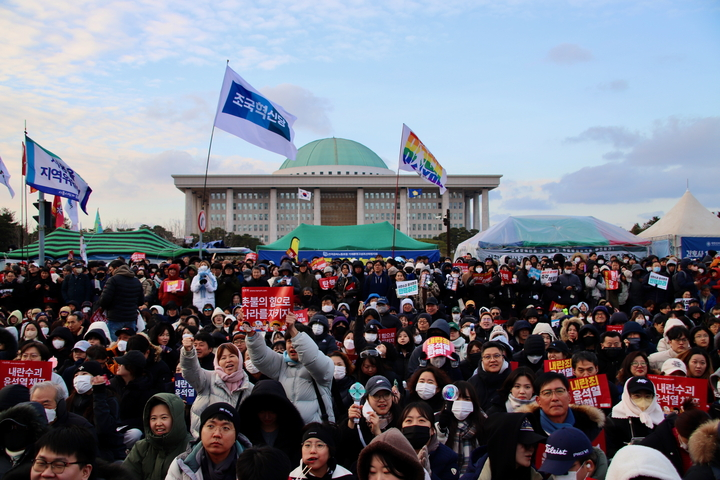 South Korean President Yoon Suk-yeol survived an impeachment vote at the National Assembly after a plenary session failed to reach quorum late Saturday. The opposition was less than ten votes short of relieving Yoon of his executive duties after he declared martial law earlier this week to root out alleged pro-North Korean forces in the country. Most of the 195 lawmakers present likely voted or plan to vote for impeachment, but 200 votes are necessary to pass the motion. Most conservatives refused to participate, which proved to be the decisive factor in preventing the motion from passing. Although voting began earlier in the evening, the National Assembly cannot tally the votes because there are fewer than 200 lawmakers present, a necessary threshold to achieve quorum. Of those present, all but one had gone on record endorsing the impeachment motion. Opposition lawmakers slow-walked the vote in hopes that enough members of the ruling People Power Party (PPP) returned to the assembly hall and supported the impeachment motion. Speaker Woo Won-shik officially announced the motion was dead after a self-imposed 9:20 p.m. deadline passed. Experts told NK News that while the impeachment process may appear largely a domestic fiasco, it has serious ramifications for inter-Korean security — including the U.S. and ROK relationship, especially if Yoon were to complete his term. “This sort of political discord has manifested in the politicization and distraction of the South Korean military at a very sensitive time on the Peninsula,” Ankit Panda, Stanton Senior Fellow at the Carnegie Endowment for International Peace, told NK News. “This is harmful for how the U.S. and South Korea might respond to crises in the short-term. All of this undercuts the reality of an ‘ironclad’ partnership between the two countries,” Panda added. “U.S. Forces Korea did not appear to have been aware of the martial law declaration, which is a real problem.” 


THE MOTION The DP had earlier pledged to reintroduce an impeachment motion in the next special session if Saturday’s impeachment failed. Nearly all PPP lawmakers left the assembly hall after voting on a motion to initiate a special investigation into the first lady for alleged stock price manipulation, boycotting the impeachment motion that came after. Only one, Ahn Cheol-soo, remained in the assembly hall. He was greeted with applause when he moved to cast his vote. Kim Yea-ji and Kim Sang-wook of PPP returned to the assembly hall to vote after exiting with their party and were greeted similarly. In the impeachment motion, the Democratic Party (DP) and five minor opposition parties accused Yoon of violating 16 constitutional articles and six legal statutes through his martial law declaration. The motion they submitted specifically cited Yoon’s Dec. 3 martial law declaration as “unconstitutional and illegal,” arguing there was no situation equivalent to wartime or national emergency to justify such measures. The motion stated that Yoon issued a proclamation order within just one hour of declaring martial law — a serious constitutional violation. It also accused the South Korean president of violating constitutional requirements for political neutrality of public servants and military personnel by mobilizing martial law troops to blockade the National Assembly and arrest various politicians. 


CHAIN OF COMMAND VACUUM Before Tuesday, only South Korea’s military dictators had ordered martial law in the country. Yoon’s declaration was the first since the country’s democratization, and involved military helicopters landing at the National Assembly and troops attempting to enter the main chamber, leading to physical confrontations with parliamentary staff. Yoon claimed “anti-state” and “pro-North Korea” forces threatened the country’s fate, which analysts told NK News that likely refers to his political and public opposition. Army chief Park An-su, whom Yoon tapped as the martial law commander, banned a wide range of freedoms in his decree on the night of Dec. 3, from political gatherings, parliamentary activities to medical and labor union strikes. It further mandated that the press came under the military’s purview. The military deployment ended after an emergency Assembly session passed a resolution nullifying the martial law with unanimous support from 190 attending lawmakers. The interim defense minister as well as various military leaders such as special forces and the Joint Chiefs of Staff, vowed to disobey any further martial law orders from Yoon. Three high-profile commanders have been suspended from their positions. Daniel Pinkston, an international relations professor at Troy University in Seoul told NK News that regardless of Saturday’s result, the power vacuum in the military and the lack of Yoon’s authority as Commander in Chief “definitely undermines military readiness and preparedness” in the coming weeks. “A major or fundamental military principle is unity of command. You have to know who’s boss, who’s in charge, who has the authority and the responsibility. Ultimately that comes down to the president — under the constitution of the ROK, the president is the commander in chief of the armed forces.” “The new acting defense minister is saying that ‘I won’t obey any unlawful orders’ and saying today that there won’t be a second martial law order because of the rumors surrounding that. But there’s a problem with that — how can any kind of commitment or promise not to declare another martial law order be credible? How can anyone believe that?” Pinkston suggested this may lead to even longer-term security problems with the ROK citizens not trusting the government about any actual North Korea threat.  SECURITY IMPLICATIONS Pinkston recalled the night of the martial law was a serious sign of peninsula risk, confusing foreign residents about evacuation needs — but not stemming from the North, but the South. Inability to have Yoon be suspended from his authorities on Saturday will be an added risk, he said. He added that a South Korean leader’s “cognitive error” about the pro-DPRK or North Korea-led threat in Seoul, listening to a handful of close aides, will be remembered as a major security risk by diplomatic partners that erodes the alliance posture. Meanwhile, North Korean state media has made no mention of South Korea’s martial law crisis as of Saturday evening. Peter Ward, research fellow at the Sejong Institute’s Center for Korean Peninsula Strategy, said that the “messiness” in Seoul serves North Korea’s purposes “perfectly,” regardless of whether Saturday’s impeachment bill passes. “A divided and chaotic South Korea going through major difficulties in effectively working with its partners and allies is a highly welcome development in Pyongyang,” he told NK News. But he expected North Korea to remain largely cautious in responding to the political crisis in Seoul. “They would like to avoid a confrontation that will empower the current government. So I doubt they will start anything right now,” Ward said. Panda of Carnegie Endowment added that how North Korea uses the issue for their propaganda will be important to monitor, compared to how it did with Park’s impeachment. “It may be the case that they underemphasize this given the change in unification policy,” Panda said. “North Korea is likely studying the opportunities that may be available in the coming weeks as this discord lingers and we shouldn’t rule out measures to test South Korea’s readiness during the U.S. presidential transition period.” Pinkston stated that the unsuccessful martial law procedure may lead to serious “miscalculations” from North Korea. “North Korean analysts could be looking at this and thinking: ‘These guys really are incompetent. They can’t even secure the National Assembly building … They would be a pushover,’ they could have thought,” Pinkston said. “So, it could lead them to misjudge the strength and capabilities of the South Korean military and think it’s an opportunity to attack. It’s extremely dangerous.” Anton Sokolin, Colin Zwirko, Ifang Bremer, Joon Ha Park, John Lee and Shreyas Reddy contributed reporting to this article. Edited by Arius Derr © Korea Risk Group. All rights reserved. |


 SHARE
SHARE COPY LINK
 X
X MASTODON


Recent Stories