
|
News North Korea demolishes symbolic unification arch, satellite imagery suggestsKim Jong Un ordered monument removed to ‘completely eliminate’ public’s idea of kinship with South Korea
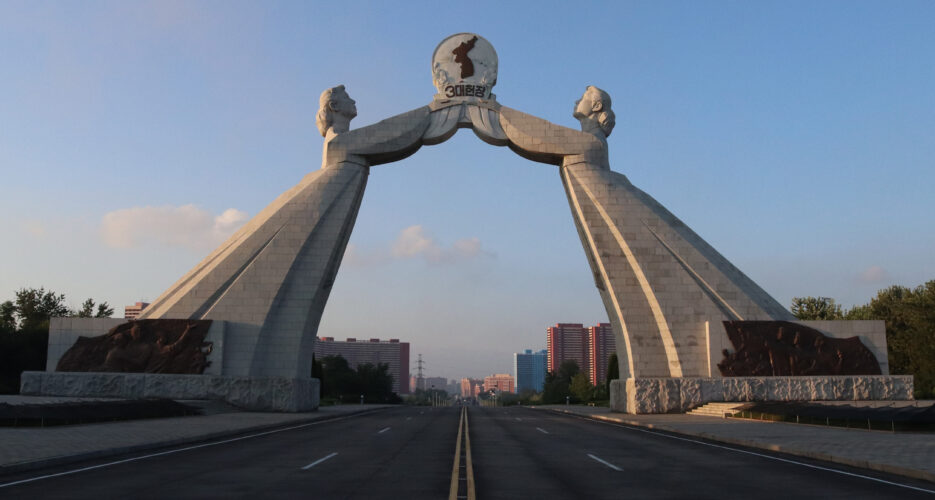 North Korea appears to have demolished a large monument in Pyongyang symbolizing hope for unification with South Korea, according to NK News analysis of satellite imagery, after leader Kim Jong Un ordered it be removed earlier this month. The move appears aimed at sending a strong signal to both domestic audiences and authorities in Seoul that Kim is serious about ditching a policy of peaceful unification with the South. The Monument to the Three Charters for National Reunification appeared gone in a Planet Labs medium-resolution image taken on Tuesday morning, though it is unclear precisely when or how it was taken down. 
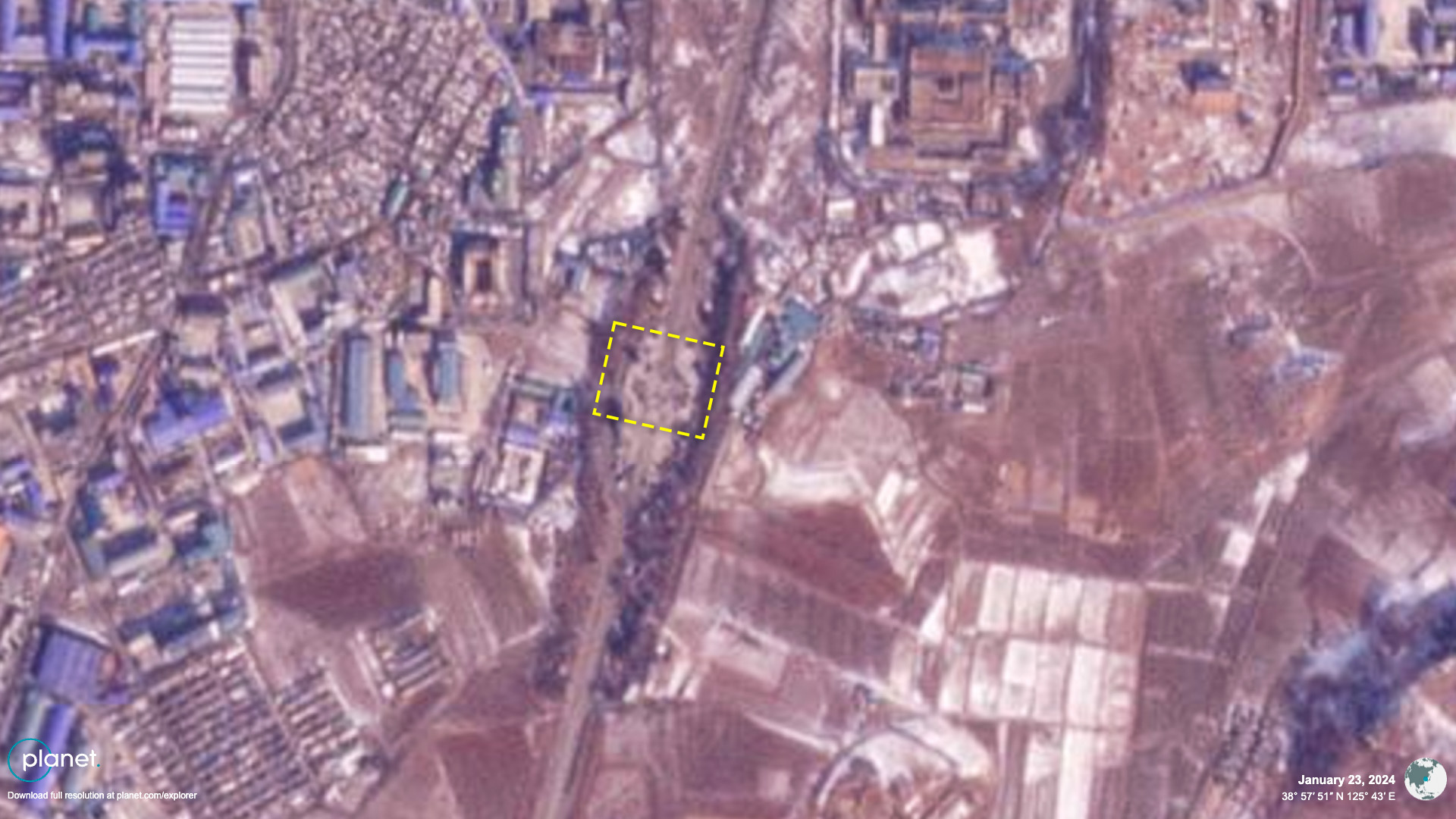
It was last seen standing in an image taken on Jan. 19. It may have already been removed by Jan. 22, though imagery on that day was hazy. Kim called the monument an “eye-sore” at a Supreme People’s Assembly (SPA) session on Jan. 15 and ordered it to be “completely removed … to completely eliminate such concepts as ‘reunification,’ ‘reconciliation’ and ‘fellow countrymen’ from the national history of our Republic.” The monument — around 100 feet tall (30 meters) and 200 feet wide (61.5 meters) — stood above Thongil (Unification) Street in southwest Pyongyang, the highway leading from the capital down to Kaesong and across to South Korea. Completed in 2001, it depicted two women, one from each Korea, holding an emblem of the outline of the entire Korean Peninsula, according to a now-deleted page on the DPRK-run website Naenara. “It highlights that the Koreans are a homogeneous nation with one territory, the same blood and one language from ancient times, and that all the fellow countrymen should turn out in the struggle for national reunification, true to the three charters,” the page said. 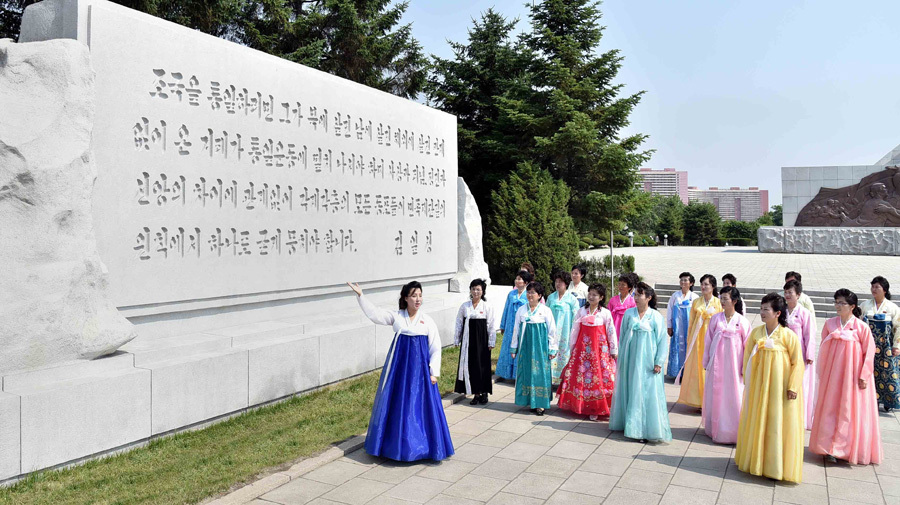
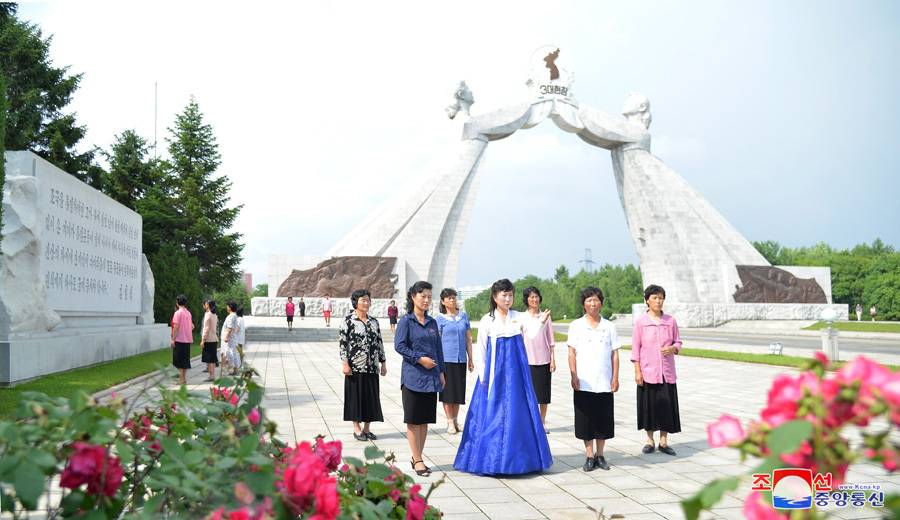
The monument was made up of “740 high-grade commemoration stones sent at home and abroad by numerous people aspiring after national reunification including the patriotic figures and pro-reunification personages in south Korea,” another DPRK webpage stated. Its apparent demolition follows other efforts in recent weeks to remove references to unification and peninsular iconography from state media and physical installations, as part of what is likely to be a costly process nationwide. Kim also said at this month’s SPA that authorities should “thoroughly block all the channels of north-south communication along the border, including physically and completely cutting off the railway tracks on our side, which existed as a symbol of north-south exchange and cooperation, to an irretrievable level.” A satellite image taken Tuesday of the key inter-Korean rail crossing at Kaesong did not clearly show any large-scale work to destroy the tracks, but higher-resolution imagery or ground photos taken from south of the border could shed light on the status of Kim’s orders. After a period of inter-Korean detente from 2018 to 2020 failed to produce the outcome North Korea wanted, it reverted back to what the U.S. and South Korea call provocative behavior. This includes blowing up a multi-million dollar inter-Korean liaison office in the Kaesong Industrial Complex in 2020 and ramping up propaganda encouraging the brutal murder of South Koreans. Kim also led multiple military planning meetings last year where he was seen pointing to areas of South Korea on large maps. Pyongyang has maintained that the North will not attack the South unless attacked first, while warning of total “annihilation” if Washington and Seoul “violate even 0.001 mm of our territorial land, air and waters.” Edited by Alannah Hill. Updated on Jan. 24 at 9:48 a.m. © Korea Risk Group. All rights reserved. |


 SHARE
SHARE COPY LINK
 X
X MASTODON


Recent Stories