
|
COVID-19 Expats in Pyongyang worry about getting medical help amid COVID-19 restrictionsCOVID-19 travel restrictions mean that expats in North Korea may not have access to medical evacuation or proper care
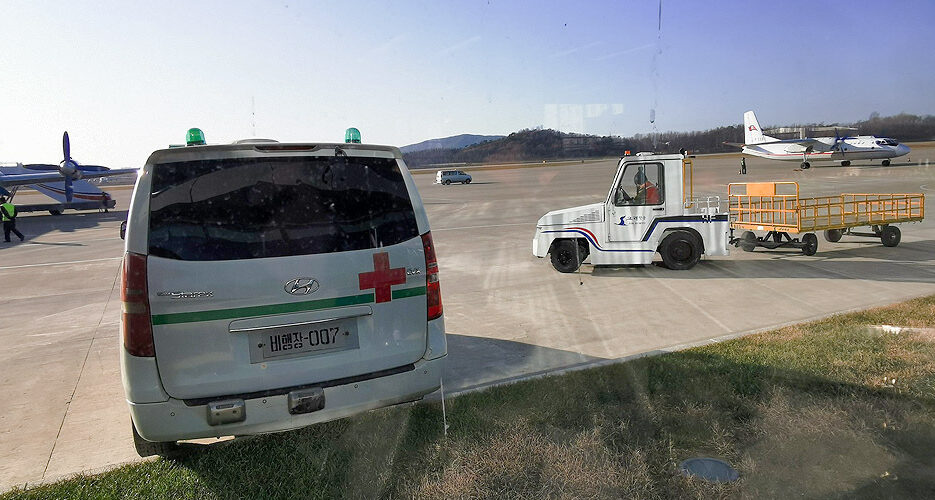 In wake of the Pyongyang expat community’s ongoing exodus out of the capital city, some are worried that foreigners who remain in the North will have limited healthcare options in the event of an emergency, sources tell NK News. Travel to and from North Korea has been restricted ever since the DPRK imposed strict measures in January to prevent the spread of COVID-19, and authorities have so far allowed only a small handful of flights in and out of the country. The last such flight was in early March. This means that the chances of North Korean authorities allowing medical evacuation flights to help foreigners who need emergency healthcare is extremely low, multiple informed sources told NK News. Meanwhile, expats may only be able to get help at resource-strapped North Korean hospitals. “The only viable route is crossing the bridge between Sinuiju and Dandong,” said one diplomatic source, who requested anonymity. “[The] Koreans were adamant about not allowing evacuation planes into their airport — it was obviously an order from higher levels.” But driving between Sinuiju, North Korea and Dandong, China would take almost an entire day by car — meaning that it’s not suited for an emergency. Other informed sources also said that Chinese COVID-19 restrictions complicate that option: Upon arriving on the Chinese side of the border, visitors must take a COVID-19 test and get a negative result before moving onto emergency healthcare facilities. Meanwhile, another source said that some expats, such as non-diplomats, will be required to conduct a 14-day quarantine period before any hospital treatment in China would even be possible. Crossing the land border is also complicated and costly, with unconfirmed figures seen by NK News suggesting that those without a car would have to pay roughly 13,000 to 20,000 RMB ($1,888 to $2,905) to source a Chinese vehicle to cross the bridge in. “You are pretty vulnerable while in DPRK — that’s a part of it, unfortunately,” the diplomatic source told NK News. “[And] medical emergency assistance in [the] DPRK is not recommended, from my experience.”  For those who have no alternative but to stay in North Korea, local treatment would be the only option in an urgent health crisis. “As for anyone there now needing medical attention, I would assume that the Friendship Hospital would be the place to go [if they’re still] in Pyongyang,” said Simon Cockerell, the general manager of Koryo Tours. “There are clinics and hospitals everywhere, of course, but the issue is the standard of care and access to medicine.” While North Korean leader Kim Jong Un kicked off an ambitious project to build a modern showcase hospital in Pyongyang earlier this year, he complained in July that construction efforts were encountering “serious problems.” NK News understands that one of the key problems has been obtaining high-tech medical equipment and supplies. “The best advice you can really give anyone is that they should avoid needing medical attention when in North Korea,” Cockerell said. “[That’s] not always a matter of choice, though.” Edited by Kelly Kasulis © Korea Risk Group. All rights reserved. |


 SHARE
SHARE COPY LINK
 X
X MASTODON

Recent Stories