
|
Evergreen “Being in North Korea”: teaching business in the world’s last Stalinist stateA new book details the trials and tribulations of on-the-ground engagement in the DPRK
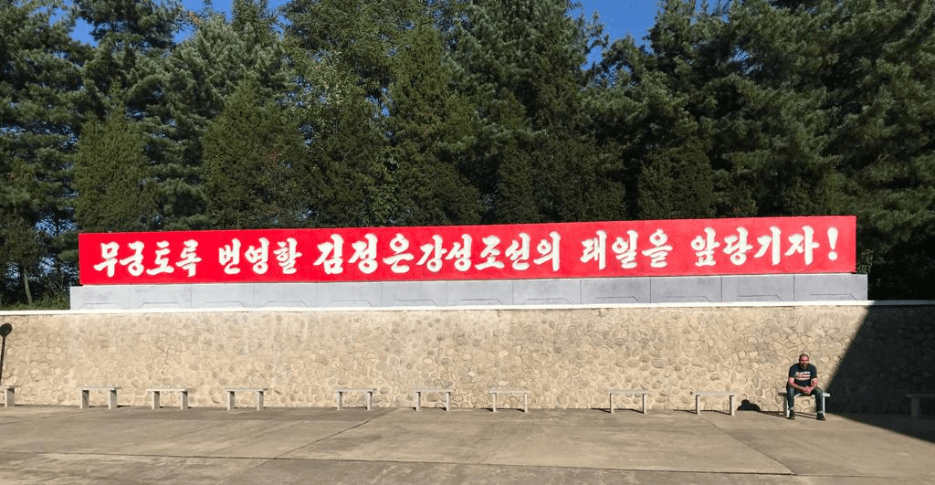 You can buy “Being in North Korea” by Andray Abrahamian here. In North Korea, even a simple morning run around the block can land you in hot water. Andray Abrahamian was in Wonsan, on the east coast of the DPRK, to conduct a workshop with the Choson Exchange NGO and North Korean colleagues. But before that, he wanted to get some exercise. “I went straight down to the lobby of the hotel in my Lululemon running shorts and said to the hotel lady, ‘I’m going to go run in the hills behind the hotel,’” he told journalists in Seoul last week. “And she says, ‘You should run down by the water. It’s really nice to run by the water.’ I’ve been going to North Korea for five years at this point … and was still too stupid to realize what she was telling me was, ‘Don’t run in the hills.’” Five minutes later, Abrahamian found himself at the wrong end of a bayonet, brandished by a scrawny young military cadet and being sternly admonished in English for running in a prohibited area. Superiors were called, excuses were traded, and eventually he was let go. “Finally, after about 15 minutes, it gets resolved and he says, ‘Okay, you go,’” he recalled. “I run away and, about 30 or 40 meters down this hill, this voice rings out behind me: ‘Let’s be friends forever!’” Being in North Korea is often like this: Your local counterparts go from rebuking you for asking too many questions or taking a photo of the wrong thing, to having a sincere heart-to-heart with you about daily life within the space of five minutes. Moods can change at breakneck speed, with the North Koreans so acutely aware of the danger of saying or doing the wrong thing, but also keen to make sure that their foreign guests come away with a good impression of their country and their system. As a foreign guest, you’re also acutely aware of this: You’re anxious not to get your local interlocutors in trouble, but also determined to push back at the absurdity of the rules and regulations placed on you — don’t walk there, don’t talk about that, don’t do that — and get a glimpse of the “real” North Korea, whatever that may be.  Andray Abrahamian’s new book — suitably titled “Being in North Korea” — attempts to make sense of these contradictions, ten years’ travel to the DPRK, and take stock of just how effectively this kind of people-to-people engagement really is. His work in North Korea began with a chance encounter with Geoffrey See, a bright young Singaporean entrepreneur who had decided to give up a lucrative consulting career to teach entrepreneurship in the DPRK back in 2010. He relocated to Beijing and began regular travel to North Korea, leading talks on economic development, marketing, and entrepreneurship with local business people and officials, all the time navigating the tricky work of teaching capitalism to the world’s last truly Stalinist state. DON’T MENTION THE LAW First and foremost among these challenges, Abrahamian writes, was the fact that the North Korean refused to accept that changes to the country’s economy — gradually implemented in the early 2000s by the late Kim Jong Il and later in the past decade by Kim Jong Un — constituted “reform.” Choson Exchange learned this early on, with a North Korean counterpart taking issue with Abrahamian’s use of the word “reform” to describe what was taking place in the country. “Please don’t use that word. Use other ways to explain our country,” the North Korean reportedly said, though they were happy with a range of euphemisms, from “new economic rules” to “policy experiments.” “The North Koreans were — and still are — reluctant to discuss what is going on,” Abrahamian writes. “I became a master of saying ‘reform’ without saying it. Look at any article I’ve written or contributed to, and you’ll find an orgy of euphemism.” Other cultural challenges abounded, too: in a collectivist society like North Korea, capitalist assets like bravado and self-confidence are not encouraged — instead citizens must display humility and piety. But how, then, does the job interview process work? Seeking volunteers for a study trip abroad to Singapore, Abrahamian and See found themselves encouraging their North Korean applicants to share their proudest accomplishments. Some, he writes, took to the process well: One interviewee touted her successes in introducing a new “accounting system” in her workplace, while another discussed her dream of opening a high-end chocolate shop in Pyongyang. Others were less adaptive. “To the question, ‘What accomplishment are you most proud of?’, designed to draw out their individuality, one young lady told it was swimming in front of Kim Jong Il at an athletic event when she was in school,” Abrahamian writes. “I tried to redirect. ‘Is there anything at your work that you’ve done well, like a challenge you’ve overcome or a problem you’ve solved?'” “No, there isn’t,” she replied.  OBSTACLES ABOUND Matters of nomenclature and attitude were, of course, far from the only obstacle that Choson Exchange faced in North Korea, where entrepreneurs do not have access to the internet, let alone reliable market data or access to international banking. Conducting a workshop a few years ago with a plucky group of North Korean software developers, for example, he and his volunteers ran into a small problem: the North Koreans were unable to do basic market research — and harbored wildly unrealistic ideas about the prospects for their business overseas. “There was a spring in their step, a strut in their stride,” he writes — attitudes befitting North Koreans able to do business with the outside world. The programmers were chuffed. They had been commissioned to work with a Chinese app developer on some basic code — a sign that they were moving up and that their business was gaining interest abroad. But one Choson Exchange volunteer decided that he needed to bring the Koreans back to reality and help them understand where their work stood in the context of international markets. “It was the stuff that the Chinese company thought wasn’t worth the time of even their cheapest engineers,” he writes. “The guys from the company looked crestfallen.” “Implicit was the fact that because they didn’t have full internet access, they couldn’t see what markets would bear, they couldn’t make their own competitive products, and they couldn’t compete for better outsourcing projects.” Abrahamian describes these people as “trapped,” forced to try and make something of themselves in a system that rewards conformity and loyalty and punishes critical thinking and individuality. “They wish they lived somewhere where things weren’t so difficult,” he said. “If they were in their position in China or South Korea, or anywhere, they would be incredibly wealthy and with the whole world at their fingertips. Of course, those people wish they had that as well.” Many of Choson Exchange’s local counterparts were acutely aware of just how different things were abroad — because the NGO would take them there to see it for themselves. Abrahamian recounts one anecdote of a North Korean colleague seeing Beijing traffic for the first time and asking his wife whether “these are all government cars, right?” “And my wife says, ‘No, these are just people’s cars,'” he said. “The Korean guy just shut down. No more follow up questions. The impact of how wealthy and how much freedom of action Chinese people have — opportunities to make money — it’s really striking for a North Korean.”  CAPITALIST COMRADES That said, Choson Exchange did have a few stars, such as graduates of their programs who went on to do big things. And while he’s reluctant to name names, Abrahamian points to a growing diversification of products in North Korea’s consumer goods industry as proof that their lessons on marketing and branding may have had an impact. “You see that, now on the shelves in North Korean supermarkets, those trying to stand out, trying to look different,” he told reporters. “The life of a consumer in North Korea now is considerably better than it was a decade ago when I started this kind of thing – not comparable to here, obviously, but by the North Korean baseline.” “I don’t want to take credit for those kinds of ideas or those people, but we were hoping to identify them and feed into that,” he said. Other case studies include an alumnus now working to “make handbags to sell in North Korea, but to appear as if they were a brand from Hong Kong,” as well another working to open North Korea’s first 7-Eleven style convenience store. So where does these new North Korean entrepreneurial class (Abrahamian dismisses to oft-repeated adage “Donju” as overly-simplistic) come from? Stories abound of the emergence of North Korean capitalism famine years, in which desperate people in the countryside turned to trade and barter as a means to survive — with many getting rich in the process. These days, however, the sons and daughters of the ruling party are just as keen to expand their horizons and work in business. “The whole project kind of began with Geoffrey See, the founder and I, around 2010. [We] noticed that there were some top-down changes happening,” he said, citing the rapid expansion of state-owned conglomerates like Air Koryo as one example of capitalist ideas making their way into resolutely-socialist North Korea.  NO REFORM OR OPENING UP? But ten years on, prospects for that kind of economic change in North Korea are looking slim. In the wake of the failed summit between North Korean leader Kim Jong Un and U.S. President Donald Trump, Pyongyang has closed up, with hints that it may begin rolling back some reforms as it prepares to weather a long storm. “I think the political instinct is, ‘Well then, let’s maximize our control over what’s going on domestically,'” Abrahamian argued. “Post-Hanoi … I think there was real uncertainty at the elite level and they pushed that uncertainty down through the channels they control. And that creates an overall environment of stress.” “There are fewer incentives to experiment and take risks, and more incentives for you to catch people out and get other people in trouble to demonstrate your loyalty. If you think the pie is shrinking, you’d be removing rivals for that piece of pie at all levels,” he added. Many foreigners have long tried to get a piece of that pie themselves, too, and the path to North Korea’s long-awaited reform and opening is strewn with failed businesses and missed opportunities. Many have come away from those experiences cynical: If North Korea isn’t willing to change itself, the argument goes, what’s the point of trying? “The question is, what can we do in order to try to create better outcomes for the people of North Korea and the world,” Abrahamian — who now teaches at George Mason University Korea and runs the Coreana Connect NGO — said. “Let’s face it, both engagement and pressure have come up short.” “I think one of the key questions is, what are the downsides from your methodology or your approach? If you fail on engagement, what have you done? And if you fail at pressure, also, what are the consequences of that? For me, failures towards engagement are more acceptable.” Edited by Kelly Kasulis © Korea Risk Group. All rights reserved. |


 SHARE
SHARE COPY LINK
 X
X MASTODON


Recent Stories