
|
Opinion “Kingdom of discrimination”: North Korea’s long interest in U.S. race relationsThe DPRK has for decades served as a notable, but deeply insincere, supporter of African American struggle
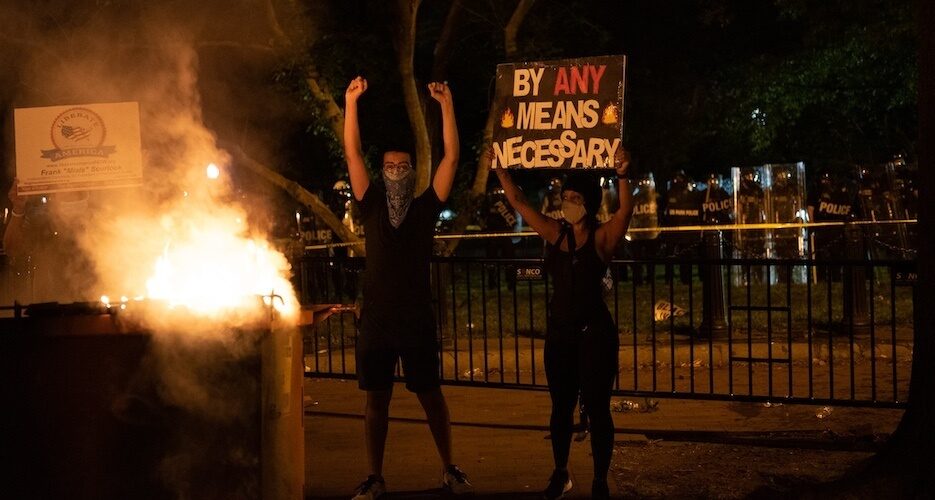 Views expressed in Opinion articles are exclusively the authors’ own and do not represent those of NK News. With the U.S embroiled in nationwide protests, North Korea’s state-run media did not miss the opportunity to criticize U.S police treatment of African Americans and express solidarity with the protesters. In an article on May 31, the Rodong Sinmun ran an article that reported: “Various regions in the U.S. see protests that condemn a white policeman’s brutality for murdering a black man.” North Korea has a long history of supporting African Americans in their fight against racism in the U.S., though that concern for discrimination has often been largely rhetorical and superficial. Pyongyang’s reaction to U.S racial inequalities began during the Korean War, when the DPRK military disseminated propaganda leaflets during the war that told Black soldiers to lay down their arms and leave Korea to the Koreans. One leaflet read, “Did you ever stop to think why you should be in Korea, fighting other colored people, while lynchings, murders and insults pile up against the Negro people at home? We say: No U.S. soldiers have any business in Korea. Korea for the Koreans. China for the Chinese. America for the Americans, Negro and white.” After the Korean War, the North Korean government would continue to rhetorically support the Black freedom struggle, with state-run media supporting the Watts Riots of 1965 and the Black Power Movement of the late 1960s. The North Korean government also had close relations with the Black Panther Party. From hosting Eldridge Cleaver on two separate occasions to providing medical support to Kathleen Cleaver during her pregnancy, Kim Il Sung backed his African American comrades. In the late 1960s, Kim Il Sung sent the Panthers a telegram wishing them success in their “just struggle to abolish the cursed system of racial discrimination of the U.S. imperialists and win liberty and emancipation.” During the Cold War era, North Korea’s indictment of American racism was typical for many communist regimes. The Soviet Union and the People’s Republic of China routinely criticized U.S racial segregation and expressed their support for the Black freedom struggle.  North Korea was not unique in its support for Black liberation, but it did attract certain eccentric figures, most notably Eldridge Cleaver, that identified with Pyongyang’s self-reliant line and militancy. In some respects, Cleaver envied the deification of Kim Il Sung within the DPRK and may have wanted similar cultish leader worship for himself within the Black Panther Party. That’s not to say Pyongyang is necessarily sincere: much of this has been rhetorical and superficial, and North Korea’s indictment of American racism is self-serving and the propaganda apparatus’s coverage often neglects the complexities of the issues at hand. In the DPRK, anti-racism was not practiced as policy. From the well-known case of a visiting Cuban delegation being surrounded by angry locals yelling racial epithets to forcing North Korean men to divorce their Eastern European wives in the 1960s, the DPRK government’s internal commitment to racial solidarity was superficial at best. After the fall of the Communist bloc, North Korea’s ideology shifted in an even more nationalistic direction. During NFL football player Hines Ward’s 2006 visit to South Korea, the Rodong Sinmun published an article that criticized South Korea’s “race-mixing” and multiculturalism. That article said: “The theory of ‘multiracial society’ is a poison and anti-reunification logic aimed to emasculate the basic idea in the era of independent reunification. The anti-national logic is advocated in south Korea, contrary to the aspiration of the fellow countrymen.” North Korean media’s use of racist slurs towards Barack Obama are also well known. The North Korean state-run media ran an article in 2014 that called the African American President “a monkey… who climbs up this and that tree and picks fruit, or picks up food from the ground.” Much of the DPRK’s overt racism was expressed in the Korean language in order to shield it as much as possible from foreign eyes.  However, when racial tensions arise in the U.S., Pyongyang rarely misses the opportunity to lash out. For example, amid outrage back in 2012 over the murder of Trayvon Martin, state media reported that: “The U.S. true colors as a kingdom of racial discrimination was fully revealed by last year’s case that the Florida Court gave a verdict of not guilty to a white policeman who shot to death an innocent black boy.” George Zimmerman was not a police officer, but precise details typically do not factor highly in North Korea’s media coverage of U.S race relations. North Korean media also covered the 2014 Ferguson protests, noting that “the U.S. is, indeed, a country wantonly violating the human rights where people are subject to discrimination and humiliation due to their races and they are seized with such horror that they do not know when they are shot to death…” “The protests in Ferguson City and other parts of the U.S. are an eruption of the pent-up discontent and resistance of the people against racial discrimination and inequality deeply rooted in the American society.” So, what to make of North Korea’s current coverage of the Black Lives Matter protests? Well, it would be a long shot to consider Pyongyang an ally in this global movement. As a regime that has long internally-championed racial purity, Pyongyang’s foreign-oriented anti-racist discourse is self-interested. It is meant only to criticize and delegitimize the U.S. government. America’s racial issues have long been an easy target for news media in the country’s adversaries. Considering the profound inequalities and racial tensions in the U.S., it is easy to see why it is such a soft and appealing target for authoritarian governments around the world. Edited by Oliver Hotham © Korea Risk Group. All rights reserved. |


 SHARE
SHARE COPY LINK
 X
X MASTODON


Recent Stories