
|
News South Korea’s ruling party on course to win legislative elections: exit pollsSouth's Democratic party has pursued a policy of engagement and reconciliation with North Korea
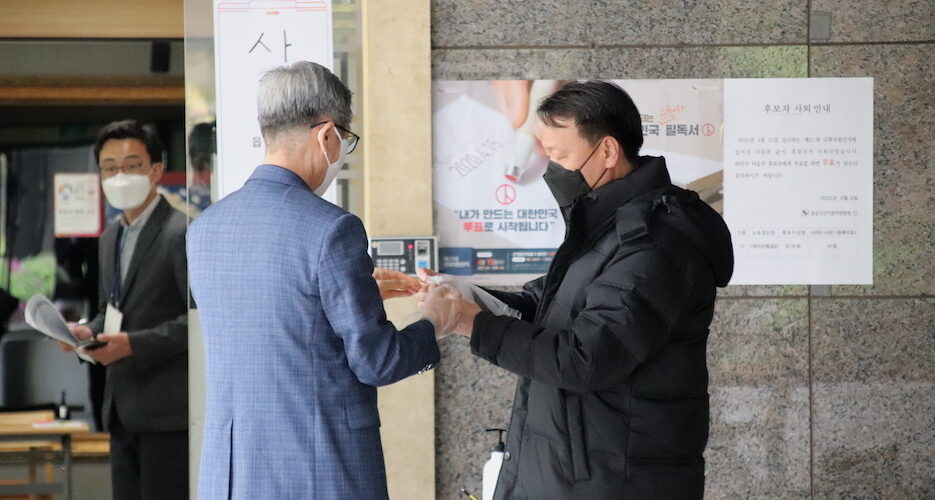 Updated at 18:45 and 20:50 KST to include updated total voter turnout and exit poll district results South Korea’s ruling Democratic Party (DP) and its satellite Civil Together Party (CTP) may have secured a historic majority in this week’s legislative elections, a joint exit poll by South Korean broadcasters projected as voting ended on Wednesday evening. The exit poll by Korea Election Pool (KEP), reported by broadcasters KBS, MBC, SBS, forecasted that the ruling party and the CTP is set to win between 153 and 178 seats in the South’s National Assembly out of a total 300 seats. If confirmed, the results will represent the largest majority for a liberal South Korean political party in 16 years. The main opposition United Future Party (UFP) and its satellite Future Korea Party (FKP), in turn, is expected to win between 107 to 133 parliamentary seats. Full results are expected early Thursday morning. The vote, which comes half-way through incumbent South Korean President Moon Jae-in’s five-year term, is widely seen as a mandate on many of the current administration’s policies, including inter-Korean cooperation and push for dialogue with Pyongyang. Voter turnout for this week’s election as of 20:30 was 66.2%, the highest for a parliamentary election since 1992 — despite lingering concerns about the threat of the spread of novel coronavirus (COVID-19). To prevent a potential mass outbreak on election day, the South Korean government this year implemented a number of new voting procedures, with voters required to use hand sanitizer and plastic gloves and stand in line a meter apart from each other. In comparison, previous legislative elections in 2016 saw 58.0% voter turnout. Held midway through the administration of the now-impeached President Park Geun-hye, that election saw the conservative Saenuri Party lose to the Democratic Party by one seat, with the latter winning 123 (41.0%) seats total. 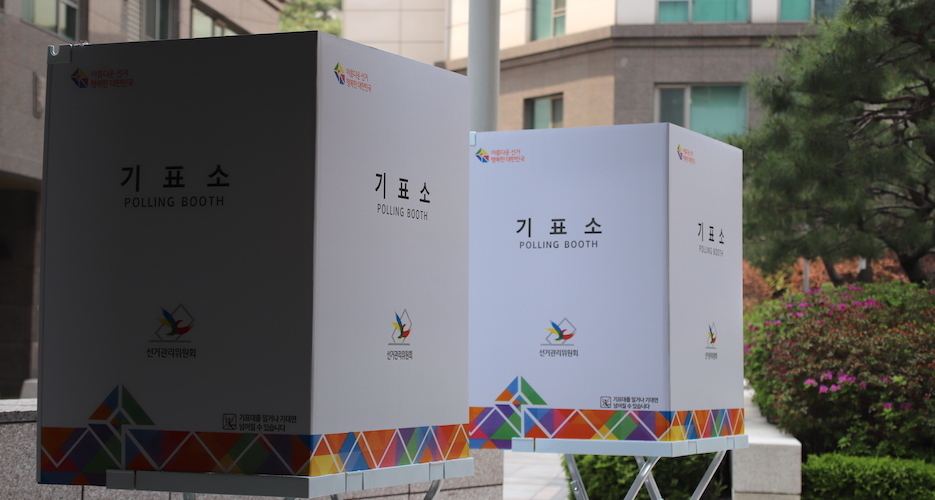 RULING DEMOCRATIC PARTY WINS: IMPLICATIONS FOR NORTH KOREA POLICY The result of the 21st general election is set to have a major impact on Seoul’s North Korea policy, with the country’s two major parties diverging sharply on their approach on inter-Korean cooperation and dialogue. The Democratic Party and its satellite Civil Together Party (CTP) had pledged to continue the more reconciliatory policies pursued by the incumbent Moon administration, promising ahead of the vote to step-up work towards an inter-Korean “peace economy” should they win. In contrast, the United Future Party (UFP) and its satellite Future Korea Party (FKP) has vowed to discard Moon’s policy on North Korea and national security, promising instead to refocus attention on the nuclear threat from Pyongyang. The camps also diverged in their positions on deals made at 2018’s inter-Korean summits, with the conservatives calling for a nullification of a military agreement signed by the two Koreas in September that year. Both camps, however had vowed to work to improve the lives of North Korean defectors in South Korea — a response to nationwide outrage prompted by the death of a young defector family in August last year. A win by the Democratic Party will also likely see many expired bills return to the 21st National Assembly — including those on establishing a “peace economy special district” and on consolidating greater parliamentary support for inter-Korean economic cooperation. 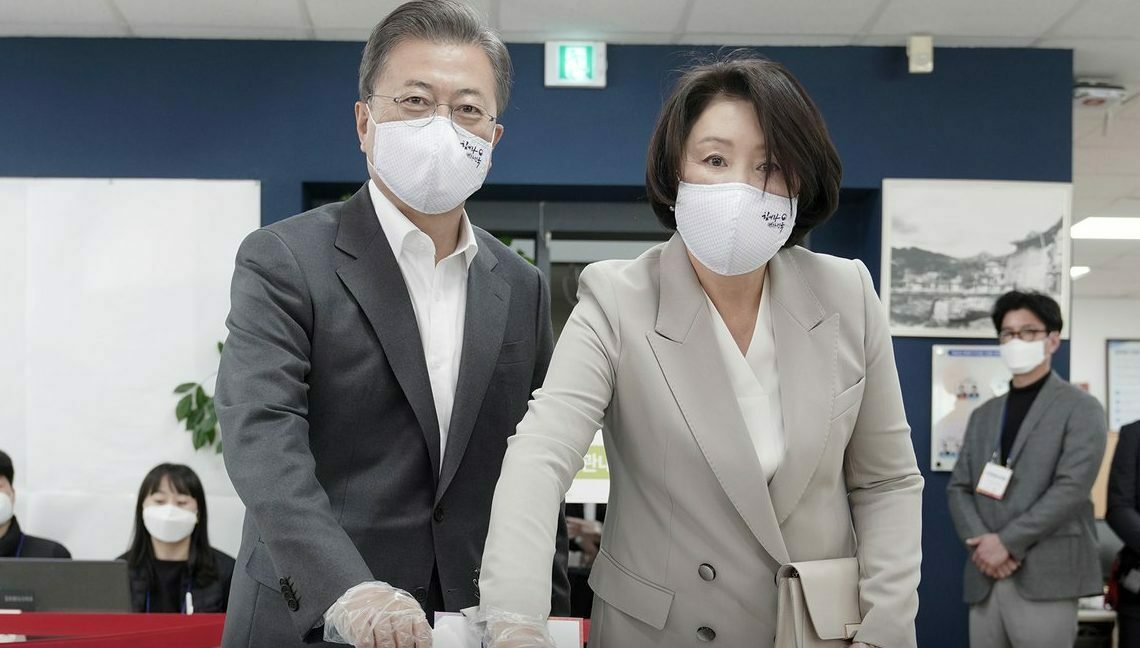 Meanwhile, despite last year’s election reform to make the parliament more diverse, the two major parties — and their satellite parties — on Wednesday appeared to have retained their dominant presence. Minor parties the Justice Party and People’s Party are expected to win 4-6 and 2-5 seats respectively. Thae Yong Ho, a former North Korean diplomat and a defector who announced his decision to run for office this February, is expected to win a seat for the opposition United Future Party (UFP) in Gangnam-A district with 58.4% votes, according to the exit polls by the Korea Election Pool. If confirmed, Thae will be the first North Korean defector ever to win a parliamentary seat in this way. 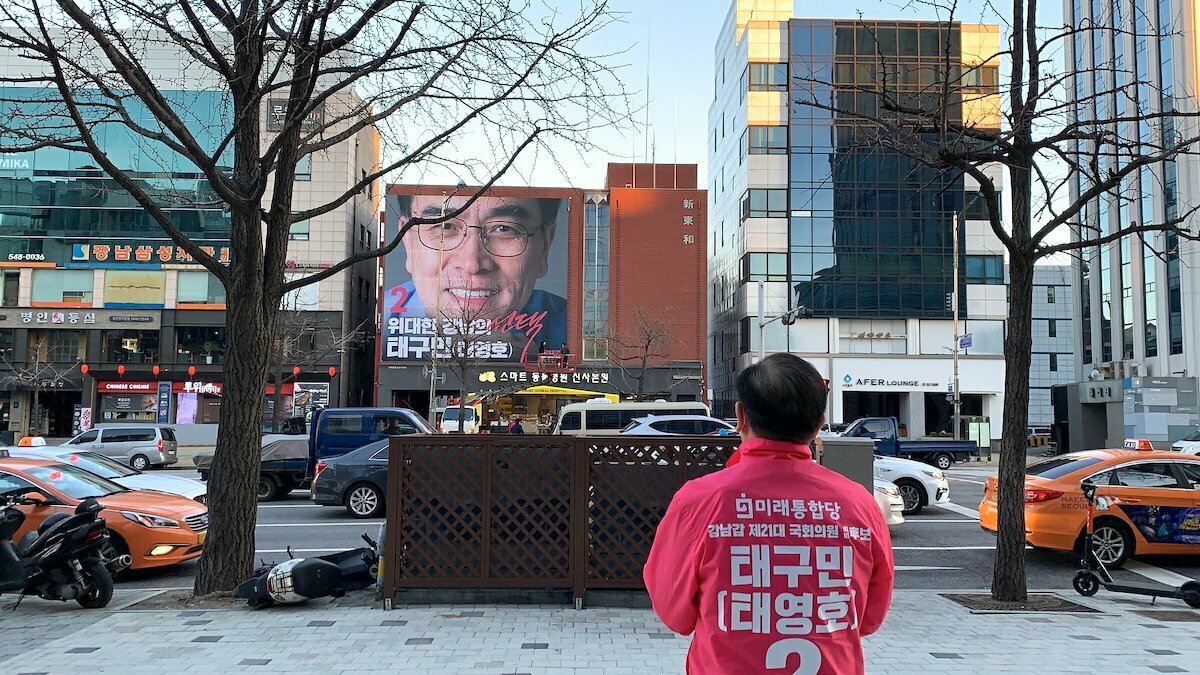 ELECTION D-1: NORTH KOREA FIRES MISSILES Today’s poll comes just a day after North Korea was reported to have fired multiple cruise missiles from Kangwon province Tuesday morning 07:00 local time. The test represented Pyongyang’s fifth this year, and took place alongside a flurry of additional reported military activity by Pyongyang. The launch was, unusually, not reported by North Korean state media the next morning, breaking from recent precedent. North Korea is one of the thorniest issues in South Korean politics — especially during election periods — and the two major parties on Tuesday both issued statements condemning the North for its military actions. The ruling Democratic Party public affairs bureau released statement late Tuesday calling on North Korea to “immediately stop military action that… harms inter-Korean peace.” The statement also expressed “deep regret” about the North’s decision to conduct the test “a day ahead of the election… making the entire Korean peninsula tense.” The test-launch, the ruling party said, “appears to be an intended threat to get the upper hand in negotiation with South Korea and the U.S.,” condemning the activity as “a stumbling block for the peace process on the Korean peninsula.” The main opposition party UFP also issued a statement, using the occasion to slam the ruling party and the Moon administration. “They are still our enemy, and a threat,” the UFP said. “If the Democratic Party wins tomorrow… ROK national security will, once again, suffer.” Edited by Oliver Hotham © Korea Risk Group. All rights reserved. |


 SHARE
SHARE COPY LINK
 X
X MASTODON


Recent Stories