
|
Analysis Leadership, guns, and money in North Korea: what happens if Kim Jong Un goesDespite claims to the contrary, the country has a formal process in place if the leader is no longer around
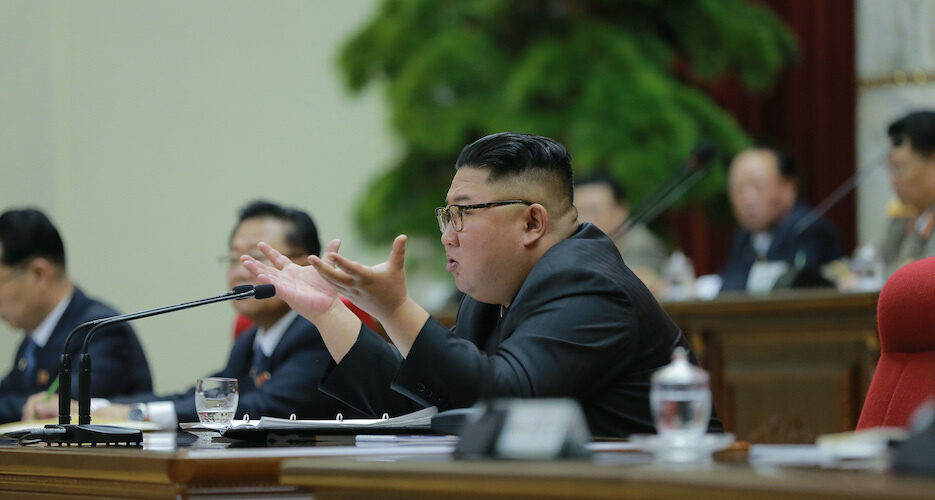 North Korean leader Kim Jong Un missed the country’s most important holiday on April 15 (Kim Il Sung’s birthday) and has not been seen in public since chairing a Politburo meeting on 11 April. Kim’s absence has triggered speculation that he might be ill or that he is avoiding crowds in the wake of the COVID-19 pandemic. Speculation intensified following a report by the Daily NK, a South Korean website, on 20 April that claimed Kim had undergone a cardiovascular procedure. The original Korean article suggests that Kim had received something like an angioplasty or stent insertion, but the Daily NK English version of the article the following day used the term “heart surgery,” which generated more confusion and speculation about Kim’s health and whether his condition is grave. There is still no credible public evidence to confirm the status of Kim’s health, but it is extraordinary for him to miss the ceremony honoring his grandfather’s birthday. Regardless of Kim’s condition, the incident raises the question of how a third North Korean leadership transition would proceed. Many are speculating about a possible succession, but the public discussion has focused little if any attention on how a succession process would ensue, what institutions would matter, who the relevant actors would be, and what their interests are. Some have claimed there is no succession plan, but North Korea does have a formal process for leadership transition. The rules and institutions are explicated in the Workers’ Party of Korea (WPK) Bylaws, which were last revised during the Seventh Party Congress in May 2016. Scholars and media have speculated about another Kim family member succeeding Kim Jong Un, but any leadership transition almost certainly would follow the formal rules as stipulated in the party Bylaws. Granted, under emergency conditions, the senior leadership has extensive powers and it does not have to follow precedent unequivocally. Whatever actions the senior leadership takes, those measures will reflect their interests and the interests of the party’s core elites. Nevertheless, significant deviation from the formal rules and procedures could be a sign that the process is being contested, subsequently increasing the likelihood of instability or violence. Ultimately, the process comes down to seizing and controlling the guns and the money.  POWER AND CONTROL IN NORTH KOREA North Korea is a personalistic dictatorship, so any succession could have serious implications for numerous internal and external actors. Kim Jong Un has multiple lines of authority; he serves as chairman of the WPK, chairman of the WPK Central Military Commission, as a member of the WPK Politburo Presidium, chairman of the WPK Executive Policy Bureau, chairman of the State Affairs Commission (SAC), and supreme commander of the DPRK’s armed forces. So what are the applicable institutions and rules for succession if Kim is unable to rule? The WPK Party Congress is the party’s highest decision-making authority, but only seven have been convened since 1945; the Seventh Party Congress was held in May 2016, the Sixth in October 1980. Nominally, the WPK Central Committee (about 125 members) assumes full party authority between party congresses (Party Bylaws, Article 25), but the WPK functions under the principle of democratic centralism (Party Bylaws, Article 11); therefore, power and control flow from the top. The Central Committee (CC) elects the Politburo and the Politburo Presidium (Party Bylaws, Article 26), but the CC is too large to overcome collective action problems and to act on its own, and democratic centralism results in the CC obeying orders from the top. Therefore, real decision-making authority is vested in the Politburo and the Politburo Presidium, which have the authority to “organize and guide” all party activities on behalf of the CC (Party Bylaws, Article 27). The CC also “organizes” the Party’s Central Military Committee (CMC), which deliberates and decides all party lines and policies in the realm of military affairs and national defense industries (Party Bylaws, Article 26). The CC elects the Control Commission, another important regime institution that “investigates violations of party discipline including deviant actions against the party’s monolithic leadership system or violations of the party bylaws” (Party Bylaws, Article 30). The Control Commission provides investigations and information for purges; it adds some redundancy as well as a check on the Organization and Guidance Department (OGD), which maintains files on every party member’s “party life,” in other words an assessment of regime loyalty. Every Central Committee member certainly realizes that contesting a Politburo decision is a textbook example of “factionalism” and grounds for swift retribution that in the worst case is execution. Currently, the Politburo Presidium is the formal locus of political power and control in North Korea. However, it is a very narrow coalition with only three members: Kim Jong Un, Choe Ryong Hae, and Pak Pong Ju. Pak is an 81-year old technocrat who previously served as premier of the cabinet. He showed up on the last day of the WPK Fifth Plenary of the Seventh Party Congress last December in a wheelchair but now seems to have recovered. Nevertheless, Pak had been purged and rehabilitated by Kim Jong Il, and he does not have the political or military base of support to contest any leadership transition.  Choe Ryong Hae is a different story. He is probably the closest embodiment of the “Paektu bloodline” without being a Kim family member. Choe Hyon, Choe Ryong Hae’s deceased father, was a guerrilla comrade of Kim Il Sung with legitimate anti-Japanese resistance credentials. Choe was five years older than Kim Il Sung and could have been the Soviet favorite for endorsement and support as leader in 1945. Nevertheless, Choe deferred to Kim; he remained a Kim family loyalist and survived the purges of the late 1950s through the 1960s, eventually serving as Minister of the People’s Armed Forces from 1968 to 1976. Choe Ryong Hae was born in January 1950, only five months before the outbreak of the Korean War. As a guerrilla faction princeling, Choe graduated from the Mangyongdae Revolution Academy and Kim Il Sung University, majoring in political economy. He shares school ties with several other Politburo and CC members. Choe began his political life in the Socialist Youth League (subsequently renamed the “Kimilsungist-Kimjongilist Youth League”) and obtained extensive experience in this mass organizations, rising to the rank of Youth League Central Committee First Secretary in 1996. He has served in the rubber-stamp Supreme People’s Assembly (SPA) since 1990 and currently serves as chairman of the SPA Presidium, which has the authority to pass legislation, to elect state officials, and to amend the DPRK Constitution. In September 2009, Choe Ryong Hae was relieved from his duty as a party secretary for South Hwanghae Province and received promotions to multiple positions to coincide with Kim Jong Un’s anointment as successor. He was elected as a CC secretary, an alternate member of the Politburo, and a member of the CMC. He also was promoted to 4-star general. In April 2012, four months after Kim Jong Il’s death, Choe was elected to the Politburo Presidium and as a vice-chairman of the CMC. He simultaneously was elected as the director of the General Political Bureau (GPB), which is the system of political officers that exercises political control over the Korean People’s Army. Furthermore, Choe was promoted to the rank of vice marshal. Choe was relieved of his GPB duties in April 2014, but in May 2016, Choe became a member of the Politburo Presidium and a vice-chairman of the WPK Central Committee. In October 2017, he became the director of the OGD. Despite Choe’s authority and credentials, his record is not unblemished. In the past, he has been marginalized, demoted, and subsequently rehabilitated and promoted, most recently in 2014. In North Korea, there really is no “number two,” but Choe has the family legacy as well as the experience and connections throughout the party, the security forces, the state, and the mass organizations to assume leadership. Choe’s potential weakness is that he is not a professional military officer who has commanded military units. However, as a former director of the GPB, Choe has experience wielding political control of the military, which counterintuitively to many outsiders is weak compared to the party. Another probable weakness is that although he is well positioned to “seize control of the guns,” he almost certainly does not have full access or control of critical financial resources. If Kim Jong Un can no longer rule, then nominally the Politburo Presidium and Choe Ryong Hae are in the driver’s seat to execute any leadership transition. Pak Pong Ju is in no position to challenge Choe, but such an extremely narrow coalition could not impose its succession preferences if they did not align significantly with those of the Politburo. After Politburo approval, an endorsement by the CC would be a mere formality. Ultimately, Choe would be the power broker in the succession but he would have to deliberate with the other 13 Politburo members to implement, modify, or reject and any succession plans left by Kim Jong Un.  Kim Yo Jong, Kim Jong Un’s younger sister, also could be influential in a leadership transition. Some have speculated that she could assume her brother’s role as the new Supreme Leader, but this is unlikely. Granted, she does have a number of attributes in her favor: a direct descendant of Kim Il Sung and Kim Jong Il; experience in the WPK Politburo as an alternative member; experience in the WPK Organization and Guidance Department and the Propaganda and Agitation Department; experience as Kim Jong Un’s informal chief of staff or personal secretary; likely access or control of secret financial resources (the money!); and possibly the necessary ambition and intelligence. On the other hand, she has some significant weaknesses. She’s young, believed to be 32, albeit about the same age as her grandfather when he rose to power, and older than her brother when he assumed leadership. While knowledgable, she lacks the depth of experience—especially in the military and security realm—that Choe Ryong Hae and the other senior Politburo members have. Finally, her gender is a major impediment to becoming Supreme Leader. North Korea is a very patriarchal society so it would be extraordinary for a woman to succeed Kim Jong Un. It’s not impossible, but it would be very difficult for her to surmount the barrier of gender bias. POWER BROKERS AND INSTITUTIONAL CHANGE Since April 2019, there has been significant turnover in the Politburo, with eight new members being elected. The core power group in the Politburo is centered on the four senior members with experience in the military and security forces. These include Kim Yong Chol (75), Choe Pu Il (76), Kim Su Gil (70), and Ri Pyong Chol (72), who are all long-term Kim family regime loyalists with no incentive to overturn the system. They should be expected to support a smooth transition that maintains strict discipline and an emphasis on national (regime) security. Secondary but also critical members are Pak Tae Song (65), Jong Kyong Thaek (57~59), and Pak Jong Chon (50s). While Jong Kyong Taek and Pak Jong Chon are key power brokers as Minister of State Security and KPA Chief of the General Staff, respectively, they have risen to these positions recently and most likely would follow the lead of their more senior colleagues. It is difficult to imagine them contesting Choe Ryong Hae and the other senior members. Finally, the less influential group consists of technocrats and authorities in education or ideology. These members include O Su Yong (73), Kim Jae Ryong (50s), Thae Hyong Chol (67), Choe Hwi (65), Ri Il Hwan (60), and Kim Dok Hun (59). This group is competent with experience managing large organizations such as cabinet ministries, industrial enterprises, mass organizations, and research institutions. However, they do not have the experience and the personal connections in the military and security institutions to muster a loyal group of rebels to contest the preferences of Choe Ryong Hae and his four senior comrades.  CONCLUSIONS The key to sustaining a dictatorship is to maintain control of the guns and the money. If Kim Jong Un is unable to lead, Choe Ryong Hae is in the best position to seize control of the military and security apparatus. Kim Yo Jong’s advantage is that she is part of the “sacred Mt. Paektu bloodline,” and she probably has control or access to key financial resources. Both parties need each other to sustain a post-Kim Jong-un regime, so they have very strong incentives to cooperate and to coopt the rest of the Politburo support an equilibrium with some division of labor between the two. Choe Ryong Hae and Kim Yo Jong have greater incentives to cooperate if the rumors surrounding her marriage to Choe’s second son turn out to be true. Furthermore, Ri Pyong Chol, a supposed relative (potentially an uncle) of Kim Jong Un’s wife Ri Sol Ju, should be expected to be a loyal guardian to continue the system even if it is a “hybrid regime” with some division of labor between Choe Ryong Hae and Kim Yo Jong. A cooperative arrangement, if it emerges, probably would be stable in the months and even years ahead—but not without tensions, especially when questions arise regarding the ultimate command authority of the nuclear arsenal, the military, and the internal security forces. However, if Kim Yo Jong is ambitious and smart, she can play the long-game while building up her networks and obtaining the experience necessary to become the next Supreme Leader after Choe Ryong Hae and his cohorts pass from the scene. In sum, if the worst-case rumors surrounding Kim Jong Un’s health are true, mechanisms are in place to execute a stable leadership transition. Workers’ Party of Korea Politburo as of April 2020
Sources: 통일부, 북한 주요인물정보 2019; 통일부, 북한 기관별 인명록 2019; Rodong Sinmun; KCNA; 김소연 및 이제훈, “북한 ‘무기개발 지휘’ 리병철 정치국 위원 승진,” 한겨레 신문, 2020.01.01. Edited by Oliver Hotham © Korea Risk Group. All rights reserved. |


 SHARE
SHARE COPY LINK
 X
X MASTODON


Recent Stories