

|
News North Korea fires two “short-range ballistic missiles,” South Korea saysTest is first of its kind by the DPRK this year
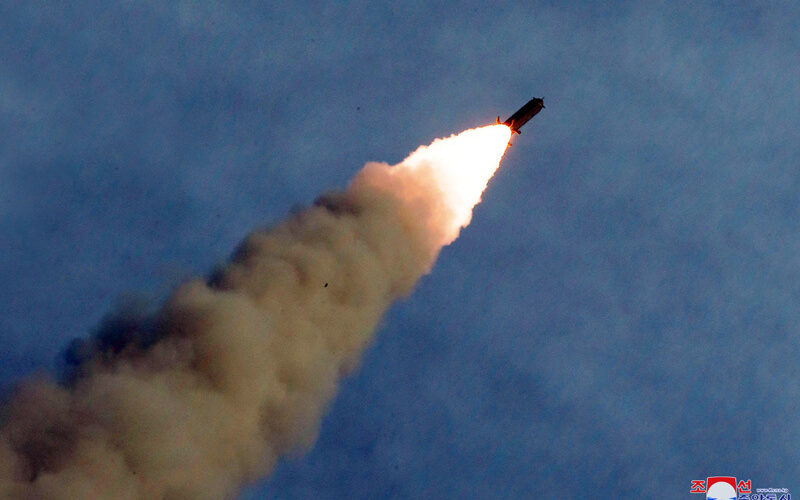 Updated at 15:00 and 16:35 KST: This article has been updated to include further assessments from the South Korean military, as well as commentary from three experts. It was later updated to include additional comments from a JCS official. North Korea on Monday test-fired two short-range ballistic missiles, South Korea’s military said, the first such launch by the country this year. The projectiles were fired from Wonsan on the country’s east coast around 12:37 local time, the Joint Chiefs of Staff (JCS) reported, and headed towards the Sea of Japan, known in Korea as the East Sea. “Our military is maintaining the readiness posture while tracking and monitoring the relevant movement in preparation for additional launch,” the statement added. Monday’s test comes just days after North Korea conducted what it described as a “joint strike” military drill on its east coast — also its first such exercise in 2020. South Korea’s military assessed that Monday’s test marked a continuation of that exercise, and that the projectiles in question traveled 240 kilometers at a maximum altitude of 35 kilometers. “Additional specifications are being analyzed by ROK-U.S. intelligence authorities,” the JCS said, adding that “North Korea’s such actions do not help to ease tensions on the Korean peninsula, and it is urged repeatedly to stop immediately.” A later briefing by an unnamed JCS official to local press described the test as having been of “short-range ballistic missiles.” Monday marks North Korea’s first missile test since November 28, when the country was reported to have conducted a “test-fire of super-large multiple rocket launchers [MRLs].” It also marks the first from Wonsan since the launch of the “new-type” Pukguksong-3 submarine-launched ballistic missile (SLBM) on October 3. “It sounds like they are starting off with something small and conventional in nature,” Joshua Pollack, a senior research associate at the Middlebury Institute of International Studies at Monterey, said, adding that South Korea’s assessment that the test represented a continuation of the weekend’s exercise “makes sense.” “North Korea has presented missiles that fit this profile as ‘tactical’ and implicitly conventional in nature,” he said. The test follows months of diplomatic inaction between the U.S. and North Korea, with talks effectively on ice since a meeting in Stockholm fell apart without a deal in October last year. December passed in relative calm, however, despite North Korean threats of a “Christmas gift” for the U.S. earlier that month. A ruling party plenum that month also saw DPRK leader Kim Jong Un promise the country would “steadily develop necessary and prerequisite strategic weapons” in the coming year, though he stopped short of ending an April 2018 self-declared moratorium on nuclear and intercontinental ballistic missile (ICBM) testing. North Korea’s borders have been effectively closed since late January, amid a nationwide campaign to prevent the spread of the coronavirus. Concerns about the spread of that virus — known officially as COVID-19 — last week prompted ROK and U.S. military officials postpone plans to go ahead with a joint computer-simulated “command post training” exercise.  One expert said Monday’s test likely represented the kind of “operational training test” often undertaken by North Korea in March. “Historically, in the Kim Jong Un era, March has been a reliable month for missile testing, especially as a response to U.S.-ROK drills,” Ankit Panda, an adjunct senior fellow at the Federation of American Scientists, told NK News. “This time, Kim is drawing a contrast, carrying on with normal defense drills even as allied exercises are suspended amid COVID-19,” he added, saying that current South Korean estimates suggested that the missile tested was a KN-23, “perhaps on a more depressed trajectory than normal.” It’s not immediately clear how the U.S. will respond to Monday’s test: with diplomacy between the two countries stalled, President Donald Trump and top officials have largely refrained from discussion of the North Korean issue in recent months. “We can be certain that the Trump administration will try to play down this incident, saying it’s not a big deal,” Andrei Lankov, a director at the Korea Risk Group — which owns and operates NK News — said. “For the North Koreans it’s just a show of force and a reminder about their existence, and probably a way to get some useful technical information,” he added. “Remember, these tests are not just about politics, they are about technology, too.” Edited by James Fretwell © Korea Risk Group. All rights reserved. |


 SHARE
SHARE COPY LINK
 X
X MASTODON


Recent Stories