
|
COVID-19 North Korea working with WHO to prevent potential coronavirus outbreak: officialDPRK health ministry on Tuesday issued alert over virus symptoms, spread in China and Asian region
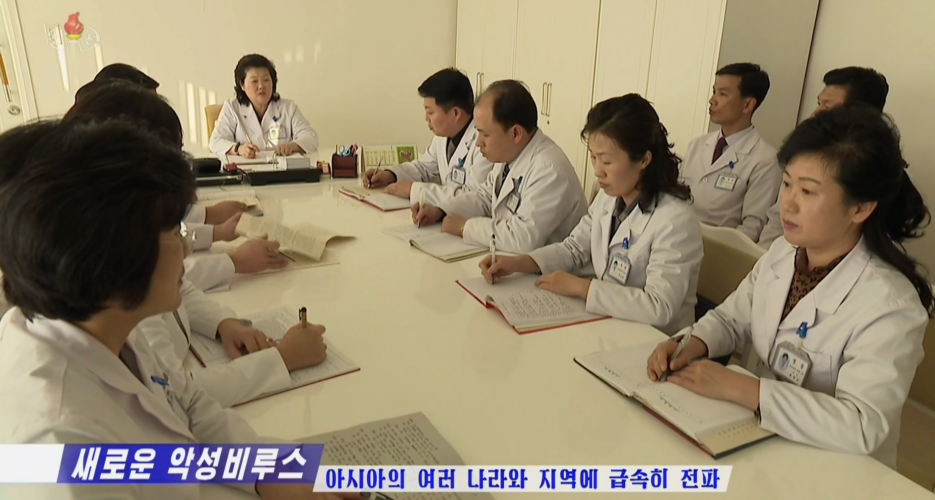 North Korea is working with the World Health Organization (WHO) to prevent the new Chinese coronavirus from spreading domestically, a health ministry official told the country’s state television Tuesday evening. The announcement of symptoms of the “new malignant virus” and details of its spread in China and other Asian nations in state TV news — followed by the ruling party-run Rodong Sinmun on Wednesday — marks the first mention of the outbreak in domestic media. It comes as NK News reported late Tuesday on North Korea’s efforts to close off its border to tourists and potentially other sectors of travelers as part of prevention efforts related to the new flu-like coronavirus. “Working closely with the WHO, we are intensifying hygienic education activities regarding the new malignant virus, as well as strongly carrying out activities nationwide to head off [the virus],” office director Kang Chol Jin of the Ministry of Public Health’s (MPH) State Hygienic Control Board said during the Korean Central Television (KCTV) 20:00 newscast.  The statement at the end of the segment was made over shots of DPRK health officials and doctors holding meetings at an undisclosed time and place. NK News has reached out to the WHO for comment on their cooperation with the DPRK and is awaiting a response. The segment began with Kang describing the coronavirus as “causing severe concerns around the world” and that “the malignant virus newly occurring this time is entirely different than past coronaviruses” like SARS and MERS. “From the time the virus was first detected in China until the 19th this month, three persons died and 200 persons have been infected with the virus,” Kang said. “This virus now continues to be discovered in various Asian countries such as Thailand, Japan, and South Korea,” he added as scenes from Thai hospitals and health officials’ meetings were shown. Much of the news segment focused on China, showing scenes from security checkpoints using a thermal camera system to detect people with high temperatures, and reporting that the country is strictly carrying out checks at airports and train stations with a policy of preventing detected patients from traveling. Describing the symptoms, Kang said they are in the beginning “similar to a common cold such as fever and cough, but if it gets worse there is respiratory difficulties and various other complications that can occur with long-term effects that can threaten one’s life.”  The WHO, he added, was working with countries throughout the region to prevent the spread of the virus, and repeated some recommendations such as encouraging people to wear masks when going out and to frequently wash their hands, clean desks and other surfaces at offices, and open windows to circulate air. An article published on the last page of Wednesday’s edition of the Rodong Sinmun also included similar details of the symptoms and spread of the virus in China in recent weeks, saying that as of January 20 there had been 217 confirmed cases. It added, however, that there may be more cases that have so far gone unreported, citing the “UK Medical Research Association,” possibly referring to statements of the Medical Research Council’s (MRC) Centre for Global Infectious Disease Analysis at Imperial College London. There have been no reported cases of the coronavirus in North Korea, and the DPRK government is also yet to publicly report on any of its own efforts to prevent tourists or others from entering the country to halt the virus’s potential spread. The South Korean government on Wednesday said they were paying “sharp attention” to the situation, which could impact Seoul’s ongoing plans to restart independent tourism by its citizens to the North. “We will be reviewing the issue of independent tourism with a full consideration of said matters,” unification ministry spokesperson Lee Sang-min told a regular press briefing. North Korea last instituted strict travel restrictions and quarantines amid the spread of the Ebola virus mainly in Africa in late 2014, extending its closed-border policy for several months through the spring of 2015 — effectively closing the tourism industry and causing a range of knock-on effects. During the spread of another coronavirus named MERS across the border in South Korea in mid-2015, however, tourism resumed and continued without such restrictions, with DPRK media accusing the U.S. of intentionally spreading the virus to the South as an act of chemical warfare targeting the North. North Korea’s apparent efforts to once again initiate strict border controls amid the new coronavirus spread may be linked to the country’s reported lack of public health infrastructure to handle a widespread outbreak. Additional reporting by Jeongmin Kim Edited by James Fretwell and Oliver Hotham © Korea Risk Group. All rights reserved. |


 SHARE
SHARE COPY LINK
 X
X MASTODON


Recent Stories