

|
Analysis Expert survey: Can the international community slow N. Korea’s missile testing?Scholars weigh in on the potential fallout from Pyongyang's latest missile launch over Japan
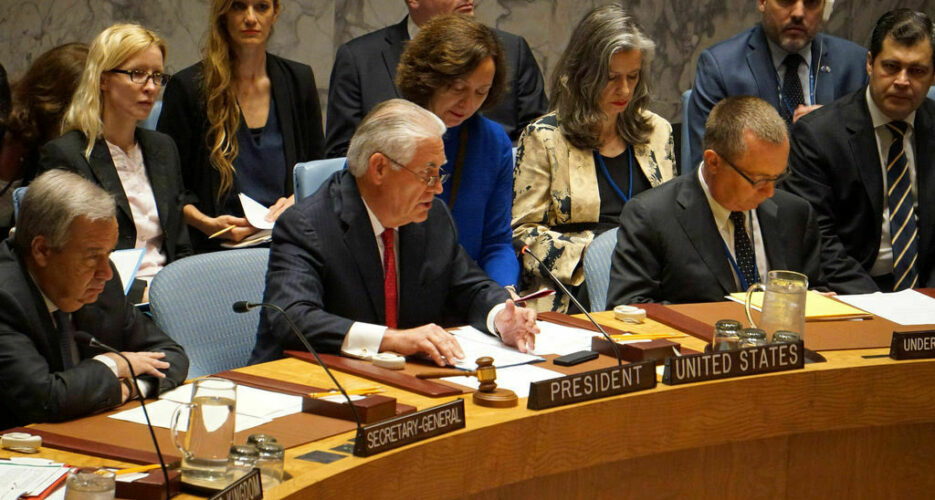 Three days after test-launching several short-range projectiles toward the Sea of Japan (known in Korea as the East Sea) from Gwangwon Province, North Korea on Tuesday morning conducted a test launch of a ballistic missile. Coming less than a week after U.S. Secretary of State Rex Tillerson described a “level of restraint” from Pyongyang in August, Japan’s Chief Cabinet Secretary Yoshihide Suga on Tuesday morning described the launch as an “unprecedented, serious, and grave threat to our nation.” The tests came amid the two-week long Ulchi Freedom Guardian (UFG) joint military exercise by the U.S. and South Korea that runs until the end of this month, which North Korea’s army last Tuesday described as representing a “military confrontation” against the DPRK. But with the international community sending signals to Pyongyang to respond to calls for talks, it seems that the North has sent the message that it isn’t interested – for now at least. With an emergency meeting of the United Nations Security Council (UNSC) announced to discuss the latest test late Tuesday afternoon, following a joint request by the U.S., South Korea, and Japan, it appears that an international response will be swift. But what can really be done, at this stage, to prevent Pyongyang from further developing its weapons? And what motivated Tuesday’s test – and the provocative launch over Japan? The following North Korea specialists responded on the issue in time for our deadline:
 1. What motive might North Korea have to launch a missile over Japan?
So the point is, while we are focused on Japan, and Japan is important, it could be a mistake to define it as “the test that flew over Japan.” If you look at the map, North Korea has to fly over and near its neighbors. So, it could go over or land near South Korea, Japan, Russia, Guam… China. So, I think that’s important, not to over-read the Japan component to this while recognizing Tokyo’s serious concerns.
In the meantime, they have technological demands for further tests. That’s why they’d keep testing until they perfect the technologies.
i) Divert attention away from the failed short-range missile launches a few days earlier; ii) partly compensate for backing down on the earlier missile launch threat towards Guam. The trajectory of the launch was eastward instead of south, because – as Foreign Minister Taro Kono speculated at the press conference immediately after the NSC has concluded this morning – North Korea may have “flinched” and decided against shooting the missile towards Guam, opting instead to launch it towards a different direction but still over Japan. In short, this missile launch allowed North Korea to send separate messages to its domestic and international audiences: one of North Korean strength to the former and one of defiance to the latter.
To me, this one is just a normal test. Previously, they launched the missiles toward the sky and have restrained themselves, avoiding launching toward other neighboring countries. But they also need to test their technology with the “normal launched angle.”  2. What are the prospects that sanctions can prevent North Korea from deploying credible ICBMs at this point?
The other kinds of sanctions more broadly trying to inflict pain on the North Korean economy in order to dissuade Kim Jong Un from developing the nuclear missile program— in the absence of a high-level, diplomatic effort that is moving into formal negotiations— will be counter-productive. North Korean media is, on a daily basis, ranting about the UN sanctions, against foreign hostility led by the United States, assisted by South Korea, and is part of the block to any inter-Korean breakthrough. The relationship is already bad between Pyongyang and Beijing, and sanctions make that relationship worse — which means Beijing has even less influence over the DPRK. Meanwhile, decision makers in the United States are tempted to sit back and wait, thinking, let’s see, once the new sanctions start to bite, then maybe Kim Jong Un will come to us, seeking negotiation. Then we will have the upper hand, we will have the leverage. Unfortunately, it’s unlikely to go that way.
Resolution 2371, which was unanimously adopted by the UNSC earlier this month, is the strongest sanction on North Korea to date that includes a full sectoral ban on coal, iron, and lead exports. Complete compliance with this sanction by all relevant parties, especially China and Russia, would likely have a profound impact on North Korean calculus. Other countries should be prepared to engage in secondary sanctions against those that associate with North Korea’s missile and nuclear programs to pressure China and Russia into fully implementing resolution 2371.
 3. What is “unprecedented, grave and serious” about the launch – as Yoshihide Suga, Japan’s Chief Cabinet Secretary described it?
It is grave and serious, as a part of a security dilemma that keeps getting worse and worse where North Korea is developing deterrence capabilities and the United States and its allies Japan and South Korea are developing their deterrence capabilities. Both sides use offensive and defensive elements to what are basically deterrence strategies. And so it’s a serious security dilemma, for now, focused on the missile capabilities because that’s what we’re most worried about. But of course, those capabilities are connected to their nuclear arsenal. And the nuclear-missile capabilities are symptomatic of a 70-year security dilemma. So yes, it’s grave and serious and it’s going to take a long time to reverse the dynamics.
They don’t have many options on choosing directions. Though this test also shows Pyongyang’s confidence to the missile’s distance capability. This is not the first time North Korean missile flying through Japan, and North Korea doesn’t take risks easily. Today’s test is only one of the many, and it is not even part of the ICBM.
i) First is North Korea’s increasingly unclear intentions – missile launches by North Korea that flew over Japan in the past two decades were preceded by advance warnings, making this the first time since the 1998 Taepodong-1 missile launch that North Korea did not give prior warnings. ii) Second is the advancement of North Korean missile and nuclear weapons capabilities, which makes it much more threatening than in the past. iii) Third is the recent increasing tensions between the U.S. and North Korea, where fiery rhetoric is no longer limited to a one-way street. iv) Fourth is the lack of effective means by the international society to prevent North Korea from further developing its missile and nuclear weapons program, with the missile being launched immediately after the unanimous adoption of resolution 2371. v) Fifth is the strong belief held by security experts in Japan that North Korea’s nuclear weapons, if they are to be used, will be against Japan.
 4. What can and should the international community do in response to this test?
Abe once said he would go to Pyongyang if it would help get the abducted Japanese citizens released. Would he go to Pyongyang, if it would help reduce hostility and risks? It’s the middle of the night in the United States, but in the morning, someone is going to wake up and get on Twitter, and possibly throw everything off course. So Tokyo and Seoul have to frame this and work on a response, have that already in some kind of motion before the rhetoric potentially escalates in a way that Japanese people probably don’t want. I think this requires proactive regional, bilateral diplomacy more than it demands another round at UN security council.
The U.S. still owns the decision rights. What the international society can do now is preventing the outbreak of the war, keeping advocating the importance of peace. The U.S.’s attitude is the most crucial factor. To me, the problem is Trump’s unpredictability. Pyongyang knows its own capability. We need to let Trump understand the consequence of war. Pyongyang’s nuclear weapon is for leverage. They have enough rationality not to actively attacking other people.
Mounting this pressure should not be limited to the usual trilateral framework of Japan, U.S., and ROK. The increased missile range of North Korea implies that Australia, Europe, and the Middle East are all within range, which may lead some countries to perceive North Korea to be an increasing threat to themselves and opt to play a more active role compared to the past.
South Korea and the U.S. are still insisting the precondition for negotiation. The U.S. is reluctant to accept the current status of North Korea, but I think the international society would eventually be forced to accept it. That’s why China thinks starting to talk sooner is better than later. Edited by Oliver Hotham Featured Image: U.S. Department of State © Korea Risk Group. All rights reserved. |


 SHARE
SHARE COPY LINK
 X
X MASTODON
 John Delury: This test has to be seen in the context of a series of tests to demonstrate the capability of this particular missile system, and it also has to be seen in the context of five years of relentless missile tests in the Kim Jong Un era.
 Zhang Huizhi: I think this is aimed at the South Korea-U.S. military exercises. To me, this motivation is very obvious.
 Jiyoung Park: The North wants to test an actual ICBM by putting together a number of partial tests over the past year and this year, and will continue to keep this routine, with a mix of long and intermediate range missiles, until it succeeds.
 Akira Igata: The timing of the launch suggests that this is a direct response to the ongoing annual Ulchi-Freedom Guardian exercise, a joint military exercise between U.S. and South Korea. The decision to launch the missile over Japan is a means to:
 Cai Jian: I think this test is part of Pyongyang’s normal routine. They need to keep testing to perfect its technology. Failures (last weekend) demonstrate the fact that its technology still has problems. That’s why they need more tests.
 John Delury: Sanctions alone are likely to accelerate their work on the weapons program, not slow them down. Sanctions narrowly targeting the weapons program are useful, although hardly fool-proof—and as we know, they can do a lot indigenously, on their own.


Recent Stories