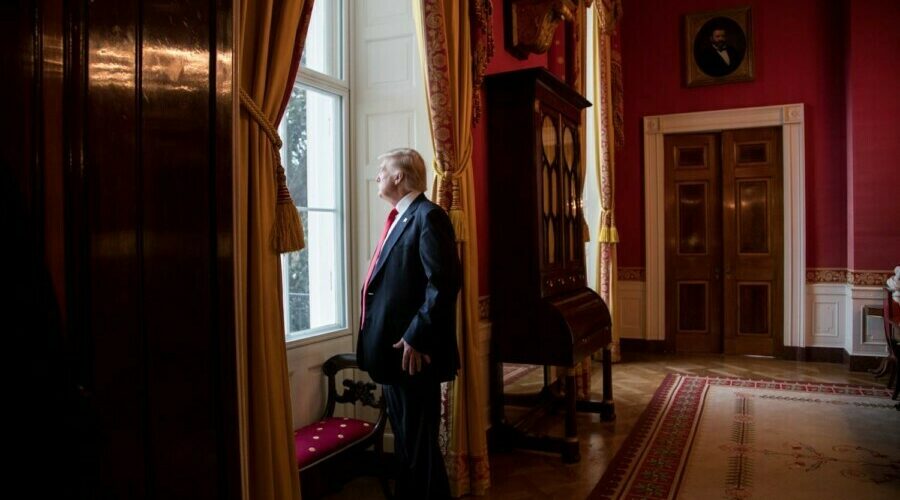

Over two months since his inauguration, President Donald Trump has been remarkably slow in naming candidates for key roles in his administration: of 553 key positions requiring Senate confirmation, as of Thursday just 21 positions had been confirmed, with hundreds of nomination selections still pending.
But while much ink has been spilled on the impact of this delay on broader areas such as defense and the economy, the specific consequences of this as far as North Korea policy could be concerned are becoming increasingly important.
With a major summit meeting next week between Trump and Chinese leader Xi Jinping, the specter of a sixth North Korean nuclear test looming, and an election in South Korea just over a month away, the lack of senior Asia- hands and officials with Korea experience could have a significant and far-reaching impact on the peninsula.

With the Department of State (which faces budget cuts of up to 30%) and the Department of Defense having so many Korea-focused vacancies, how then would the U.S. be able to respond should major problems emerge on the Korean peninsula? And what are the risks?
“First of all, it looks like American diplomacy will be unable to function properly because right now they have acting deputies and acting officials, who are by definition insecure in their positions, cautious, and obviously afraid of making any potentially risky decisions in a crisis situation,” says Dr. Andrei Lankov, a regular contributor to NK News and a professor at Seoul’s Kookmin University. “So it will just mean that any crisis is going to be even messier than usual.”
“On the other hand, it looks like that for the time being, Donald Trump and his advisors are quite skeptical about the State Department and traditional diplomacy, and would prefer to operate through the National Security Council (NSC),” he continued. “So most likely, crisis management will be done by people in the NSC, rather than in the State Department.”
Indeed, from a practical defense and deterrence perspective, it seems the U.S. response to a military provocation would not be difficult to coordinate, even with Washington lacking senior personnel in key Korea positions.
“If a crisis were to emerge on the Korean peninsula tomorrow, the U.S. and South Korea would be well within their capabilities to handle it,” says Dr. John Hemmings, Director of the Asia Studies Centre at the Henry Jackson Society.
“Their forces are integrated in command for exactly these contingencies, and troops regularly train and exercise war plans together,” he says. “While the Trump administration has yet to develop a policy team, it has the capacity in the NSC to make decisions in a crisis.”
Of 553 key positions requiring Senate confirmation, as of Thursday just 21 positions had been confirmed
But if a crisis emerges – for example, should North Korea reveal an intercontinental ballistic missile (ICBM) capable of reaching the continental United States – “it is best to be well prepared,” says Dr. Robert Kelly of Pusan National University.
That’s because such an event “could well be the issue that sets the U.S. and North Korea on a collision course,” he says.
Therefore, “having well-trained experts around the president would help decision-making enormously,” he says. “Good, smart people filling pre-existing policy roles is almost certainly wise, no matter who the president is.”

Trump is yet to nominate an Ambassador to Seoul I Photo: Wikimedia Commons
But whether the Trump administration can find the right appointees, implement the recommendations of a still-unfinished North Korea policy review, and build a constructive working relationship with the next government of South Korea before such a crisis emerges, remains an uncertain question.
And for some, it appears that North Korea is far from the priority that Secretary of State Tillerson seemed to suggest during his tour of Japan, South Korea, and China this March.
“North Korea was one of the areas where it has been easiest to maintain bipartisan consistency over the years and decades,” says Dr. Daniel Pinkston, an instructor at Troy University.
“(But now) it seems the Trump administration is more interested in domestic policy,” he adds. “Foreign policy, especially East Asian policy, does not seem to be a priority.”
CHINA PRECEDENCE
What happens, then, if a crisis emerges with North Korea in the coming weeks and months? An important historical precedence exists which offers some insight into the consequences of an incomplete U.S. government handling a serious diplomatic incident.
How might a crisis now look with so many holes in the current administration?
In April 2001, a collision took place over the South China Sea between a U.S. EP-3 reconnaissance plane and Chinese naval fighter plane, resulting in the American plane having to make an emergency landing on a nearby Chinese airfield. As a result of the incident, the 24 crew members were detained less than three months after the inauguration of President George W. Bush.
“Washington and Beijing disagreed over the cause of the accident, when and how to release the U.S. crew and plane, whether the U.S. government would “apologize,” and the PRC’s right to board the U.S. aircraft and learn about its equipment,” a Congressional Research Service report said about the incident in October 2001.
Longer-term, the incident was important for Washington because it would also have implications for “the right of U.S. and other nations’ aircraft to fly in international airspace near China,” the report said.
At the time the U.S. Department of Defense had only Secretary of Defense Donald Rumsfeld and Deputy Secretary of Defense Paul Wolfowitz in place, with numerous key picks and political appointees relevant to a response still pending.
Although the U.S. was able to eventually get back its crew and plane, on Washington’s dime, it capitulated – in the view of some – by issuing the “Letter of two sorries,” which said the U.S. was “very sorry” for the death of China’s pilot and for entering Chinese airspace and landing on Chinese soil without verbal clearance.
The result? While the Bush administration sought a compromise solution to resolve the situation despite an initially tough stance on the issue, the high-level involvement of senior figures catalyzed an increasingly tougher line towards Beijing following the incident.
So, how might a crisis now look with so many holes in the current administration?
“Ad hoc responses to crises when a policy approach is not already in place become de facto policy,” says Roy D. Kamphausen, Senior Vice President for Research and Director at the National Bureau of Asian Research, who previously worked as China policy director in the Office of the Secretary of Defense and was a military attaché at the U.S. Embassy in Beijing.
“So, the challenges of incomplete staffing are that it is unlikely that a process for developing policy is in place and that when a crisis occurs the responses to that crisis become de facto policy,” Kamphuasen added.
“I don’t think the North Koreans understand it, (but) I think they are quite happy to see chaos in Washington”

Does the lack of leadership at the State and Defense Departments benefit the North?
KOREAN VIEW?
How, then, must North and South Korea be viewing the sluggish pace of Trump’s appointment of figures relevant to the peninsula?
“Well I think that North Korea is probably reading it with relief, as a sign that they’re not really on the agenda,” says Lankov.
But one impact of that, Lankov says, is that “any crisis could get out of control… (especially) given the personal traits of Mr. Trump… it would be advisable to have reasonable people around him who would give him calming advice.”
Whether the North Koreans understand the significance of the void in key positions, is, however another question. “I don’t think the North Koreans understand it, (but) I think they are quite happy to see chaos in Washington.”
“Talking about South Korea,” Lankov continues, “they are definitely unhappy about it, because they see it as partially a sign of neglect, and partially a sign that their major ally is unpredictable.”
Not all, agree, however.
“I don’t get the sense that Trump’s indifference to Northeast Asia position-filling resonates much (in Korea),” says Kelly. “That is pretty arcane issue to most people.”
“I would imagine South Korea elites are a little unnerved. But I have long argued that the ‘pivot to Asia’ only resonates with American elites, and that most Americans don’t care that much about Asia and care more about the Middle East. Trump the populist reflects that. Had Clinton won, she’d be much more involved.”
NEXT STEPS
Next week, Trump will meet with Xi Jinping in Mar-a-Lago, just as reports have emerged that the U.S. may be considering secondary sanctions that could have an unwelcome impact on numerous companies and banks based near the Chinese border with North Korea. But is the U.S. prepared for the potential difficulties that could arise?
“The upcoming Xi – Trump meeting is extremely premature,” says Hemmings. “The Trump White House has yet to appoint many key personnel in its administration, and since people are policy in Washington, the President is reduced to symbolics and reactive policymaking.”
But “the one issue that the Administration can discuss meaningfully with China is North Korea,” he says. “They will want a stricter set of sanctions on the regime, at the very least. The question is, of course, what they will offer Beijing in return.”
Longer-term, South Korea’s presidential elections loom. And in the event of an election of Moon Jae-in this May, who is well known for advocating engagement with the North that would stand at odds with the U.S., Lankov warns of “probably the worst period in relations between Washington and Seoul ever in the next four years.”
“Talking about what I basically see, well we don’t have nominations. People are quite uncertain about the future policy line. Plus of course, most officials or at least many officials are skeptical or hostile towards Donald Trump,” Lankov continues.
“Probably, he faces the greatest level of animosity among the Washingtonian bureaucracy, a greater level than any president has faced in decades. And of course that’s not helping his position.”
Featured image: White House
Join the influential community of members who rely on NK News original news and in-depth reporting.
Subscribe to read the remaining 1708 words of this article.
EXISTING MEMBER?


');
newWindow.document.write('
');
newWindow.document.write('