
|
Evergreen All seeing but unseen: life as a U.S. military interpreter in South KoreaFormer army interpreter was one of the few to visit 2015 land mine incident site
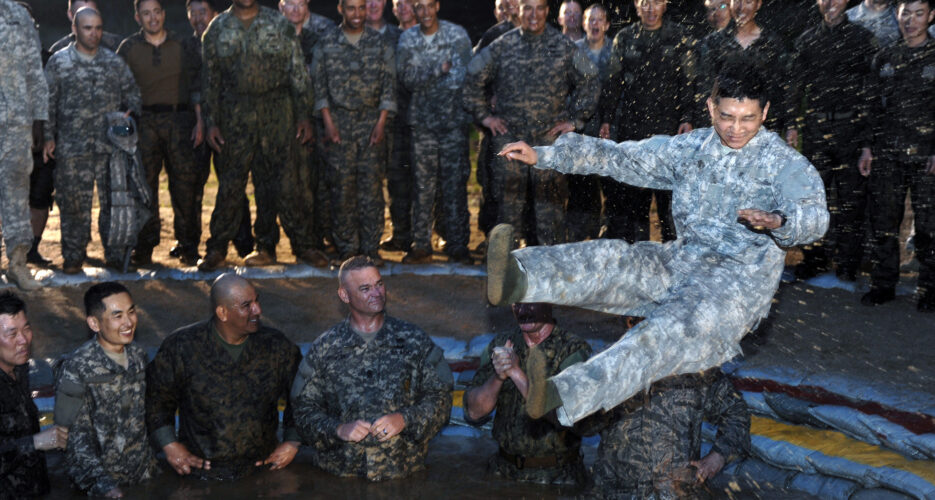 “Entering the DMZ about a week after the North Korean mine-attack of August last year, my boss told me to follow his steps closely, as the zone was filled with landmines,” says Choi Young-hyun, a former military interpreter now living in Hong Kong, far from the 38th Parallel. Working as an interpreter for the-then Command Sergeant Major of U.S. Forces Korea, Choi would become one of the few men to visit the site of the attack within a few days of an incident that severely injured two South Korean soldiers. At the time, tension at the ROK Army First Division was at its peak, and Choi and his team had to be fully equipped with body armor and guarded by South Korean DMZ forces, who he says were constantly aiming their rifles outside their vehicle windows on the way to the site. “The way to the mine attack site was so rough,” remembers Choi, his party’s vehicle wheels being “stuck in mud pools” at one point had to be dug out by hand. Shortly after the incident, Seoul claimed evidence it found on site showed North Korea had deliberately placed the mines, though the North soon released a statement fully denying the charges.
But from what Choi saw, it was clear that the mines were planted by North Korean soldiers, purposefully and deliberately against South Korean forces. “The explosion site was at a blind spot which South Koreans couldn’t see through easily,” says Choi. “That location gave South Korean guards a very limited line of sight (towards anyone placing the mines), with the North having a much superior field of view,” Choi continues, saying that according to a military briefing, all of the mine components found were traced back to the North. Choi also denies the possibility – raised several times after the incident – that the mine had drifted to the site in mud after heavy rain. “If those mines drifted to the location after torrential rains, South Koreans should have been able to see the direction they came from,” he says. “But the mines did not follow any pattern at all.” “Also, one (mine) was planted right under the fence door towards the southern side – only possible if someone has put their arms under the wall and dug – with another one planted at the northern side.”  QUASI-BATTLEFIELD TRAINING While some people might think a “military interpreter” sounds like the type who wears suits and works in comfortable offices, that wasn’t the case for Choi. “I had to eat cat food mixed with rice during training in May 2015, and cooked pig liver in my September training,” Choi says. “It was part of the ROK-U.S. Mangudai exercise which was aimed at maintaining our readiness against the North.” And during a total of 58 non-stop hours of Mangudai, participants like Choi were served only half the normal amount of ready meals each day and were only allowed four hours of rough sleep on a mountain, occupied with numerous tasks throughout their waking hours. “Starting at 4am on the first day of Mangudai, we were given ten different tasks to solve, such as destroying enemy fortifications and even killing Kim Jong Un,” Choi says. “It was all done while carrying our bulky gear and climbing the roughest mountain tracks I ever experienced.”
But while it was physically and mentally challenging, Choi says the training was worth it, giving him the opportunity to learn how to survive an ambush, rescue hostages, and even learn ways to earn the trust of North Korean locals in the event of war. The best and last part of training, Choi says, was practicing negotiations at a facility designed to simulate the Joint Security Area. “At the ending phase of the training script, the ROK – U.S. forces have finally figured out the hiding location of the KPA commander, most likely Kim Jong Un.” “Both forces and interpreters like me entered the building, simulating negotiations with ‘North Korean’ counterparts to demand they turn their commander to surrender to ROK – U.S. forces.”  After leaving the military in early July as Sergeant, Choi now works in finance in Hong Kong. Soon after his return to civilian life, South Korea announced its plan to select around 2000 young South Korean males to work as 2017’s Korean Augmentation To the United States Army (KATUSA). And some of these young men will have a chance to work in high-level military organizations similar to those Choi belonged to. “With some sacrifices and commitment, you will enjoy the most colorful 21-months of your life with the greatest exposure you can have in any organization at your level,” Choi says to all the military interpreter-wannabees. “While the journey might be filled with uncertainties and unprecedented tasks you have not heard of before, in the end, you will have learned so much from being part of the ‘unseen messengers’ between two forces. Good luck.” Featured image: Choi Young-hyun © Korea Risk Group. All rights reserved. |


 SHARE
SHARE COPY LINK
 X
X MASTODON


Recent Stories