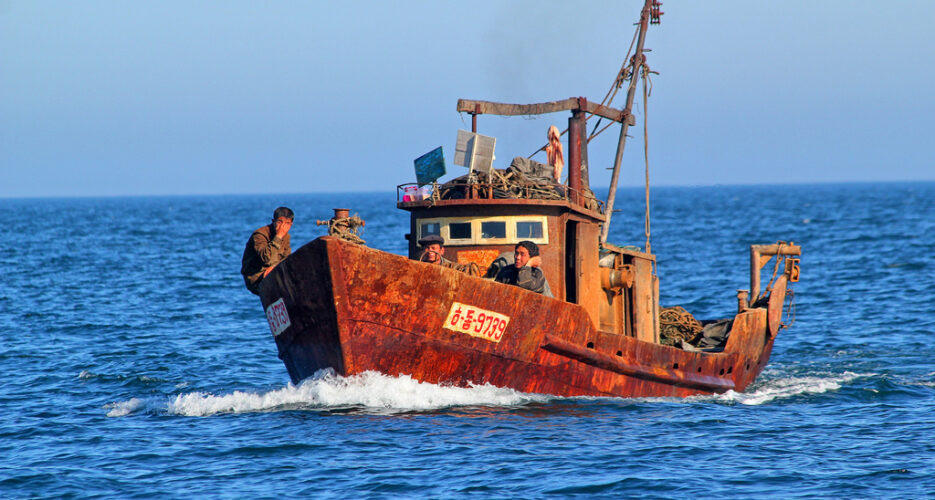

Despite a reported ban on North Korean seafood exports last month, Chinese customs data indicates the majority of products continued to cross the border into China in similar volumes to previous months.
In October, the Daily NK reported that various seafood products including “dried squid, frozen small octopus, king crabs, shrimp, and other shellfish” had been rerouted from export to domestic markets.
Chinese customs figures tally to some extent with this possible ban, with volumes of a major seafood export categorized as “Frozen/dried/salted/smoked cuttle fish and squid” dropping sharply in October.
Despite the ban however, North Korean exports of the product still remained above zero, though did decrease from roughly 2,000 tons in September, to just 40 the following month.
The drop off was larger than any other previously seen decrease since 2013, before which China does not publish data.
‘Exporting products from fishing is very important and valuable for North Korea. It can’t be banned totally’
Other products however appeared unaffected. The numerous export groups including crabs, did not vary in any significant way, and overall crustacean shipments carried on relatively normally.
“Exporting products from fishing is very important and valuable for North Korea. It can’t be banned totally, although I’m not sure whether it is true that Kim Jong Un enacted a ban or not,” Kwon Tae-jin from the GS&J Institute in Seoul told NK News.
The drop in cuttlefish and squid exports however did make a dent in overall trade volumes and revenues for October, with North Korean shipping only 3,000 tons to China, as opposed to 5,000 the previous month. The number, however, was only slightly below the average figure for the first ten months of 2015.
Overall, yearly exports of seafood products to China also plummeted sharply, dropping by nearly 50 percent when compared to the same period last year. The numbers were also down on their 2013 equivalents and reversed a four year trend which showed steadily rising shipments out of the country.
The volatile nature of the exports could reflect the generally unpredictable conditions involved in large-scale fishing.
“I think the decreasing (seafood) exports have not been affected by other special factors, it usually depends on the catch. When you look back, in the past, the export volume has been inconsistent and shows that it depends the fishing haul,” Kwon added.
The figures are in tension with reports from North Korean media however which have loudly proclaimed otherwise in 2015.
“The big fish hauls in the east sea are a manifestation of the KPA’s (Korean People’s Army) spirit of devotedly defending the leader and carrying out his order under any circumstance as it shares thought, breath and step with the Central Committee of the Workers’ Party of Korea,” the Korean Central News Agency (KCNA) wrote on November 30.
CEREALS IMPORTS CONTINUE TO FALL
North imports of cereals from China dropped sharply again in October, continuing a downward trend which began in July.
The decreased volumes of what has traditionally been one of the DPRK’s larger food imports comes despite a much publicized long-running drought earlier in the year.
The long running drought sparked some concern among international aid agencies, with Russia, Iran and the World Food Program all increasing donations to North Korea to help mitigate the drought’s effects.
The drop in imports is more pronounced when compared to the same period in 2014. During the first ten months of last year, North Korean imported 72,000 tonnes of cereals compared to just 22,000 so far in 2015, a 70 percent decrease.
“Twenty-two thousand tons is very low. To live without malnutrition, North Korea needs to import and receive donations equaling more than a million tons of crops (not just cereals),” Rhee Yoojin at the Korea Development Bank told NK News.
Another usually large import category – products of the milling industry – fared even worse, dropping from 71,000 tonnes in 2014, to 16,000 from January to October this year.
Despite the apparent lower imports, the Daily NK’s rice tracker shows prices in the country have remained relatively stable, with only a relatively small increase in September, which fell back toward the yearly average price the preceding month.
‘North Korea is expected to suffer from food shortages in 2016 … so we won’t know what they will do’
The numbers follow a recent report from the GS&J Institute, which claimed the North Korea could face food shortages next year. The possible deficit could be the worst since 2011, due to a near 1 million tonne shortfall of rice.
“North Korea is expected to suffer from food shortages in 2016 (not this year), so we won’t know what they will do (with regards food imports from China),” Kwon, one of the report’s co-authors, told NK News in October.
North Korea however could be less prone to sudden shocks its agricultural sector, due to the prevalence of black markets and other unofficial methods of obtaining food.
The UN Food and Agriculture Organization (FAO) most recent report indicated that despite recent improvements with agriculture, North Korea still struggles with basic food provision.
The FAO’s “State of Food and Agriculture 2015″ report said there were twice as many undernourished children in the DPRK’s rural areas than in cities.
Additional reporting by Hyunbi Park
Join the influential community of members who rely on NK News original news and in-depth reporting.
Subscribe to read the remaining 869 words of this article.
EXISTING MEMBER?

Featured Image: North Korean Fishing Boat by Ray Cunningham on 2013-06-23 16:53:21


');
newWindow.document.write('
');
newWindow.document.write('