
|
Analysis Being a minor party in the NorthIn a totalitarian regime, what do N. Korea’s other political blocs do?
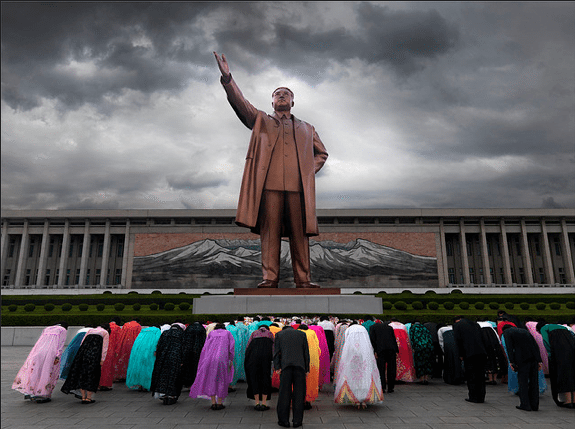 North Korea would be one of the last countries in the world that one would think of when it comes to political pluralism. However, three political parties do exist legally in the DPRK. In addition to the ruling Workers’ Party of Korea there is another, with the quite Western-sounding name of the Social Democratic Party of Korea, and the more Oriental-sounding Party of Young Friends of Chondogyo. This article tells why these two parties exist and what place they occupy in modern North Korean politics. The history of both parties goes back to the late 1940s when, after the defeat of the Axis bloc in World War II, the USSR began to decide its policy towards the occupied territories. The initial idea was that the countries to be created in Eastern Europe and northern Korea would be “people’s democracies,” i.e. states with a multi-party system, more democratic than the Soviet Union. These states were supposed to be loyal to the USSR, as the Soviet authorities hoped that communists would be able to maintain power even in democratic system. Soon, however, it became quite obvious that they would not – and all non-communist parties were reduced to mere puppets of the ruling one. INTRA-PARTY PURGES
A similar processes took place in Korea. The first non-communist party in the Soviet occupation zone was the Democratic Party of Korea, created by Cho Man Shik, a prominent member of the independence movement, in October 1945. However, after the Soviets realized that Cho was not a man to actively cooperate with the new authorities, he was placed under arrest in January 1946. Choe Yong Gon, one of Kim Il Sung’s best friends, was chosen to lead the Democratic Party instead. Choe quickly purged all disloyal members of the party. This was of the end of the Democratic Party as an independent power. The third and the last North Korean political party was created on February 8, 1946, when the subjugation of the Democrats had already been completed. Its name was the Party of Young Friends of Chondogyo. Chondogyo – literally translated as “religion of the Heavenly Way” – is a syncretic religion, which was quite popular in Korea in middle 20th century. The head of this party was Kim Tal Hyon, a Chondogyo activist. The history of the Party of Young Friends was more dramatic, as the party tried to moderately oppose the Soviet policies. The culmination of this opposition was to be the demonstration scheduled for March 1, 1948, the 29th anniversary of the March 1st anti-Japanese uprising in Korea. However, Kim Tal Hyon betrayed his comrades by reporting the plans to the Soviets. Many arrests followed and the party was deprived of power to resist – or so it seemed. The next stage came during the UN counteroffensive in Korean War, when members of the Party of Young Friends of Chondogyo attacked the communists vigorously, killing members of the Workers’ Party, as well as their families. After the armistice was signed more purges followed – and that was the end for the Party of Young Friends’ independence as well. For another five-to-seven years both small parties kept their organizational structures, but remained under strict control of the Kim regime, with the Central Committees of both parties refusing membership to anyone who could possibly become an oppositionist. The next stage took place in the late 1950s, when Kim Il Sung, who managed to stay in power despite the failed coup of 1956, and subsequent political turmoil, became independent from both the USSR and China and started to annihilate the remnants of the opposition. Another – final – wave of repression eradicated all local organizations of both parties. Kim Tal Hyon, despite his loyal service, was seemingly purged as well. Both parties became nothing more than bureaucratic appendixes of the Workers’ Party. Here begins the final stage of their history – the stage that continues up to this very day. LE PARTI, C’EST MOI Both parties nowadays share exactly the same structure. The have the same number of permanent members – one – and that person leads the party. The head of the former Democratic and now Social Democratic Party is Kim Yong Dae and the chairwoman of the Party of Young Friends of Chondogyo is Ryu Mi Yon. While Kim Yong Dae is just another North Korean bureaucrat, Ryu Mi Yon is a person with a much more interesting fate. She is from South Korea, which she left in 1986 with her husband. Her husband – Choe Tok Shin – was minister of foreign affairs in the military junta that ruled South Korea from 1961-63. We still do not know why these two defected to the North, and some even say that they were abducted. In any case, both Choe Tok Shin and Ryu Mi Yon were very welcome in Pyongyang. As they both were Chondogyo believers, Choe was appointed to lead the Party of Young Friends and after his death in 1989 Ryu Mi Yon inherited the position. She is more than 90 years old, so the name “Young Friends” begins to sound rather sarcastic.
What place do Kim Yong Dae and Ryu Mi Yon occupy in North Korean power hierarchy? We have an answer: When Kim Jong Il died in 2011, the DPRK leadership presented Pyongyang watchers with a gift: a list of 232 members of the funeral committee, listed in hierarchical order. Kim Yong Dae was 231st and Ryu Mi Yon – the 232nd. Both parties have non-permanent members as well. These people work in the North Korean Ministry of Foreign Affairs. Their job is to pretend to be the members of one of the two parties during meetings with foreigners, usually being representatives of far left organizations. For example, in 2012, Kim Yong Dae met the representatives of the South Korean ultra-left Unified Progressive Party and they signed a joined declaration condemning “the intentions of Japan to invade the Liancourt Rocks.” (Known as “Dokdo” in Korea and “Takeshima” in Japan, the Liancourt Rocks are a group of contested islands in the Sea of Japan and are the major part of Korean nationalistic discourse.) Also, Kim Yong Dae gave a letter to the Southerners in which he wished them to “overcome the crisis” which the Unified Progressive Party faced (this crisis, by the way, was caused by rigging an inter-party elections, which caused the further downfall of the electoral fortunes of the South Korean far left).  AIMING OUTWARD Such meetings are the only type of political activities held by both parties inside North Korea. This, however, is not the case when it comes to foreign policy. As Chondogyo is not nearly as popular in South Korea as it used to be, while social democracy is a respected and popular political viewpoint, Pyongyang almost exclusively uses the Social Democratic Party in its foreign-directed propaganda. This is might be the cause of why the Democratic Party was renamed to Social Democratic Party in 1981: Such a name would appeal more to the left-wing radicals, who are the main target of the North Korean propaganda efforts. The peak of the activity of North Korea’s Social Democrats came in the early 1990s, when the party was issuing two English-language journals (Korean Social Democratic Party and KSDP says…) and one in Korean (Social Democratic Party of Korea). The journals, judging by their contents, were trying to deliver two messages: 1) There is independent political activity in the DPRK. North Korea is a special, but free country with a multi-party system. 2) There is no independent political activity in the DPRK. All North Koreans love the Leader wholeheartedly, there are no deviations. These two messages were in obvious contradiction, which led to confusion in the journals’ contents. For example, KSDP says… wrote that it was very important to deliver the “party’s understanding of socialism” to the party members, without bothering to tell what this understanding actually was. This makes sense, since any definition of socialism that is different from a quote of one of the Kims is a heresy and will not be tolerated in North Korea. And Social Democratic Party of Korea stated that only North Korea has such a wonderful political system: there are several parties, but they do not compete, but rather work together for the good of the country. Needless to say, all titles of the members of the Kim dynasty – such as “Eternal Sun of the Nation” or “Ever-Victorious Iron Willed Brilliant Commander” – were used as often as they are in other North Korean publications for foreign audiences and the Kims’ names were spelled in bold, like in every other North Korean periodical. THE PARTIES TODAY The Social Democratic Party also got its emblem – a rose, obviously designed to resemble the emblems of social democratic parties in Western Europe, and an Internet site, or rather, a section of the North Korea propaganda site “Only Our Nation.” The only contents of this section are the issues of the Social Democratic Party of Korea journal. The Party of Young Friends of Chondogyo (i.e. Ryu Mi Yon) is much less active, although a few years ago comrade Ryu did publish an article on the North Korean sites, in which she stated that her husband (who, as the readers remember, was a foreign minister in a South Korean junta) had considered Kim Il Sung the incarnation of the supreme deity of Chondogyo. Probably the freedom to hail the Leader in their own way is the last and the only remnant of the autonomy of the two parties.
Does the North Korean regime gets anything from the existence of these two parties? Apart from the questionable merit of using them for foreign propaganda, no. Moreover, inside North Korea the existence of these two parties may have an ideological effect, which DPRK authorities would hardly desire. The problem is that the existence of several political parties contradicts one of the most important North Korean doctrines: “single-hearted unity,” according to which all North Korean society is united around the figures of the Kims and there is no place for doubt or opposition. One cannot explain how the existence of three parties fits this image, especially since North Korean authorities continue to state that both small parties are real and have tens of thousands of members. Probably the best way of action for Pyongyang would to be simply send Ryu Mi Yon to her well-earned retirement, and to present Kim Yong Dae with, for example, the Kim Il Sung Order and send him to work into another department of the Ministry of the Foreign Affairs. As for the parties – just simply stop mentioning them, as their formal dissolution may produce unnecessary questions. However, this will probably not happen, as tradition is a powerful thing – especially is such a country as North Korea. Main picture: Eric Lafforgue © Korea Risk Group. All rights reserved. |


 SHARE
SHARE COPY LINK
 X
X MASTODON


Recent Stories