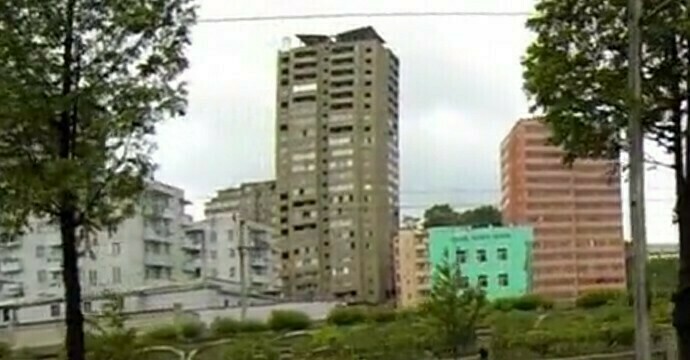

Photos exclusively obtained by NK News provide independent corroboration to North Korean claims that a Pyongyang apartment block collapsed on May 13, confirming the subsequent search, rescue and clean-up operation was completed in under just four days.
But such a rapid rescue and clean-up operation, experts told NK News, could mean the lives of survivors were put at risk, raising questions as to why North Korean authorities pushed to clear the area so rapidly.
And, citing the lack of major damage to neighboring buildings and the rapid clearance of an estimated 5,000+ tons of debris, two engineering experts said it was possible that the building collapse may have, in fact, been planned.
PHOTOGRAPHIC EVIDENCE
Four photos, taken from the Juche Tower throughout April and May, show the visible disappearance of an apartment complex in Pyongyang’s Pyongchon district at the same time North Korean state media said the collapse occurred.
While photos dated April 4, 30, and May 13 all show the building standing on the horizon, a photo taken in the morning of May 14 show the building to have clearly gone.
The photos, therefore, indicate the window in which the building collapsed was between roughly midday May 13 and 09:35 on May 14, the same period North Korea said the accident occurred, contradicting previous analysis that doubted the official account of the event.

Timeline of Pyongyang skyline imagery, from Juche Tower | Pictures: NK News, DPRK360, R. Arbour
4 DAY SEARCH, RESCUE, CLEARANCE
With satellite imagery showing the accident site to be nearly completely cleared of debris by the morning of May 17, the photos indicate that North Korea’s search, rescue and clean-up appear to have taken a maximum of 96 hours – an impressive feat when compared to similar disasters.
In contrast, the 2013 collapse of the eight floor Rana Plaza building in Bangladesh led to an army-led search and recovery effort that was still identifying survivors 17 days after the accident occurred.
“The search and rescue operations at the Rana Plaza site, apparently a smaller building than the North Korean one, took more than nine days around the clock and was not officially terminated until one month after the event,” said Robert Hodgson, an engineering expert with experience in assessing factory buildings in Bangladesh for structural safety.
“From my experience of several [emergency] assignments, including two war zones and a brief spell in Haiti, I do not see how the debris from a 23 storey building collapse could be searched in 4 days, let alone cleared,” added Hodgson, pointing out that rescue must be done with “great care to avoid additional injury to any survivors”.
John Holland OBE, Director of RAPID International, a disaster response NGO, echoed Hodgson’s skepticism about the effectiveness of such rapid search and rescue.
“If you are asking me whether a building this size could be searched in 4 days I would say that depends on whether people were missing and how many. If people were missing then I would say to search this properly then four days would not be enough,” Holland said.
“From a professional point of view and with over 28 years experience in search and rescue…you could not search and clear a building that size in four days even working day and night,” Holland explained.
ABANDONED BUILDING DEMOLITION?
Photos taken of the building in early April show that construction had likely stalled at the apartment block prior to completion, with glass windows inconsistently covering balcony openings and a temporary roof atop of the building.
When compared to a new photo obtained NK News of the site just five days before the collapse, there is little change in the unfinished state of the building, further suggesting construction had been abandoned at the site for some time before the accident.
But because photos and satellite imagery taken four days after the accident show little signs of damage to nearby buildings, the characteristics of the collapse meant that a controlled demolition of the unfinished building could not be ruled out.

Photographs of building show little to no construction progress over one month period | Picture NK News
“I would guess that the building must have collapsed in a straight downward movement, like the World Trade Center on 9/11, because the nearby buildings seem undamaged,” said Professor Høiseth of the Norwegian University of Science and Technology (NTNU).
That, another engineering expert said, indicated it may have been a planned collapse – something that would have directly aided the rapid nature of the clearance operation.
“The way it has come down so quickly and cleanly could mean it was a controlled explosive demolition, with the building being brought in on itself – a surprisingly efficient and safe method,” said an expert who requested anonymity for commercial reasons.
“That would suggest something planned and well resourced from manpower and logistics,” the expert said. “If it had been accidental the reactions and planning in a period of confusion would possibly have been much slower.”
Robert Benaim, the founder of Benaim group, an engineering consultancy, echoed the possibility of a controlled demolition. “It is unusual for a building to collapse so completely. The possible explanations should include foundation failure, or controlled demolition,” he said.
“…having such a building, looking unfinished, in the middle of Pyongyang could present a risk to legitimacy,”
ORDER FROM THE TOP?
Christopher Green, International Editor at the Daily NK told NK News that if speculation about a controlled demolition being the cause of the collapse was true, it meant the “order came from the top”.
“What would trigger such an order? Well, Kim Jong Un has been promoted in the propaganda as a man of fine architectural and aesthetic sense, the one who conveyed “종합대학” status on the University of Architecture, etc,” Green explained.
“Under such circumstances, having such a building, looking unfinished, in the middle of Pyongyang could present a risk to legitimacy. They only recently managed to get glass on the Ryugyong Hotel, remember, and were always very sensitive to the narrative of economic failure that it came to represent.”
“If the leadership decided that it had to be removed, it would happen with immediate effect, and that could in principle take precedence over issues of human safety,” added Green.
Despite speculation of controlled demolition being the cause of the collapse, a foreign resident of Pyongyang told NK News the official account of affairs may be true, despite the difficulties experts have expressed in believing such a rapid recovery operation and cleanup could be possible.
Pointing to the construction of the full size Masikyrong ski resort in less than one year, the resident, who requested anonymity, said North Korean capacities to mobilize significant human resources at short notice could explain the extreme speed that the building was cleared.
But John Nolan, former President of the Institution of Structural Engineers, said that “unless there was certainty that the building was empty and there were no casualties … I would anticipate that rescue and recovery should take at least four days.” The major cost of such a rapid clean-up operation in case of inhabitants being present at the time of collapse “would be in lives not saved,” added Nolan.
Main picture: NK News
Join the influential community of members who rely on NK News original news and in-depth reporting.
Subscribe to read the remaining 1190 words of this article.
EXISTING MEMBER?


');
newWindow.document.write('
');
newWindow.document.write('