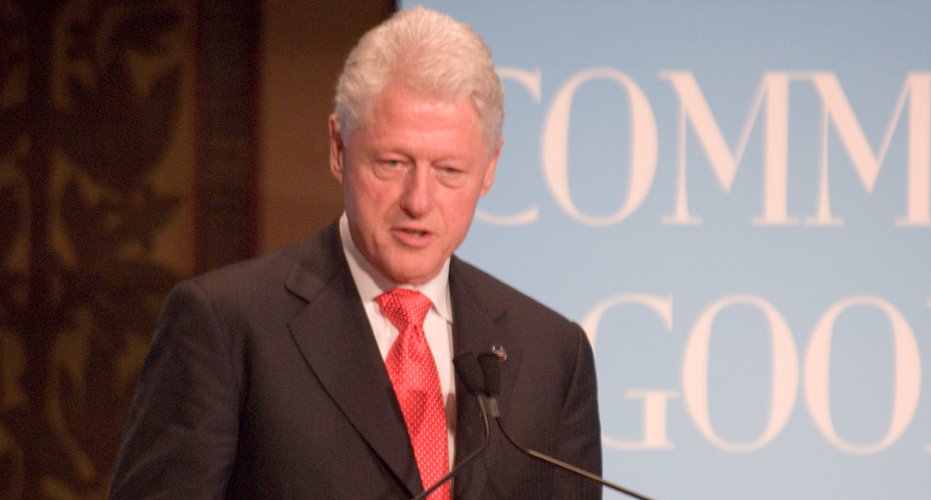

It is curious that so few people ask why the Obama administration has refused to negotiate with North Korea. The Clinton administration did, and even signed a de-facto treaty, the Agreed Framework, which had it been left to run its course would have produced a very different situation from what we have today. North Korea would not be a nuclear weapons state, it would have light water reactors (LWRs) alleviating its electricity shortage, and if the U.S. had normalized relations, as promised, then peace, of a sort, would have broken out.
True, Clinton did not do it willingly – he was outmaneuvred by Jimmy Carter giving an interview to CNN from Pyongyang saying that Kim Il Sung had told him that he would be happy to do a deal on the nuclear program. Even the much-maligned George W Bush negotiated. True, he did tear up the Agreed Framework, and renege on various commitments, but through most of his period in office negotiation was, if not on the immediate agenda, on the near horizon. Two steps backward, and one step forward. But Obama has steadfastly refused to negotiate, apart from the brief, strange, Leap Day talks in New York in 2012. Why?
Negotiations between Washington and Pyongyang are essentially about Washington dropping its policy of hostility, and accepting peaceful co-existence, in exchange for Pyongyang giving up nuclear weapons
And why don’t people ask why? Some, no doubt, are persuaded by the mantra of “strategic patience.” It sounds so good, with positive connotations. It seems plausible and reasonable because the United States never says it will not negotiate with North Korea, merely that it insists on preconditions to ensure that the talks are fruitful and productive. The device is quite a simple one. If you do not want negotiations with the other side, but do not want to appear to reject talks as such, you merely insist on preconditions that you know the other side will not, and cannot, accept. Negotiations between Washington and Pyongyang are essentially about Washington dropping its policy of hostility, and accepting peaceful co-existence, in exchange for Pyongyang giving up nuclear weapons. Exactly what that might entail is a complex matter to be discussed another time. However, for Pyongyang to start dismantling nuclear weapons without anything in return (other than promises that negotiations will follow) would be foolish, and so won’t happen. If the United States does not want to negotiate with North Korea, and wishes to shift the blame onto the other side, this provides an elegant solution.
GRANTING LEGITIMACY
The United States is so much bigger and more powerful than any other country that deigning to negotiate does not come easily
Needless to say, this narrative is accepted by most of the media and commentariat, but not by all. There are a number of people, some of them former officials during the Clinton period, who see that the Obama administration is stalling, and call for it to engage with North Korea. Joel Wit, Donald Gregg, Mike Chinoy, Robert Carlin, James Hoare, Stephen Bosworth and Leon Sigal come to mind. A common theme of the “engagers” is that refusal to negotiate results in North Korea improving its nuclear weapons capability. The Washington correspondent of the Hankyoreh, Park Hyun however goes further by posing the question of why the administration does not engage.
Before examining Park’s article it is useful to step back and look at U.S. negotiating at two levels, the generic and the specific. In general, the United States finds negotiating with other countries problematic. There are a number of reasons for this.
The United States is so much bigger and more powerful than any other country that deigning to negotiate does not come easily. That applies even to great powers such as Russia and China. A recent article on the Ukraine crisis reported that Obama had “written off“ Putin, and would seek to ostracize him and make Russia a “pariah state.” There might be contacts, but the emphasis would be on containment rather than negotiation. Talks continue with China, and containment is denied, but the underlying reality is much the same.
Negotiation is seen to accord legitimacy to the other side which becomes, as the North Koreans put it, a dialogue partner. But the U.S. regards legitimacy not as a matter of effective control, or even popular support, but as something that it bestows on worthy governments. As John Foster Dulles said in respect to China back in 1957, recognition by the U.S. was a privilege not a right. By contrast, the British (thinking of Hong Kong?) had taken a more pragmatic line, and had recognized the new Chinese government in 1950.
America’s negotiation problem is exacerbated by the particular, even peculiar, nature of its political structure, and particularly the separation of powers. The concept has its virtues, and constraining the power of the executive is desirable, but somehow America seems to have ended up getting the worst of all possible worlds. The United States has gone to war numerous times but it is hard to think of the last time it actually declared war, because that requires the approval of Congress, with all sorts of inconveniences in its wake. So the president makes war without making a formal declaration. Not much constraint on power there. But when the president attempts to negotiate, to make peace, it is a different matter. The Democrat’s loss of Congress to the Republicans in the latter years of the Clinton administration caused serious problems with the implementation of the Agreed Framework. The Obama administration’s tussle with Congress over negotiations with Iran is well-known.
ONGOING CONTAINMENT
In fact, the U.S. regards Pyongyang’s nukes as an excuse to boost its military presence to counter the rise of China and to reinforce the three-way security pact with South Korea and Japan
The president is effectively directly elected and although domestic concerns take precedence, as they do elsewhere, Americans are famously ignorant about the outside world. A recent survey found that the less people knew about Ukraine (or even where it was) the more likely they were to want the president to take decisive action. Presidents are always vulnerable to attack by critics who can bang the patriot drum louder, not having to face the consequences of foolish action. Then there is the Treasury, which seems to operate as an independent kingdom cutting across administration policy, as it did with the BDA affair, disrupting talks with Pyongyang, and as it has done, to less effect, with Iran.
Turning to the specifics of the U.S.-North Korea relationship Park Hyun observes that:
Indeed, the U.S. has effectively put off looking for a diplomatic solution to North Korea’s nuclear weapons program. In fact, the U.S. regards Pyongyang’s nukes as an excuse to boost its military presence to counter the rise of China and to reinforce the three-way security pact with South Korea and Japan.
Actually the whole business goes further than that. U.S. policy towards the Korean peninsula since 1945 has been essentially about the containment of the then-Soviet Union, and China, now mainly China, but also Russia. Japan is both war booty to be protected, and increasingly a weapon in the struggle. All this gives the U.S. good reason to keep tension in Northeast Asia bubbling along. It may well judge that negotiations would serve no useful purpose. The Clinton administration signed the Agreed Framework because it thought that North Korea would collapse before it had to deliver on its commitments. The Bush administration solved that problem by scrapping the agreement but made the mistake of allowing the establishment of the Six-Party Talks, hosted by China. Not a smart move to hand that prize to the hegemonic challenger.
Would a further nuclear test change the American position? It seems unlikely. Despite all the nonsensical hype, North Korea does not, and cannot, threaten the U.S. At the most, further down the track, it might be able to deliver retaliation as a weapon of last resort in the event of an American invasion. That is the logic of the nuclear deterrent. However, the U.S. is not going to invade unless it perceives that Pyongyang has lost control and is not able to retaliate, even conventionally, or resist. On that reasoning the actual strength of the North Korean deterrent is not a major issue. The engagers read the situation the wrong way round, seeing a test as a failure of strategic patience when in fact it is more a desired outcome for Washington – it escalates tension, reinforcing strategic objectives; and North Korea gets the blame, exacerbating its relations with China en route.
North Korea also plays the negotiating game, perhaps well, perhaps badly, but its situation is fundamentally different from that of the U.S. For North Korea peace with the U.S. is a necessity and hence negotiations a priority. The United States has other options, and wider concerns. Given the rather poor track record of recent administrations – Afghanistan, Iraq, Libya, Syria come to mind – doing nothing in respect of North Korea might be quite the most sensible thing to do. The present situation serves the containment of China very well and what would a “diplomatic solution” achieve? The U.S. could utilize North Korea’s resentment of China, but that would be small beer in comparison with the loss of tension. As elsewhere, controlled chaos may serve strategic objectives best.
Picture: Center for American Progress, Flickr Creative Commons
Join the influential community of members who rely on NK News original news and in-depth reporting.
Subscribe to read the remaining 1589 words of this article.
EXISTING MEMBER?


');
newWindow.document.write('
');
newWindow.document.write('