
Book Review: Human Rights Discourse in North Korea, by Song Jiyoung, London: Routledge, 2010.
Not even North Korea says it’s against human rights, at least as they define them. It’s just that the North, on a war footing since the Korean War came to an unsatisfactory conclusion in 1953, believes that the threats to its survival mean suppressing individual rights in favor of promoting the right to survival. At least that’s what the literature suggests.
Professor Jiyoung Song, who teaches human rights and migration at Singapore Management University, has explored North Korean publications in search of North Korean definitions of human rights, and found some interesting parallels to the Western conceptions of the subject in the post 9/11 landscape. Song’s current research focuses on the nexus between irregular migration and human security in East Asia.
The book, first published in 2011, comes in handy at a time when North Korea is in the spotlight after the findings of the UN Commission of Inquiry on Human Rights in the DPRK, the recent deliberations of the UN Assembly, and after the vitriolic attacks carried out by North Korean state media against the head of the UN Commission of Inquiry, judge Michael Kirby, U.S. President Obama and South Korean President Park Geun-hye.
With an introduction by James Hoare, the work explores a very difficult topic, asking whether the undeniable suffering and material deprivation of millions of North Koreans can be interpreted as the byproduct of a history of struggles for independence, and whether the reasons adduced by the North Korean government have roots that go deeper than the Korean War. Song’s work poses questions that challenge the status quo and ask the reader to re-think assumptions about a matter on which most of us tend to be emotional, because we assume that certain values (such as the right to food, survival, education and a number of personal freedoms) are the only desirable goal for any government.
To think otherwise, in terms of Western culture wold be unthinkable, and in fact North Korea’s exploits on the international scene remain baffling to most outside viewers, who keep wondering why would a country ever behave in a way that is so detached from any acceptable standards of international relations. This is where Song’s book differs from most publications related to human rights in North Korea, whether they are the period reports prepared by the South Korean government or by major NGOs such as Human Rights Watch. Most of these works are indeed useful in that they raise awareness on the suffering of millions of people, however, they all build upon a series of values, which are taken for granted in Western culture but are not as prominent in other settings.
Very rarely in fact, the position on viewpoint of North Korea on such topics is taken into consideration, the assumption being that as North Korea deliberately and continuously violates human rights as they are defined according to international standards, its leadership must be estranged from any understanding of such rights in the first place.
The question of “what is the North Korean view of human rights” is very often suppressed by the assumption of “why would they have any concept of human rights at all, given their current record” and it is such logic that Song tries to debunk in her book, by linking North Korea’s contemporary stance on human rights to philosophical and political currents such as the Sirhak and the Tonghak, as well as to Confucian tradition.
The book also explores the connection between Marxism and human rights in the North Korean discourse, although the author recognizes that North Korea is not the far-left country that many Western media still seem to believe it is.
Granted, since its publication, the work has not been immune from criticism: in her review, Suzy Kim has pointed out that while the attempt of an informed constructivist approach to analyzing North Korean human rights discourse deserves praise, the book suffers from a tentative framing of North Korean human rights discourse within a too linear evolution, which is not sufficiently supported by proof, as the author tries to traces contemporary North Korean discourses “all the way back to the fourteenth-century adoption of Confucianism by the Chosŏn state.” Indeed, the emphasis that Song puts on North Korean as a Confucian country (or at least one where Confucian values still exert some influence on politics and society) would see even authors as diverse as B.R. Myers and Sonia Ryang united in disagreement, and it is hard to see contemporary North Korea as Confucian, with a leader like Kim Jong Un in charge.
Human Rights Discourse in North Korea remains nevertheless an interesting and innovative work, because of its peculiar angle of observation, and the excellent work on the systematization of North Korean primary sources for a topic with which the DPRK is supposed to be completely at odds. To learn more about is contents, NK News spoke to Song about a number of topics, including South Koreans’ increasing tolerance for examining North Korean motivations, the intellectual roots of North Korea’s conceptions of human rights, and what the United Nations Commission of Inquiry on Human Rights in the Democratic People’s Republic of Korea means for the North’s future.
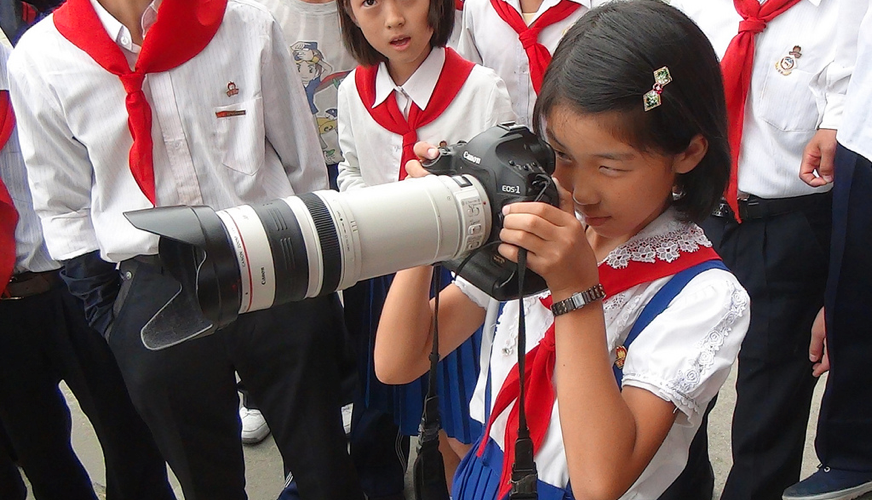
Picture: Eric Lafforgue
Join the influential community of members who rely on NK News original news and in-depth reporting.
Subscribe to read the remaining 890 words of this article.
EXISTING MEMBER?


');
newWindow.document.write('
');
newWindow.document.write('