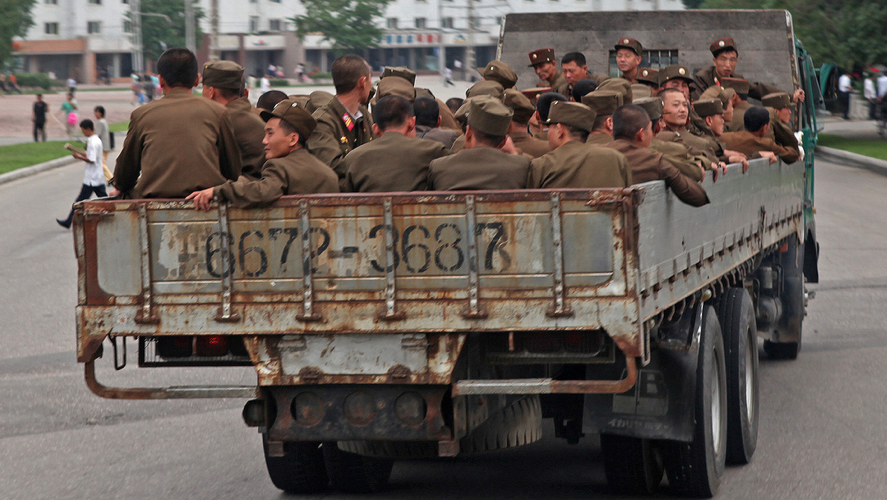

North Korean army barracks are not a nice place to be, even by the tough standards of barracks worldwide. Conditions are tough, food supplies are poor and discipline is harsh. To make matters worse, the average length of military service in the North is now close to 10 years (though it used to be even longer). Nonetheless, until roughly 2000, the Korean People’s Army (KPA) had little problem with recruitment.
In those not so distant days, till the outbreak of famine, only the children of the top elite could and would opt out of military service. The North Korean recruitment system followed the Soviet prototype and exempted those who successfully passed college entrance exams immediately upon graduation from a high school. Most elite children went to university straight from high school, so they did not have to worry about the draft.
Conversely, people with suspicious family backgrounds were also not eligible for the draft in North Korea. A landlord’s great-grandson would not usually get into the military, since he was not seen as reliable and worthy enough. However, members of this discriminated group did what they could to be drafted: being drafted meant being accepted to the mainstream. Others went to the military with little discontent or resistance.
AIM HIGH
This general enthusiasm for lengthy and demanding military service might appear strange, but actually it is easy to explain. In North Korea military service has long been the major (and easiest) avenue for social advancement.
The military was the place where it was easy to formally join the ruling Workers Party of Korea (WPK). As a rule, a soldier who has spent his 10 or even 13 years in uniform without committing any serious misdemeanor had good chances of going home with a party membership card in his pocket (or rather in a special pouch in which party membership cards are usually carried by North Koreans). This was also the case for women, whose military service was shorter and strictly voluntary. For women from non-privileged social backgrounds, a few years of military service might be was the sole way to become a party member.
Many readers from non-communist countries tend to assume that party membership was and is a great privilege in North Korea. This is not exactly the case: There are far too many party members in the land of Kims. While the WPK has not published exact statistics about its membership for decades, there seem to be about 4 million party members today. In other words, roughly one quarter of the entire adult population are now members of the party. This alone makes it impractical for all of them to have serious privileges.
However, party membership is still very important from a practical point of view. In North Korea, party membership is a necessary prerequisite for any promotion. In order to get any managerial job one has to be a party member. Therefore, if you have social ambitions of any kind, you should ensure that you are a party member by the time the opportunity avails itself.
An additional attraction of military service was the fact that former soldiers are easily accepted to university or college. In North Korea, only a minority of first-year students are accepted into universities immediately upon graduating high school, and most of these lucky young people are well-connected or exceptionally gifted individuals.
For a person with an average background but some ambition and/or interest in education, the normal way to get a college degree was to go to the military first and then, shortly before discharge, formally apply for college recommendation from one’s military commanders. The latter nearly always ensures a university education.
Admittedly, discharged soldiers make poor students. A decade of life spent in the barracks means they have forgotten much of what they once learnt, so they are usually unable and unwilling to academically compete with their much younger peers. Nonetheless, the ex-soldier students are usually seen as more loyal to the regime, more mature and generally more reliable. This means that getting a good job – i.e. becoming a white-collar worker upon graduation – was not all too difficult for such ex-soldier students.
For decades, then, military service was the major channel that allowed social mobility in the otherwise ossified North Korean society. This was the only chance for many ambitious individuals to overcome hereditary restrictions and make modest social advances.
DIMINISHING RETURNS
However, now we probably use past tense when describing the above-mentioned attitude to the military. Since the late 1990s things have changed a lot.
A notable new phenomenon is a steadily declining interest in military service. Younger North Koreans do not want to be drafted anymore, and are in many cases willing to bribe officials to avoid military service all together. The reason is quite simple: the career opportunities derived from service have lost much of their earlier appeal.
First, the old career path was very slow. It normally takes 15 or more years to get from the start of military service to appointment low-level administrative job. Second, the legal and illegal benefits one can derive from junior administrative positions have become relatively less attractive.
Nowadays, booming markets and the informal economy provide socially mobile youngsters with much more lucrative opportunities. With some luck, a merchant in his mid-to-late 20s can make as much as a mid-level official in his 40s or even 50s. As a result, an increasing number of North Koreans are not interested in military service or even once much-coveted party membership anymore.
The situation inside the military has changed a lot as well. According to reports from people who served in the KPA after 2000, corruption is gradually making inroads into the barracks (as it has in every other major area of North Korean society). In the past, soldiers did their best to earn the praise of their superiors in order to ensure an honorable discharge, party membership and college recommendation. Nowadays, soldiers have become willing (and able) to pay to lessen the workload during their military service.
For example, a bribe of $1,000 or so may ensure that a soldier will be given long leave from his unit. This means he will be able to go home for several months on end – the excuse given is usually poor health. The soldier can spend his time helping his family, who are probably involved in some kind of informal economic activity.
The same (or larger) sum may also get a person a very lucrative place of service near the Chinese border. Troops that are stationed there are privileged because soldiers there can extract bribes from merchants engaged in cross-border smuggling.
And, of course, party membership is increasingly for sale too. Nowadays, soldiers do not need to excel in memorizing the lengthy speeches of the leaders, or in sharpshooting. A relatively small bribe of a few hundred dollars (in some cases $200 will do) easily ensures party membership.
So, what does this all mean for the future of North Korea? It is probably not a good omen for Kim Jong Un and the system he heads. To maintain stability, any government – be it democratic or not – must use a combination of incentives and coercion to keep people happy and in line. In both regards, the North Korean regime seems to be in trouble. Compared to earlier days, people are both less frightened and less interested in what the regime has to offer. In other words, they are becoming more and more independent.
Picture: Roman Harak, Flickr Creative Commons
Join the influential community of members who rely on NK News original news and in-depth reporting.
Subscribe to read the remaining 1247 words of this article.
EXISTING MEMBER?


');
newWindow.document.write('
');
newWindow.document.write('