
|
News North Korean missiles used in Ukraine strikes aren’t just Russian copies: KyivExperts confirmed KN-23/24 missiles differ from Russia’s Iskander based on measurements ‘unique’ to DPRK
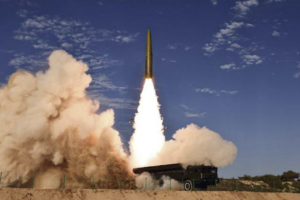
 North Korea developed its KN-23 and KN-24 ballistic missiles used by Moscow in attacks on Ukrainian cities combining foreign tech with designs of Russia’s earlier Iskander models, Kyiv’s researchers found. Ukrainian military engineers studied debris from a missile used in a Russian attack on Kharkiv in eastern Ukraine in Jan. 2024, Kyiv’s defense ministry said in a press release Thursday. 

The experts found that North Korean missiles stood out from their Russian counterparts due to their “unique geometry,” and its parameters matched those that were released by unnamed South Korean researchers. “The KN-23 has a diameter of 110 cm at the rear, narrowing to 90 cm at the front,” the release said. “A diameter of 110 cm is not found in any other country in the world except North Korea.” The KN-24 variant, on the other hand, features a diameter of around 100 cm — a characteristic also found in models produced by other countries, it added. Ukrainian researchers compared the retrieved missile fragments with photos from North Korean factories, the release said. They identified seven “key similarities,” including the “number of bolt holes used to mount the nozzle” and “the presence of specific compartments for satellite navigation receivers.” The defense ministry’s experts concluded that the KN-23 and KN-24, referred to as Hwasong-11A or Hwasong-11B in the DPRK, were “not direct copies of Soviet/Russian designs.” North Korea does not produce those variants under a licensing agreement based on the Russian Iskander 9M723 ballistic missile, they said, adding that there are indications of the DPRK having “refined an early version of the Iskander.” Kyiv also found that the DPRK missiles use lower-energy fuel and boast larger engines (1.5 times longer than Russian models) to “achieve a comparable range.” Despite North Korea using “civilian-grade components from leading brands” in control units — a well-documented practice of sourcing Western parts for its missiles — the country still relies on “outdated production methods,” according to Kyiv. 

For example, the missile’s soldering quality was “roughly comparable to that of 50 years ago,” the readout said. “Despite the use of outdated technologies, these missiles, like all ballistic systems, remain extremely difficult for air defenses to intercept and therefore pose a deadly threat to civilians in Ukraine,” it added. MORE ABOUT WEAPONRY Due to its similarities with the Iskander, Ukraine often refers to these weapons using a joint nomenclature, such as “Iskander/KN-23,” especially in public alerts that warn of incoming Russian strikes. The Ukrainian military last reported on Russia using KN-23 or Iskander missiles in attacks in February, stating that Kyiv shot down 35 of them during that month. Kyiv destroyed 274 Iskander/KN-23 missiles since the start of the war over four years ago, the Ukrainian military said in February. The KN-23 is a short-range ballistic missile (SRBM) with an estimated range of 497 miles (800 km). Ukrainian investigators previously placed its range at 435 miles (700 km), nearly three times that of the Iskander’s 155-mile (250 km) range. The KN-24 has been recorded to hit targets at 250-255 miles (400-410 km), although its maximum range may be higher. Both missiles were first tested by the DPRK in 2019. The regime is estimated to have provided nearly 250 KN-23 ballistic missiles to Russia since 2023. Kyiv previously assessed that DPRK missiles showed signs of rapid improvement in quality and accuracy after Russia’s strikes on Ukrainian targets. Along with ballistic missiles, North Korea supplied Russia with long-range Koksan artillery, 240mm and 107mm MLRS, 60mm and 140mm mortars, cluster munitions and 100mm shells for T-54/55 tanks. This trade has likely earned Pyongyang between $7.7 billion and $14.4 billion, a Seoul-based think tank said last month, while suggesting North Korea may have received only a fraction of that sum as payment for military deliveries. It is unclear whether the North Korea-Russia arms trade is ongoing, as signs indicate a slowdown since the start of the year. 

Planet Labs satellite imagery showed no signs of known Russian weapons-transport vessels docked at North Korea’s port of Rason — a major hub for arms shipments — from March 13 to April 16. The imagery showed containers piled up at inbound and outbound piers at the port. Open-source researchers previously estimated North Korea delivered to Russia 8 million to 11 million artillery shells in roughly 30,000 containers from Rason since Aug. 2023. Seoul’s Defense Intelligence Agency placed the total at 15 million shells and 33,000 containers as of February, including roughly 5,000 containers shipped during the previous six months, suggesting a slowdown from earlier shipments. Edited by David Choi © Korea Risk Group. All rights reserved. |


 SHARE
SHARE COPY LINK
 X
X MASTODON


Recent Stories