
|
News North Korea clears land at six locations inside DMZ, satellite imagery showsExperts say land clearing is likely aimed at bolstering defense with one section crossing military demarcation line
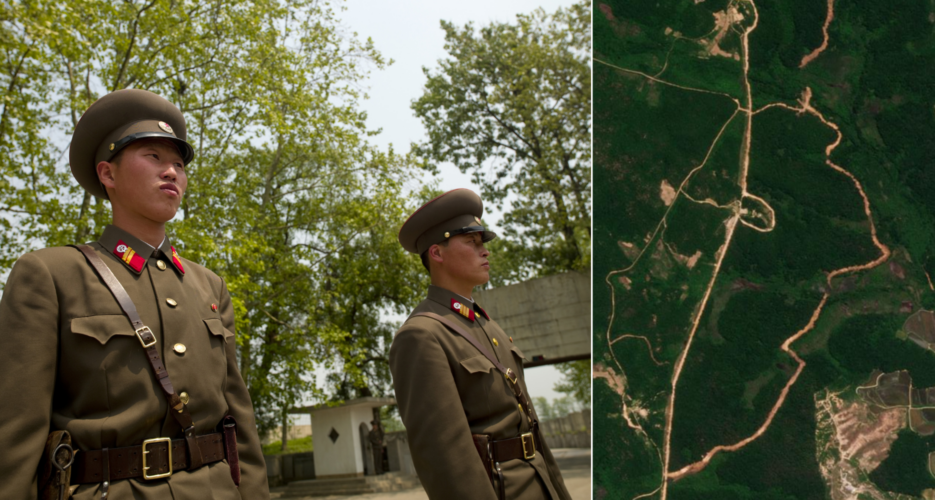 North Korea is clearing vegetation at six different areas across the peninsula’s demilitarized zone (DMZ) in apparent efforts to bolster border defenses on South Korea’s doorstep, analysis of satellite imagery by NK News reveals. NK News reported earlier this week on a section of borderland cleared by North Korea on the east coast of the peninsula, but further analysis revealed DPRK soldiers are clearing sections all along the inter-Korean border, spanning from east to west on the Korean Peninsula. OVERVIEW OF SIX LAND CLEARING SITES BY NORTH KOREA BETWEEN APRIL-JUNE 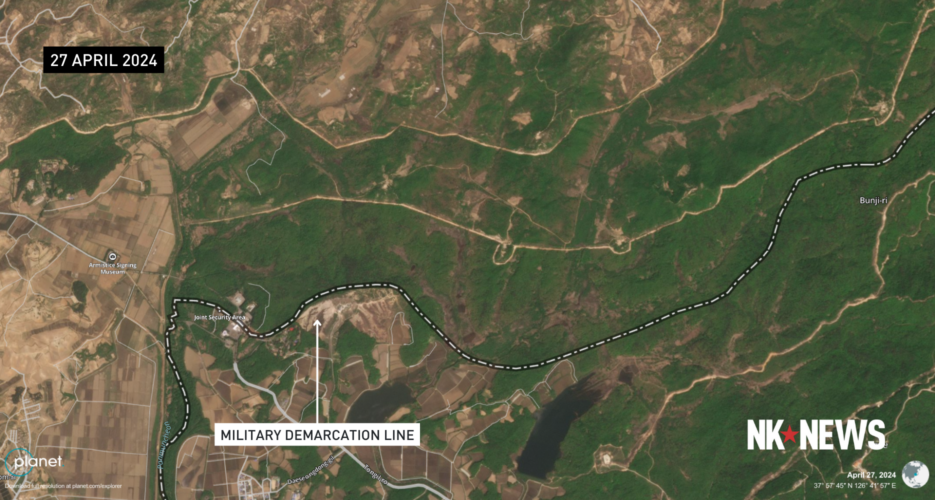


Planet Labs satellite imagery shows that DPRK soldiers have cleared and likely demined strips of land at six different locations along the heavily fortified DMZ, with one area located just 0.7 miles from Panmunjeom. All land clearing happened between late April and early June, according to satellite imagery, with some sections cleared close to the military demarcation line (MDL) and, in one instance, crossing the MDL. The U.N. Command (UNC) told NK News earlier this week that “Since its declared abandonment of unification policies, the DPRK has pursued measures to harden its boundaries.” Early this year, North Korean leader Kim Jong Un ordered officials to “redefine North Korea’s borders” as part of a sweeping policy change rejecting peaceful reunification with the South and emphasizing that the two Koreas are separate countries at war.  Christopher Green, a professor at Leiden University and analyst for the International Crisis Group, told NK News that North Korea most likely cleared the land near the MDL “for the purpose of patrols and, ergo, defense.” Green said that “hardening defenses is not by itself a problem,” but that “extra border region military activities now the Comprehensive Military Agreement (CMA) is dead, do certainly increase the risk of conflict arising from misunderstandings.” North Korea completely withdrew from the 2018 inter-Korean military deal in Nov. 2023 after South Korea suspended a provision concerning no-fly buffer zones. Seoul suspended the deal in its entirety earlier this week, citing North Korea’s recent launch of 1,000 balloons containing trash and feces across the border. South Korea has since redeployed propaganda loudspeakers to the border area and announced that it will resume normal military operations in the region. Shin Seung-ki, a senior analyst at the Korea Institute for Defense Analyses (KIDA), agreed with Green that the North’s intentions in undertaking such clearances along the fortified border could be to better monitor the movements of the ROK military guard posts (GP) along the DMZ. Shortly after North Korea’s withdrawal from the CMA, South Korea’s defense ministry announced that North Korea appeared to be rebuilding guard posts and deploying heavy weaponry to the inter-Korean border. North Korea had previously removed several GPs and weaponry along the border following the establishment of the CMA. Shin also raised the possibility that the land clearing could be part of a bid by Pyongyang to “make it more difficult for North Korean soldiers to defect to the South.” The KIDA expert voiced the need for further verification from the ROK military about its assessment of North Korea’s land clearing since creating new fences or paths that cross the MDL could “become a significant issue.” South Korea’s Ministry of National Defense refused to respond to several NK News inquiries about North Korea’s construction inside the DMZ. The construction follows confirmation that North Korea has been demolishing facilities near major roads connecting to South Korea and reports that the DPRK has also installed landmines at several inter-Korean crossings. Edited by Alannah Hill © Korea Risk Group. All rights reserved. |


 SHARE
SHARE COPY LINK
 X
X MASTODON


Recent Stories