
|
Opinion The need for speed: time as a political tool in North KoreaThe U.S. should take note that Kim Jong Un can literally change the time on a subjective — or political — whim
 Views expressed in Opinion articles are exclusively the authors’ own and do not represent the views of NK News. Tik tok. A deadline looms over Washington. As the Trump administration deals with impeachment hearings and internal turmoil, Pyongyang is keeping an eye on the clock: North Korean leader Kim Jong Un has given the U.S. government until the end of the year to reignite negotiations on the nuclear issue. While North Korea has given Washington a firm time limit on restarting talks, U.S. policymakers seem to be mired in a mix of obliviousness and ignorance regarding Pyongyang’s warnings. In November, David R. Stilwell, assistant secretary of state for East Asian and Pacific affairs, said at a press conference, “I don’t remember a time limit being set. Is this the North Koreans?” Time is on North Korea’s side. In many respects, time has always been on the side of the Kim family regime. The DPRK leadership uses time as a political tool. Whether prompting its citizens to work at “Mallima speed” or setting a deadline for Washington, Pyongyang deploys time management as a key facet of its statecraft.
During the late 1950s and early 1960s, the Workers’ Party of Korea (WPK) started the Chollima Movement in order to bolster its economic development after the Korean War. On December 13, 1960, the Rodong Sinmun, the primary mouthpiece for the North Korean regime, explained, “The WPK organized the Chollima Movement in the entire population to create the basis for self-reliant economic foundations.” The article continued, “Countrywide more than 227,000 people participated in Chollima and thus accelerated the speed of socialist construction. All facts testify that the WPK course to build socialism in rapid fashion is completely correct.” Named after the mythic Pegasus-like horse that can travel 1,000 li in a single day, the Chollima Movement was not only intended to foster rapid economic reconstruction in postwar North Korea but also to consolidate the WPK’s grip on power. Under the slogan, “Let us dash forward in the spirit of Chollima,” the movement rallied the North Korean population to work faster and harder for the national economy and thus time management became a vital facet of Kim Il Sung’s nation-building efforts. By accelerating time with speed labor campaigns, such as the Chollima Movement, the North Korean regime was able to distract the population from internal woes and promote national unity.  Time management was further brought under state control in 1967 when Kim Il Sung introduced the “eight hour work system.” As the “Great Leader” explained, “The eight hours work, eight hours rest, eight hours study system must be comprehensively implemented in every field.” Devoting eight hours a day to studying the Party line was part of the regime’s ideological program. Idleness and free time increased the risk of political dissent and anti-government rebellion. Repetition and routine strengthened revolutionary fervor and patriotic sympathies. By using labor and study as the primary modes of daily living, Kim Il Sung exerted personal control over time in the DPRK. By controlling citizens’ daily schedules, the state exercises power over their sovereignty. Thus, the Kim family regime directly influences its subjects on an everyday basis and reduces individualistic tendencies. As Hannah Arendt explains in her book, Origins of Totalitarianism, the “true goal of totalitarian propaganda is not persuasion, but organization of the polity. … What convinces masses are not facts, and not even invented facts, but only the consistency of the system of which they are presumably part.”
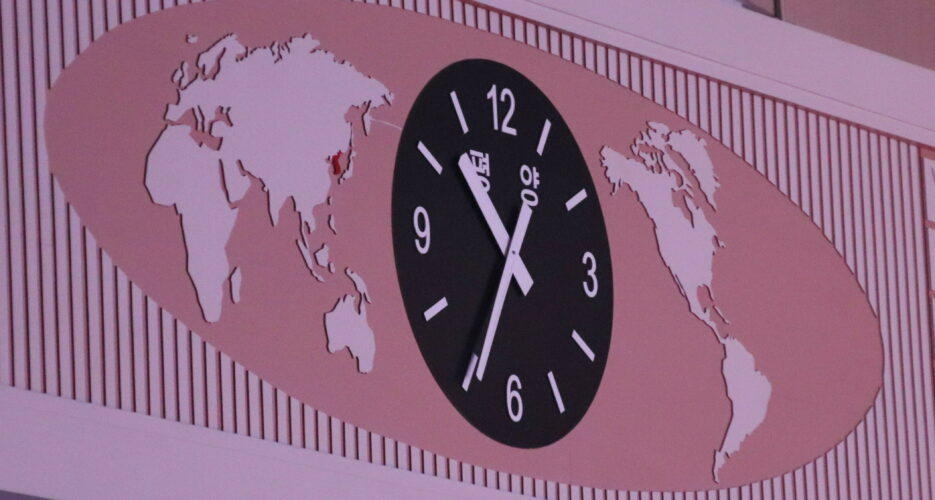
In the Kim Jong Un era, the WPK has used temporal signatures to connect back to the past. For example, Kim Jong Un evokes “Mallima Speed” as a reminder of the Chollima Movement and the golden age of Kim Il Sung’s rule. When compared with the financial troubles of contemporary North Korea, the DPRK of the 1960s was an economic power. Much like “Chollima speed,” the slogan “Mallima speed” promotes speed as the critical factor in people’s labor and North Korean industrial production. However, as a mythic horse, Mallima runs ten times faster than Chollima. In March 2017, the Rodong Sinmun announced, “To be riders and front-runners in the Mallima movement is the bounden duty and noble obligation of our generations who were born in the motherland of Juche and grew up learning the epic of the Chollima age.” The Masikryong Ski Resort, one of Kim Jong Un’s pet projects, was built in a speed campaign. Soldiers from the Korean People’s Army constructed the ski resort in a mere ten months in 2013. Using the soldiers’ labor as a symbol of North Korean collectivism, the term “Masikryong speed” became part of the DPRK’s political discourse. Meanwhile, in 2018, rapid construction projects began in Samjiyon County and naturally the slogan “Samjiyon speed” entered the North Korean lexicon.  However, this acceleration of labor mobilization pales in comparison to Kim Jong Un’s most personal manipulation of time: the creation of a new time zone in 2015. As a way to temporally distance the DPRK from “Tokyo time” and present a sharp break from its colonial past, Pyongyang created a new time zone and moved its clocks back thirty minutes. This change took place on August 15, 2015, which marked the seventieth anniversary of imperial Japan’s defeat in World War II. KCNA explained, “The wicked Japanese imperialists committed such unpardonable crimes as depriving Korea of even its standard time.” Meanwhile, South Korea remained in “Tokyo time.” However, in May 2018, North Korea changed its time zone to match South Korea’s during a period of inter-Korean rapprochement. Kim Jong Un was apparently disturbed by the sight of two different clocks in Panmunjom during meetings with South Korean President Moon Jae-in. This manipulation of time by the North Korean government was a manifestation of Pyongyang’s nationalistic ideology, historical memory of Japanese colonialism, and anxieties regarding inter-Korean relations. And due to his absolute autocracy, Kim Jong Un can literally control time in the North. As the end of the year approaches, it is important to note that North Korea’s idea of time is subjective and political. Pyongyang can easily move this deadline earlier or later. However, by imposing a strict deadline, the Kim family regime once again uses time as a political tool in its statecraft. It would be wise for U.S. policymakers to at least know North Korea’s stated deadlines. Edited by James Fretwell and Oliver Hotham Featured image: NK News © Korea Risk Group. All rights reserved. |


 SHARE
SHARE COPY LINK
 X
X MASTODON


Recent Stories