
|
Analysis N.Korea insists on ‘ritual’ displays that harm itself: AcademicKim Jong Un more likely to die in office than see his regime collapse, historian of Korea says
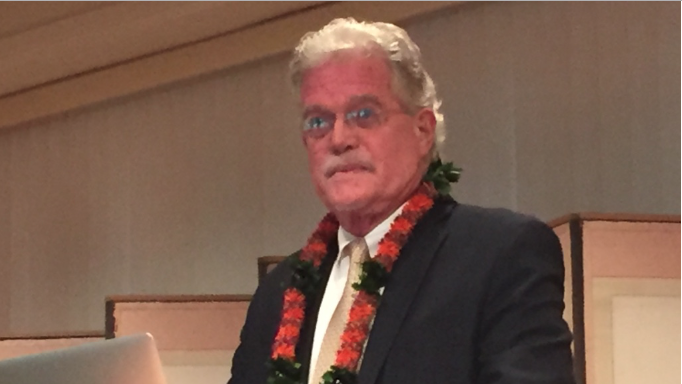 HONOLULU—North Korea insists on displaying outward signs of competitiveness with its neighbors, such as through its recent satellite launch, even when such demonstrations are not good for the country, a noted scholar of Korea said Thursday. University of Chicago history professor Bruce Cumings said that the North is a “ritualistic” regime that insists on following ritual displays, and the recent launch of a satellite into orbit demonstrates its commitment to signs that it can keep pace with South Korea and Japan technologically, even though it long ago lost the ability to compete with them economically. “People get along and rise in the regime through ritualistic means even when it hurts North Korea,” he said. “Every time I think they’re going to give this pattern up they deepen it.” The Pyongyang leadership, Cumings said, is “burying huge amounts of money trying to keep up with where the Soviet Union was 60 years ago.” Cumings, speaking at the University of Hawaii’s Center for Korean Studies, entitled his Thursday talk “The North Korea That Can Say No,” a reference to right-wing Japanese politician Shintaro Ishihara’s The Japan That Can Say No from the early 1990s, as well China Can Say No, a nationalistic compilation from 1996. Both of those books postulated that their countries increasing – at the time, in Japan’s case – stature would result in their increasing ability to defy the United States. Though Cumings noted the North’s continual defiance of the U.S., he also spoke of their ability to work against the wishes of China, ostensibly Pyongyang’s closest major ally. Cumings notes the arrival, in early February, of China’s special representative for Korean Peninsular affairs Wu Dawei to explicitly warn the North not to launch its satellite – which is considered a cover for a test of long-range missile and prohibited under UN Security Council resolutions – only to see the North do exactly that days later. “North Korea has been saying no to China in such a way that Chinese experts say is just a slap in the face,” Cumings said. Cumings is known for a contrarian take on the North, using his books such as North Korea: Another Country and The Korean War: A History to note the failure of Pyongyang’s enemies, namely the United States and Japan, to come to terms with their role in shaping the conflict on the Korean Peninsula through, respectively, the heavy bombing of the North during the Korean War and the colonization of the Korean Peninsula from 1910-45. However, during his speech Cumings noted the Obama’s administration’s improving of U.S. relations with Burma, Cuba and most recently Iran, and said that North Korea had made a “stupid” move by conducting a satellite launch and its second nuclear test in 2009, the year Barack Obama was inaugurated. He also expressed confusion as to why the North would announce the launch of a satellite in March 2012, just after it had concluded an aid-for-nuclear-freeze deal with Washington. However, Cumings said that North Koreans have been regularly disparaged as fanatical, barbaric or even childlike, dating back to the Korean War. In one particular example, he noted a Newsweek cover from 1994, just after the death of Kim Il Sung, which called North Korea “the headless beast.” Cumings called this a “racist headline on a racist article.”  Cumings also said that the headline reflects the continual belief in the coming collapse of the North, noting former George W. Bush advisor Victor Cha’s New York Times column, just after Kim Jong Il’s death in 2011, that the North would become a “province” of China or would collapse. “Don’t you say mea culpa at some point?” Cumings said. Cumings went on to say that Kim Jong Un dying in office was a more likely outcome than war or collapse, and that the U.S. priority should be capping the North’s nuclear weapons program, rather than finding or disposing of “every last A-bomb.” Images: Rob York © Korea Risk Group. All rights reserved. |


 SHARE
SHARE COPY LINK
 X
X MASTODON


Recent Stories