
|
Columns Two Korean mountain jaunts: near but worlds apartA veteran North Korea watcher recalls two formative hikes he wrote about in the 1980s, on opposite sides of the DMZ
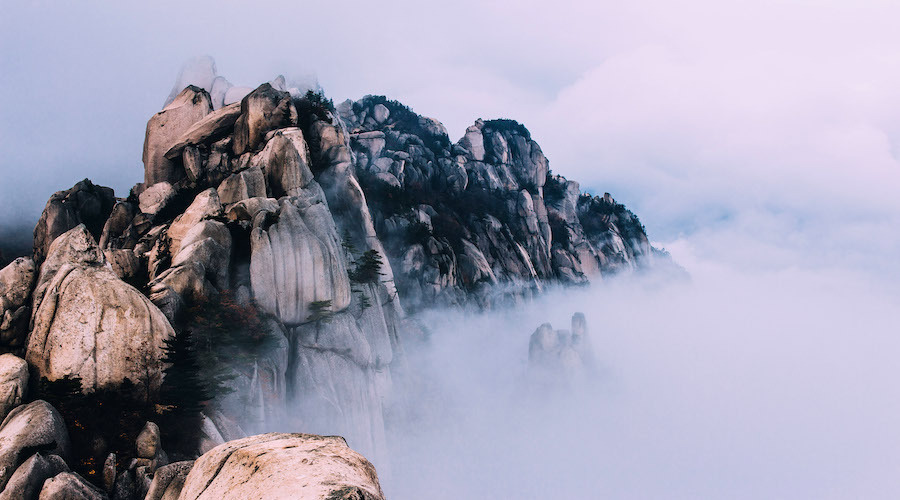 Why does Mount Kumgang matter? Here’s what it means to me – and more importantly to many others, judging by the responses to the article below when it was first published. That was a long time ago: way back in 1986, on 16 October. A third of a century ago, indeed. Not many people visited North Korea in those days. I was on the first ever tourist group from the UK – though many of us had a more than just touristic interest. Unlike today, the wider public hardly knew or cared about the DPRK at that time. With no Internet to spread Kimist memes around the planet, and no nuclear issue, the ‘hermit Kimdom’ cliché had much truth. Instead we had print. Older readers will recall the Far Eastern Economic Review (FEER). Founded in Hong Kong in 1946, for decades this was Asia’s must-read weekly on politics and economics throughout the Indo-Pacific – as nobody yet called the region. Sadly, it didn’t last long in the digital era. FEER’s sad, slow demise earlier this century is a tale told elsewhere. I declare an interest. FEER played a big part in launching me as a writer on Korea, putting me forever in their debt. In 1985, unbidden, I tentatively submitted a fat wodge – 2,500 words! – of densely speculative Pyongyangology. To my surprise and joy they printed it, in full – albeit with a rare typo in the title: “Reading the entails [sic, for entrails] of the Pyongyang goat.” Better yet, the following year FEER kindly subsidized my first visit to North Korea; offering a 10,000 word cover story, plus several further articles in subsequent issues. Millennials, eat your hearts out. Who today would be that generous to an untried writer? (Sure, nowadays you can always blog. But no one pays you, and maybe nobody reads you.) The following article was part of that bounty, but different from most. It covered both Koreas, not just the North, and took a rather personal – some might say sentimental – approach. FEER placed it in their ‘Guest Travelers’ Tales’ slot, at the back of the mag. Many people have told me they enjoyed it, and it still remains my personal favourite of all my writings on Korea. Why republish this now? I wanted to allude to it in my ongoing NK News series about Mount Kumgang tourism and why this matters. More in my next article. For now, enjoy this trip down memory lane. * * * AUGUST 1982… The day dawns wet and misty, just like yesterday. No matter: I have a mountain to climb. I am at Mt Seorak, South Korea’s principal resort area and finest scenery, not far from the border with North Korea. For the past 10 days or so, I’ve been travelling around South Korea, by bus and train, staying in yogwan (Korean inns), on my own. This baffles Koreans. “Honja imnikka?” (“Are you alone?”) they ask, as you meet them at temples or along mountain paths. They travel in coach parties, or in lovey-dovey couples. And this is the last day, and my only full day at Seorak. So I set out, in the rain. Tourism is pretty organized in South Korea. All the paths are marked, and where it gets steep there are bright-orange railings in the rock. At regular intervals there are little makeshift wayside taverns, where a weary traveler may step aside and seek sustenance in pancakes and lager. Not me, of course: I have a mountain to climb.  A group of young men stop me in my tracks. They turn out to be four waiters and a cook, on their day off from one of the local hotels. Although they speak hotel English, and I have even less Korean, the message is clear enough. It’s raining, this is no weather for climbing mountains; “so why don’t you join us and drink makgeoli [rice wine]?” After a moment’s sodden contemplation I am convinced. I abandon the mountain and join them. They are a cheerful bunch, becoming still more so as the bowls of makgeoli circulate. One, who is well away, looks at me. “You sing folk-songs?” he asks. “Er, yes,” I say hesitantly. “You sing England folk-songs, we sing Korea folk-songs.” Another reasonable proposition. And so we do, all afternoon. English folk songs are not my strong point, but thanks to my Irish mother I can manage a few from a neighboring island. So I gave them The Rocky Road to Dublin (fast and furious), and She Moved Through the Fair (slow and infinitely sad). Any lingering doubts I might have had that Koreans are really Irish in disguise (or vice-versa) were dispelled by this afternoon. The conviviality, the love of song, the sentimentality; the ability to switch between laughter and tears at a moment’s notice; all these are held in common. We got drunker, and more boisterous. I fear we must have been rather a spectacle (not that many people were about). I ran out of Irish songs, and had to enlist the aid of Elvis and Chuck Berry. Eventually, as the shadows drew in, we staggered back down the valley, still singing. Then we bade our farewells, and exchanged addresses, as one does. For some reason, I felt a lump in my throat. Damned Korean sentimentality. * * * APRIL 1986… The day dawns bright and sunny, just like yesterday. Which is just as well, since we have a mountain to climb. We are at Mt Kumgang (Diamond Mountains), North Korea’s principal resort area and finest scenery, not far from the border with South Korea. For the past ten days or so we’ve been travelling around North Korea, by minibus and train. Not alone; solo tourism is not yet permitted in North Korea. Tourism of any kind is new: ours is the first-ever party from Britain. Korean tourists are nowhere in evidence, unlike in the South. But perhaps it’s too early in the season. Winter is barely over, and though the sun shines there’s still snow on the peaks, ice floes in the clear mountain streams, and an invigorating breeze. It’s our only full day at Kumgang, and we are walking up to one of its most famous sights: Kuryong, or Nine-Dragon waterfall. Tourism (what little there is of it) is very organised in North Korea. No wayside taverns, but a fancy restaurant at the foot of the path, where we shall lunch on our return. It’s a gorgeous clear day, and the scenery is breathtaking. Pines jut out, seemingly from sheer rock, at impossible angles. The rocks themselves are pointed and twisted in strange shapes; which gives our guides an endless conversation topic. “What d’you think that looks like?” they keep asking, pointing at some peak. “Er — a rabbit?” That was actually a right answer; or it might be a frog, or whatever. Our guides are enjoying this. Mr Kim has been with us for the whole trip, and has dutifully told us (in excellent English) about the doings of the Great Leader everywhere we’ve been. But here, in these mountains (albeit disfigured by giant slogans carved in red), the Great Leader seems somehow far away. And perhaps I imagine it, but Mr Kim seems more enthusiastic telling us fairy tales (or should I say, other fairy tales). We’ve reached the falls, an easy walk, and Mr Kim regales us at length with the old story of the poor woodcutter who saw the fairy bathing, stole her clothes (so she couldn’t get back to heaven) and married her. But she pined for her heavenly home, and one day took their children and went back to heaven. Yet all ends happily, for he joins her.  Mr Kim likes song too. In the bus as we crossed the peninsula from Pyongyang to Wonsan on our way here, he’d had us all singing away, alternating English and Korean melodies. So the mountains rang to such unlikely strains as The Lass of Richmond Hill, and even In An English Country Garden. We have a local guide, too: a Miss Han, a fresh-faced young woman in a tracksuit (plus Kim Il Sung badge, of course). She too has entered with zest into the spot-the-rabbit-rock game. A few of us ask if we can climb the extra few hundred feet to a nearby peak. Mr Kim seems keen, and we head off across uncleared snow. On the tricky bits, there are bright-orange railings in the rock. And Miss Han and I fall to talking. This is not easy, since she has even less English than I have Korean. So we find another way: we sing to each other, all the way down the mountain. Once again, I go through my repertoire of Irish folk songs. Elvis might be a little risky in North Korea, where even jazz (let alone rock) is verboten. Yet I feel an obligation to do something contemporary. How about Lennon and McCartney? “I norae sarang norae imnida” (“This song is a love song”). I venture, in terrible Korean. And sarang (love), leads to nunmul: the wonderfully evocative, almost onomatopoeiac Korean word for “tears.” I launch into “Yesterday.” And Miss Han sniffs, deeply, several times, as we walk Indian file down the mountain. More than a sniff, not quite a sob. She recovers her composure; and neither of us says any more about it. But I am moved. because I so unexpectedly moved her. Who knows what hidden sadness I may have touched upon? Being in love can’t be much fun in North Korea; you must get permission to marry, and woe betide you if you try anything outside marriage. Sentimentality, lump-in-the throat time again. Very Irish, very Korean. And it wasn’t over yet. As we came down the mountain, still singing, Miss Han said, in Korean: “The mountains are crying, because Mr Foster, is leaving.” Slightly ridiculous; but it was an exquisitely tender moment. * * * How far between these two mountain-song episodes? In my life, a little less than four years. In geography, as the crow flies, perhaps 30 miles. Crows may fly, but history took a different turn. A third of a century has separated Miss Han from those waiters, her compatriots. Yet culture will out, even despite history. Even if the one occasion was more boisterous, the other more delicate, in memory they both seem much the same. It’s that damn lump in the throat again. After all, this is Korea, where lumps are semi-permanently in throats. And even North Korea is Korea. Edited by Alexandre Chambon Featured image: Jhkangphoto © Korea Risk Group. All rights reserved. |


 SHARE
SHARE COPY LINK
 X
X MASTODON


Recent Stories