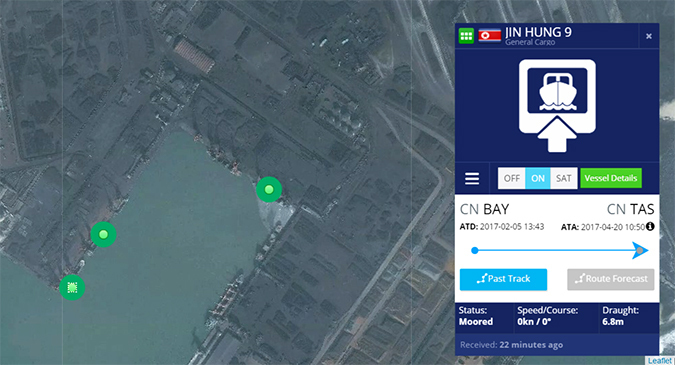
Four North Korean vessels, three of which have been linked to illicit sanctions-breaking networks, were allowed to enter a Chinese port which handles coal between Wednesday evening and Thursday morning, analysis of positional information from ship tracking site Marine Traffic shows.
The four vessels are all owned by Pyongyang-based companies and have been waiting near the port for over two weeks.
Satellite imagery of the facility – located near Tangshan in China’s northeast – shows that the area of the port where three of the vessels are docked mainly handles coal, while the fourth is located at a nearby pier that handles both coal and iron.
“This port appears to be mainly for coal handling, though there is other bulk ore handling as well. Coal appears to be the main bulk product handled here,” Scott LaFoy, a Washington-based satellite imagery analyst told NK News.
North Korea’s coal exports to China have been under the spotlight since November, when a UN resolution limited member states from importing the DPRK’s most valuable commodity. DPRK iron imports are also banned, though can be exempted if they are for livelihood purposes.
China followed up on Resolution 2321 in February, when it announced it would no longer import North Korean coal for the remainder of 2017.
Beijing doubled down on the claims earlier this month, when General Administration of Customs (GAC) spokesperson Huang Songping said that China had ceased imports at 2.7 million tonnes.
While it’s difficult to ascertain the direction of the trade from ship tracking data and satellite imagery, Marine Traffic also shows the vessels are approaching their maximum draught, a measure of how low the ships are sitting in the water and by extension, an indicator that ships are loaded with cargo.
TROUBLED PAST
The vessels’ backgrounds are also unlikely to inspire confidence that their current activity is above board. Two of the three ships in the coal handling part of the port were previously owned by companies that were integral parts of an illicit, sanctions breaching network.
The Jin Hung 9 and Pu Hae were formerly owned or managed by Aoyang International and Hua Heng Shipping, a pair of companies associated with Hiroshi Kasatusgu and Li Anshan: both individuals that have been identified in numerous UN Panel of Expert (PoE) reports as facilitators of North Korean sanctions evasion.
According to the PoE, Kasatsugu and Anshan had business relationships with Ocean Maritime Management (OMM), a sanctioned North Korean arms smuggler working under the Ministry of Land and Marine Transport.
“The Director of Mirae HK, Hiroshi Kasatsugu, has owned and controlled nine companies, including those involved in the operation of seven vessels using crews from the Democratic People’s Republic of Korea. Any business transactions relating to those vessels and companies could contribute to sanctions evasion by Mirae/OMM,” the 2016 PoE report reads.
Li Anshan has also featured in numerous PoE reports, though was most recently identified as having played a “key role” in activities linked to an Egyptian seizure of North Korean weapons, the largest since the beginning of the sanctions regime in 2006.
The Egyptian authorities captured a DPRK-linked vessel called the Jie Shun in August last year, which was smuggling 30,000 rocket-propelled grenades hidden under a shipment of (also sanctioned) iron. The Panel of Experts said that one of Anshan’s companies was the “the de-facto owner of the Jie Shun”.
Another of the vessels in the nearby coal and iron port has an equally troubled past. Formerly known as the Light, the 4650-tonne cargo ship is also linked to Kasatusgu and his associates, though was additionally identified as a likely smuggler by the U.S. and the Panel of Experts.
In 2011, the U.S. said it had reasonable grounds to believe the Light – now called the Ryon Hwa 2 – was transporting sanctioned items. A U.S. Navy vessel intercepted the ship and attempted to inspect it. Despite sailing under a Belize flag, the crew said it was a North Korean ship and refused to be boarded. According to the PoE, the ship eventually abandoned its journey and returned to North Korea.
A fifth North Korean vessel currently waiting outside the same port is also less than reputable. As with the four ships which were allowed into Tangshan port, tracking data shows the Victory 2 has been holding position there for more than two weeks.
The ship and its previous owner Buyon Shipping were sanctioned by the U.S. Treasury’s Office of Foreign Assets Control (OFAC) in March last year.
“North Korea has used the transportation industry to facilitate illicit shipments of WMD and related material,” an OFAC press statement released at the time reads, before adding Buyon to the list of designated entities.
While the vessels currently in the Chinese port are no longer directly owned by Hua Heng and Aoyang, the transfer of their ownership to Pyongyang-based companies does not necessarily indicate they’ve turned over a new leaf.
New, stricter UN measures passed last year make it more challenging for vessels to occlude their links to North Korea, so the ownership changes were unlikely to be totally voluntary, and their simultaneous appearance in a Chinese coal port could imply they’re being used for a newer kind of sanctions evasion.
The group’s movements contrast with earlier reports from Reuters that China had turned away North Korean vessels fully laden with coal. But the report did not name the vessels or indicate how the ship cargos were known.
Previous NK Pro analysis has also identified other movements between North Korean coal export facilities and Chinese terminals. While some shipments originated from Rason – and may have subsequently been exempted from UN sanctions – others appeared to leave from ports on the DPRKs east coast.
Featured image: Marine Traffic
Join the influential community of members who rely on NK News original news and in-depth reporting.
Subscribe to read the remaining 954 words of this article.
EXISTING MEMBER?


');
newWindow.document.write('
');
newWindow.document.write('